In This Article
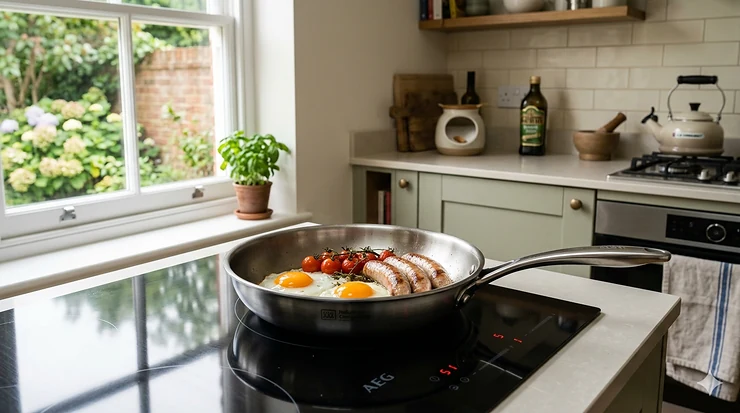
A frying pan for induction hob cooking needs one thing your old aluminium skillet never had to worry about: a magnetic base thick enough to grab the electromagnetic field and turn it into heat. Get that wrong and your hob simply throws up an error code and sulks at you. Get it right, and you’ve got the fastest, most controllable way to fry an egg this side of a professional kitchen.
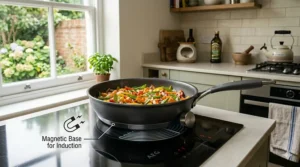
If you’ve just had an induction hob fitted — and given how many British kitchens have swapped gas for glass-ceramic in the last few years, you’re in good company — you’ve probably already discovered that half your existing cookware drawer is now decorative. Cast iron, most stainless steel, and some hard-anodised aluminium will work. Pure aluminium, copper, and most glass or ceramic will not, no matter how much you shout at the display panel.
This guide rounds up seven frying pans currently available on Amazon.co.uk that actually do the job, from a £15 Ninja that’ll see you through student digs to a French carbon steel pan built to outlive your mortgage. We’ll cover what the spec sheets really mean once the pan hits a British hob on a Tuesday night, where the genuine savings are versus the gimmicks, and how to avoid the classic mistakes that leave people Googling “why won’t my new pan work on induction” three days after delivery.
Quick Comparison Table
| Pan | Type | Best For | Price Range | Amazon.co.uk |
|---|---|---|---|---|
| Tefal Comfort Max 30cm | Stainless non-stick | Everyday fry-ups | £25–£35 | Prime eligible |
| Tefal Induction 5-Piece Set | Titanium non-stick set | First-time induction buyers | £45–£65 | Prime eligible |
| Ninja ZEROSTICK 20cm | Aluminium non-stick | Small kitchens, budget buyers | £15–£25 | Prime eligible |
| Circulon Total Hard Anodised Twin Pack | Hard-anodised non-stick | Two-pan households | £30–£50 | Prime eligible |
| ProCook Professional Uncoated 28cm | Uncoated stainless steel | Searing, steak, students of the Maillard reaction | £35–£55 | Sold by ProCook on Amazon |
| ProCook Ceramic Non-Stick Set | Ceramic non-stick, 2-piece | Health-conscious cooking, oven-to-table | £45–£70 | Sold by ProCook on Amazon |
| De Buyer Mineral B Carbon Steel 28cm | Carbon steel, uncoated | Buyers who want a pan for life | £50–£90 | Imported, multiple sellers |
A glance at that table tells you most of the story: the cheap end is dominated by coated aluminium that’ll need replacing in three or four years, the middle is stainless and hard-anodised non-stick doing a perfectly respectable job, and the top is uncoated steel that trades convenience for genuine longevity. None of these are “better” in the abstract — they’re better for different kitchens, which is rather the point of this whole article.
💬 Just one click — help others make better buying decisions too! 😊
✨ Don’t Miss These Exclusive Deals!
🔍 Take your kitchen kit to the next level with the picks below. Tap through to check current pricing and stock on Amazon.co.uk — these are the ones actually worth the basket space.
Top 7 Frying Pans for Induction Hobs: Expert Analysis
1. Tefal Comfort Max Stainless Steel Non-Stick Frying Pan 30cm (G7260744)
Tefal’s Comfort Max line has been the default “I just need a pan that works” purchase in British kitchens for years, and the 30cm version earns that reputation honestly. The stainless steel body carries Tefal’s Thermo-Spot heat indicator, a little red dot that turns solid when the pan’s actually hot enough to cook on — genuinely useful, because most of us guess wrong and either undercook bacon or set off the smoke alarm. The bonded base is built specifically to handle induction’s quick, punchy heat without warping, which matters more than people realise: a warped base on a glass-ceramic hob means patchy contact and a pan that heats like it’s having an argument with itself.
This is the pan for someone who wants reliable, no-fuss frying rather than a cookware hobby. It’s dishwasher safe, which UK reviewers consistently flag as a genuine time-saver rather than a marketing line, and the stainless build means it won’t be the first thing to go in the recycling when the coating eventually wears.
✅ Dishwasher safe
✅ Reliable heat indicator
✅ Stainless build outlasts the coating
❎ Heavier than aluminium equivalents
❎ 30cm is large for a single-hob flat
Price range: around £25–£35 on Amazon.co.uk. For an everyday workhorse, that’s good value.
2. Tefal Induction Non-Stick 5-Piece Cookware Set (G155S54)
If you’ve just moved house and your entire cookware collection currently consists of one crusty saucepan, this set solves the problem in one Amazon basket. You get 16/18/20cm saucepans with glass lids plus 22cm and 26cm frying pans, all carrying titanium-reinforced non-stick and the same Thermo-Signal indicator as the standalone pan above. The glass lids matter more than they sound — being able to see your simmering sauce without lifting the lid keeps moisture (and flavour) in, which is a small thing that makes a real difference on busy weeknights.
What most first-time induction buyers overlook is that not every pan in a “compatible” set performs identically — smaller pans heat faster and can scorch sauces if you’re not watching, while the 26cm frying pan is genuinely good for batch-cooking a fry-up for the whole household.
✅ Five pieces, one purchase
✅ Glass lids on every saucepan
✅ Consistent heat indicator across the set
❎ The smallest saucepan is fiddly for anything beyond a sauce
❎ Bulky to store in a small flat kitchen
Price range: roughly £45–£65 on Amazon.co.uk, comfortably under the £25 free delivery threshold either way.
3. Ninja ZEROSTICK Classic Cookware 20cm Frying Pan (CW50020UK)
Ninja’s cookware range is newer to the UK market than its blenders and air fryers, but the ZEROSTICK 20cm frying pan has quietly become the pan recommended to students and anyone furnishing a first flat on a tight budget. It’s aluminium with a long-lasting non-stick coating, oven safe to 180°C, and small enough to actually fit a single-ring hob in a studio flat without hanging halfway off the edge.
The trade-off for that price is durability rather than performance — it cooks an egg just as happily as anything more expensive, but won’t take the abuse of metal utensils or daily dishwasher cycles for a decade. For someone who eats mostly eggs, bacon, and the occasional grilled cheese, that’s an entirely reasonable trade.
✅ Genuinely budget-friendly
✅ Compact for small kitchens
✅ Non-stick performs well from day one
❎ Aluminium body won’t survive metal spatulas
❎ Coating life shorter than stainless or ceramic rivals
Price range: around £15–£25 on Amazon.co.uk — one of the cheapest genuinely induction-rated pans on the market.
4. Circulon Total Hard Anodised Frying Pan Twin Pack, 22cm & 25cm
Circulon built its reputation on the “Hi-Low” non-stick pattern — raised circular ridges that take the wear from your spatula while the lower grooves stay pristine — and the Total range backs that up with a lifetime guarantee, which is a confident thing for a cookware brand to offer. The hard-anodised aluminium body is roughly twice as hard as stainless steel, so it shrugs off the kind of daily knocks that dent a cheaper pan within a year.
Getting two sizes in one box (22cm and 25cm) means you’ve effectively covered “one egg” and “family dinner” without buying separately, which is the kind of practical bundling British buyers in smaller kitchens tend to appreciate, since storage space is rarely generous.
✅ Lifetime guarantee from the manufacturer
✅ Twin pack covers two cooking scenarios
✅ Hard-anodised body resists scratching
❎ Heavier in the hand than basic aluminium
❎ Oven-safe limit (240°C) is lower than uncoated steel rivals
Price range: around £30–£50 for the pair on Amazon.co.uk.
5. ProCook Professional Stainless Steel Uncoated Frying Pan, 28cm
ProCook is one of the better-kept secrets in British cookware — a homegrown brand, B Corp certified, and recognised by Which? as a recommended provider for homewares, which counts for something with UK shoppers who’ve learned to be sceptical of marketing claims. This uncoated 18/10 stainless steel pan skips non-stick coating entirely in favour of a 7mm impact-bonded base, and the CoolTouch handle stays manageable even after twenty minutes over a roaring induction ring.
What the spec sheet won’t tell you is that uncoated pans need a few weeks of getting-to-know-you before they stop sticking — a hot pan, a thin film of oil, and patience does the job, after which you get the kind of crust on a steak that no non-stick surface can match. This is the pan for someone who’s outgrown non-stick and wants to actually sear.
✅ 25-year manufacturer guarantee
✅ British brand with Which?-recognised credentials
✅ Searing and browning performance that coated pans can’t touch
❎ Learning curve before the surface behaves
❎ Not the pan for delicate fish or eggs straight out of the box
Price range: around £35–£55 on Amazon.co.uk, sold and dispatched by ProCook directly.
6. ProCook Professional Ceramic Non-Stick Frying Pan Set (2-piece, 20cm & 24cm)
For buyers who want non-stick convenience without the usual PFOA conversation, ProCook’s ceramic-coated set pairs a 20cm and 24cm pan, each with a toughened glass lid and the same CoolTouch handle found across the range. The ceramic surface is titanium-reinforced, oven safe to 260°C, and noticeably lighter in the hand than the hard-anodised competition — a genuine plus if arthritis or wrist strength makes heavier cookware a chore.
The two-size set covers the daily basics (eggs, omelettes, a quick stir-fry) without committing to a full matching collection, and the glass lids let you finish dishes gently on the hob rather than always reaching for the oven, which suits smaller British kitchens where oven space is often already booked by something else.
✅ Lighter than hard-anodised or stainless alternatives
✅ Two sizes cover most everyday cooking
✅ 25-year guarantee matches the rest of the ProCook range
❎ Ceramic coatings generally have a shorter non-stick life than titanium
❎ Not suitable for hot-plate electric hobs (induction and gas only)
Price range: around £45–£70 for the pair on Amazon.co.uk.
7. De Buyer Mineral B Carbon Steel Frying Pan, 28cm
De Buyer’s Mineral B has been made in the same French factory since the 1830s, and it’s the pan that turns up in professional kitchens precisely because it has no coating to wear out — just iron, carbon, and a beeswax finish that washes off before first use. Carbon steel is naturally magnetic, so induction compatibility was never in question; what takes getting used to is the seasoning process, where repeated thin layers of oil baked on at high heat build a natural non-stick patina over several uses.
This isn’t a pan for someone who wants to unbox and cook tonight — it’s a pan for someone who enjoys the process and wants a single skillet that, looked after properly, genuinely could be handed down. UK buyers researching this model often note the seasoning instructions in the box are a little optimistic; a proper seasoning takes more like ten rounds than the two or three suggested, but the result is worth the effort.
✅ No coating to ever wear out or flake
✅ Improves with age rather than degrading
✅ Searing performance favoured by professional chefs
❎ Requires seasoning before first use and ongoing care
❎ Cannot go in the dishwasher, ever
Price range: around £50–£90 on Amazon.co.uk depending on size and seller — note this is a French import, so check the seller is UK-based for straightforward returns under the Consumer Rights Act 2015.
Top 7 Products: Detailed Comparison
| Pan | Material | Coating | Oven Safe To | Dishwasher Safe | Guarantee |
|---|---|---|---|---|---|
| Tefal Comfort Max 30cm | Stainless steel | Non-stick | Check listing | Yes | Standard |
| Tefal 5-Piece Set | Aluminium | Titanium non-stick | Check listing | Yes | Standard |
| Ninja ZEROSTICK 20cm | Aluminium | Non-stick | 180°C | Yes | Standard |
| Circulon Total Twin Pack | Hard-anodised aluminium | Hi-Low non-stick | 240°C | Yes | Lifetime |
| ProCook Uncoated 28cm | Stainless steel | None | 260°C | Yes | 25 years |
| ProCook Ceramic Set | Aluminium | Ceramic non-stick | 260°C | Yes | 25 years |
| De Buyer Mineral B 28cm | Carbon steel | None (seasoned) | Brief oven use only | No | Lifetime |
The pattern in that table is the real story: dishwasher safety and non-stick coatings go hand in hand at the budget and mid-range end, while the two uncoated pans trade that convenience for higher oven-safe limits and guarantees measured in decades rather than years. If you genuinely can’t be bothered with seasoning or hand-washing, rule out the bottom row immediately — there’s no shame in that, and a well-made non-stick pan will still serve you for years.
Features That Actually Matter (And Those That Don’t)
A thick, fully bonded base matters more than almost anything else on the spec sheet, because it’s what stops your pan from warping on induction’s rapid heat-up. A heat indicator dot is a genuinely useful feature rather than a gimmick, particularly for anyone who’s ever ruined a pancake by guessing the pan was hot enough. By contrast, a lid that doesn’t fit your existing pans, decorative exterior colours, and “10-in-1” marketing bundles that pad out a set with pieces you’ll never use are the features that don’t move the needle — they’re there to justify a higher price tag, not to improve your cooking.
Handle material is somewhere in between: stay-cool handles are worth paying for if you’re cooking one-handed with a toddler on the other hip, but they’re not essential if your kitchen routine is calmer. Riveted handles last longer than screwed ones, full stop — it’s one of the few claims in cookware marketing that’s reliably true.

How to Choose a Frying Pan for Induction Hob in the UK
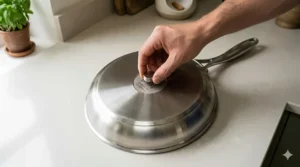
- Do the magnet test first. Hold a fridge magnet to the base of any pan you’re considering — if it grips firmly, it’ll work on induction. If it barely sticks or slides off, leave it on the shelf regardless of what the box claims.
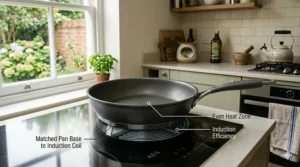
- Match the size to your hob ring, not your ambition. A 28cm pan on a 20cm ring wastes energy and heats unevenly; check your hob’s ring diameters before choosing pan size.
- Decide coated or uncoated early. Non-stick suits eggs, fish, and pancakes; uncoated stainless or carbon steel suits searing and high-heat cooking. Trying to do both with one pan usually disappoints on at least one front.
- Check the oven-safe rating if you batch-cook. Anything finishing under the grill or in the oven needs a rating well above what you’ll actually use, since handles heat up faster than the cooking surface.
- Weigh it in your hand if you can. Hard-anodised and uncoated steel pans are noticeably heavier than aluminium — fine for searing, tiring for anyone cooking one-handed.
- Look at the guarantee length, not just the price. A pan with a 25-year or lifetime guarantee from an established brand is usually cheaper per year of use than three budget pans bought in succession.
- Confirm it’s genuinely sold and shipped to the UK. Some listings on Amazon.co.uk are fulfilled by overseas third-party sellers; check delivery estimates and returns policy before adding to basket, particularly for imported brands like De Buyer.
Common Mistakes When Buying an Induction Frying Pan
The single most common mistake is assuming “stainless steel” automatically means induction compatible — it doesn’t. Only magnetic-grade stainless (typically 18/0 or with a magnetic base disc) works; some 18/10 stainless pieces, despite looking identical, will sit dead on a glass-ceramic hob. The second mistake is buying a pan rated for “all hob types” without checking it’s the induction-specific variant, since several manufacturers, Tefal included, sell otherwise identical-looking ranges where only some models carry the induction base.
A third, very British mistake is buying based on size alone to “get the big one” — a 30cm pan on a standard UK induction ring larger than 24cm or so will heat unevenly at the edges, leaving the rim of your omelette cold while the centre’s done. Finally, people regularly skip the seasoning step on carbon steel or cast iron pans, then complain the surface sticks — patience in the first fortnight pays off for years afterwards.
Coated vs Uncoated vs Carbon Steel: Which Wins for UK Kitchens?
Non-stick coated pans (titanium, ceramic, or standard PTFE) win on convenience: nothing sticks straight out of the box, cleanup is a wipe and a rinse, and they’re the obvious choice for eggs, pancakes, and fish that flake apart if it sticks. Their weakness is lifespan — even the best coatings degrade with metal utensils and high heat, typically lasting three to seven years before performance drops noticeably.
Uncoated stainless steel, like the ProCook pan in this list, sits in the middle: no seasoning required, dishwasher safe, and capable of handling much higher heat for proper searing, but food will stick until you master the “hot pan, hot oil” technique. Carbon steel goes furthest in the other direction — genuinely the best searing surface available, naturally non-stick once seasoned, but it demands hand-washing forever and will rust if left wet. For a typical British household cooking a mix of everything, owning one coated pan and one uncoated pan covers far more ground than trying to find a single pan that does both jobs adequately.
What to Expect: Real-World Performance in a British Kitchen
Induction hobs heat noticeably faster than the gas or ceramic ring most UK kitchens had before, and that catches people out in the first few weeks — a “medium” setting on induction often behaves more like “medium-high” on gas, so expect to dial down your usual heat instinct. On the plus side, induction’s responsiveness means a pan reacts to a turned-down dial almost instantly, which is genuinely useful for anyone who’s ever had a gas hob keep simmering a sauce dry while they answered the door.
British kitchens also tend to be smaller than their American or European counterparts, particularly in terraced houses and converted flats, so storage matters more here than the spec sheets let on — a stacking set like the Tefal 5-piece collection earns its keep in a way it might not in a kitchen with acres of cupboard space. Damp isn’t really a factor for cookware indoors, but it is worth drying carbon steel and uncoated pans thoroughly after washing; a British kitchen that’s cooled overnight after the heating’s gone off is exactly the kind of environment where a quick flash of rust can appear on an unprotected steel surface.
Long-Term Cost & Maintenance in the UK
A £20 non-stick pan that needs replacing every three years works out at roughly £6.67 a year before you’ve even cooked anything; a £45 pan with a genuine lifetime guarantee, replaced once a decade for wear and tear regardless, comes in cheaper over a fifteen-year span even before factoring in the hassle saved. That’s the maths worth doing before assuming the cheapest pan on the page is the best value one.
Maintenance costs for coated pans are essentially zero beyond the dishwasher tablet you’re already buying. Uncoated stainless needs nothing special either, just a decent scrub. Carbon steel is the only one with an ongoing cost: a tin of food-safe oil for reseasoning every few months, which amounts to pennies a year but does require remembering to do it. None of the seven pans here need specialist UK-only parts or servicing, so there’s no Brexit-related supply chain concern to factor in — replacement handles and spares, where offered, are typically sourced through the brand’s own UK or EU customer service rather than anything affected by import duties.
Practical Usage Guide: Get the Most From Your New Pan
Before first use, wash any pan thoroughly to remove transit coatings — De Buyer’s beeswax finish in particular needs a proper hot soapy wash before the first seasoning. For non-stick pans, season nothing; just heat gently with a touch of oil for the first cook to help the coating bed in. For uncoated stainless or carbon steel, heat the empty pan until a drop of water skitters across the surface rather than sizzling and evaporating instantly — that’s your cue it’s ready for oil and food.
Store pans so the cooking surface doesn’t grind against another pan’s base; a few felt pan protectors, sold cheaply on Amazon.co.uk alongside the cookware itself, prevent the kind of scratching that ages a non-stick coating prematurely in a crowded UK kitchen cupboard. Avoid using the “boost” function on your induction hob for anything beyond boiling water — most manufacturers, ProCook and Circulon both included, specifically warn against extended boost-level heat as the leading cause of warped bases within the warranty period.
Real-World Scenario: Which Pan Suits Your Kitchen?
The London flat-share. Two housemates, one small induction hob, minimal storage. The Ninja ZEROSTICK 20cm or a single Tefal Comfort Max covers daily eggs-and-bacon duty without hogging cupboard space, and the low price means nobody’s precious about lending it out.
The family in a Birmingham semi. Cooking for four most evenings, batch meals at weekends. The Circulon Total twin pack or the full Tefal 5-piece set makes more sense here — two sizes cover both a quick lunch and a proper Sunday fry-up, and the lifetime guarantee on the Circulon suits a household that’ll put real mileage on it.
The retired couple in the Cotswolds, cooking properly for the first time in years. Less rushed, more interested in technique. This is exactly the buyer the ProCook uncoated pan or the De Buyer carbon steel were built for — time to season a pan properly, patience for the learning curve, and an appreciation for a pan that improves rather than degrades with age.
✨ Don’t Miss These Exclusive Deals!
🔍 Whichever profile sounds like your kitchen, the matching pan above is worth a look on Amazon.co.uk before you commit to a basket full of pans you don’t actually need.
Problem → Solution: Fixing Common Induction Frying Pan Headaches
Problem: the hob says “no pan detected” even though one’s sitting right there. Solution: check the pan’s centred over the ring rather than offset, and confirm with a magnet that the base is genuinely magnetic — some older or mislabelled pans simply aren’t.
Problem: food sticks despite buying a “non-stick” pan. Solution: non-stick coatings need a little oil even when marketed as needing none, and overheating empty non-stick pans on induction’s fast ring degrades the coating within weeks — keep the heat moderate.
Problem: a new carbon steel or uncoated pan rusts within days. Solution: dry thoroughly and immediately after washing, then apply a thin film of oil before storing — skipping this step in a cooler British kitchen is the single most common cause of early rust spots.
Problem: warped base after a few months of heavy use. Solution: avoid the boost setting for empty or near-empty pans, and check the warranty — both Circulon and ProCook cover warping under normal use within their guarantee periods.
Problem: a pan ordered from an overseas Amazon.co.uk seller arrives later than expected. Solution: check the seller location and estimated delivery window before ordering, and remember the Consumer Contracts Regulations give you a 14-day cooling-off period to return most online purchases regardless of the seller’s location.
Induction Pans vs Traditional Gas-Hob Cookware
| Factor | Induction-Compatible Pan | Traditional Gas-Only Pan |
|---|---|---|
| Heat-up speed | Very fast | Moderate |
| Energy efficiency | High — heats the pan, not the air | Lower — heat escapes around the pan |
| Base requirement | Must be magnetic | Any material works |
| Typical lifespan | Comparable, coating-dependent | Comparable, coating-dependent |
| Safety | Hob stays cool to touch | Visible flame and hot surface |
The headline difference is efficiency rather than cooking quality — an induction-compatible pan on an induction hob wastes far less heat into the surrounding kitchen than a gas flame licking up the sides of a saucepan, which shows up as a genuinely lower energy bill over a year of daily cooking. The safety angle matters too, particularly in households with children or pets, since there’s no naked flame and the hob surface around the pan stays largely cool. The only real downside is the upfront cost of replacing genuinely incompatible old cookware, which is precisely the gap this guide is here to close.
Frying Pan for Induction Hob: Frequently Asked Questions
❓ Does this pan work on induction hob if it's just labelled 'stainless steel'?
❓ What is a frying pan for induction hob exactly?
❓ Is an induction frying pan set better value than buying pans individually?
❓ How long does delivery take for induction pans on Amazon.co.uk?
❓ Can I return an induction frying pan if it doesn't fit my hob properly?
Conclusion
There’s no single best frying pan for induction hob cooking — only the best one for what’s actually happening in your kitchen. Students and small households are well served by the Ninja ZEROSTICK’s low price, families benefit from the flexibility of a Tefal or Circulon set, and anyone serious about searing should be looking at the ProCook uncoated pan or De Buyer’s carbon steel. What unites all seven is that they’re genuinely induction-compatible, currently available on Amazon.co.uk, and worth more than the marketing copy on the box — which, in a category this crowded, is rarer than it should be.
✨ Don’t Miss These Exclusive Deals!
🔍 Ready to retire that pan that’s been sulking at your new hob? Check current pricing and availability for any of the seven picks above on Amazon.co.uk before you decide.
Recommended for You
- Best Cast Iron Skillet UK 2026: 7 Proven Picks Tested
- Best Stainless Steel Frying Pan UK 2026: 7 Top Picks Tested
- Best Non Stick Frying Pan UK 2026: 7 Top Picks Tested
Disclaimer: This article contains affiliate links. As an Amazon Associate, I earn from qualifying purchases. If you purchase products through these links, we may earn a small commission at no additional cost to you.
✨ Found this helpful? Share it with your mates! 💬🤗
