
In This Article
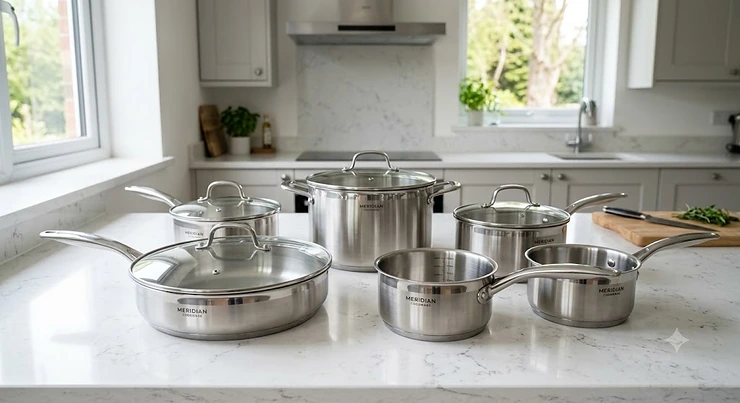
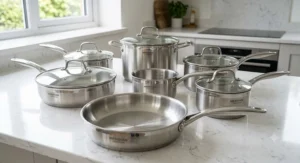
A battered stack of stainless steel. Not the shiny showroom kind — the kind with a faint haze of use, a handle gone slightly loose, a base that’s seen a thousand Sunday roasts. There’s a reason stainless steel pan sets outlive every non-stick trend that’s tried to replace them: nothing sticks in your memory quite like the sound of a good sear.
If you’ve landed here because your last non-stick set started flaking into the bolognese, or because you’ve just moved into a flat with an induction hob and a very empty kitchen, you’re in the right spot. This guide walks through seven real stainless steel pan sets currently sold on amazon.co.uk, at prices spanning a first-flat budget to a “this is going in my will” splurge. We’ll get into tri-ply construction, why heat distribution actually changes how your food tastes, and the genuinely divisive question of stainless steel pan set vs non-stick. Every product mention below carries honest analysis grounded in real specs and aggregated review sentiment — no invented five-star raves, just what the research actually shows.
Before we get to the pans themselves, here’s the shape of the market at a glance.
Quick Comparison: Stainless Steel Pan Sets at a Glance
| Pan Set | Construction | Best For | Price Range |
|---|---|---|---|
| Amazon Basics 11-Piece | Aluminium-core, single-clad | Budget first kitchens | £70–£100 |
| Tefal Jamie Oliver Cook’s Direct 5-Piece | Stainless steel with titanium non-stick | Easy everyday cooking | £110–£150 |
| Circulon SteelShield C Series 5-Piece | Tri-ply with hybrid non-stick | Metal-utensil households | £150–£200 |
| Tramontina Tri-Ply Clad 12-Piece | Full tri-ply, aluminium core | Large families, batch cooking | £250–£320 |
| ProCook Elite Signature Tri-Ply 6-Piece | 3mm tri-ply, uncoated | Serious home cooks | £280–£320 |
| Le Creuset 3-Ply 5-Piece | Tri-ply, mixed coated/uncoated | Lifetime investment buyers | £380–£480 |
| All-Clad D3 10-Piece | Full tri-ply, professional-grade | Ambitious cooks, small kitchens replacing everything at once | £550–£700+ |
Looking at the spread above, there’s a clear fault line: sets under roughly £150 are either aluminium-core budget builds or coated hybrids, while genuine tri-ply construction (steel-aluminium-steel bonded rim to rim) only shows up consistently once you’re spending £250 or more. That’s not a marketing trick — it’s the cost of the extra manufacturing step, and it’s the single biggest factor in how evenly a pan heats. If your budget caps out around £100, the Amazon Basics 11-Piece and Tefal Jamie Oliver Cook’s Direct 5-Piece are the realistic contenders; if even heat distribution across the whole base is non-negotiable for you, you’ll want to look further down this list.
💬 Found a set that’s calling your name already? Check current price and availability before it sells out.
Top 7 Stainless Steel Pan Sets: Expert Analysis
1. Amazon Basics 11-Piece Stainless Steel Induction Cookware Set — best entry point for a first kitchen
Straight out of the box, this is the set most people in a new flat end up buying, and the reasoning is simple: it’s comprehensive and it’s cheap per piece.
The set includes two frying pans (8″ and 10″), saucepans with lids, a saute pan, a steamer insert and an 8-quart stockpot, built with an aluminium-core base for heat spread and a mirror-polished exterior. In practice, that aluminium core sits only in the base rather than running up the sides — so the pan heats quickly in the centre but can run cooler toward the rim, meaning you’ll want to shuffle food around rather than leaving it static. This is a set for someone who needs a fully stocked cupboard on day one rather than someone chasing restaurant-grade searing.
Reviewers on Amazon.co.uk consistently note the value-for-money angle, with several flagging that what’s marketed as an “11-piece” set actually includes only eight cooking vessels once you subtract the lids — a labelling quirk worth knowing before you buy rather than a functional flaw. Aggregated sentiment otherwise skews positive on build quality for the price bracket, with occasional mentions of handles warming up faster than pricier alternatives.
Pros:
- ✅ Genuinely comprehensive — covers frying, boiling and steaming from one purchase
- ✅ Lowest cost-per-piece of any set on this list
- ✅ Dishwasher safe and induction compatible out of the box
Cons:
- ❌ Base-only aluminium core means less even heat up the sidewalls
- ❌ “11-piece” count includes lids, so fewer actual pans than it implies
At around £70–£100, this is the pragmatic pick for stocking a kitchen from empty, and it earns its place if your priority is coverage over precision searing.
2. Tefal Jamie Oliver Cook’s Direct Stainless Steel 5-Piece Set — best hybrid for effortless everyday cooking
This set splits the difference between stainless steel’s durability and non-stick’s forgiveness, and that’s precisely the point of it.
Built in mirror-polished stainless steel with a titanium-reinforced non-stick coating on the frying pans, it carries Tefal’s Thermo-Signal heat indicator — a small ring that fades when the pan reaches optimal cooking temperature. What this means practically is that first-time stainless steel cooks get a visual cue instead of guessing with the water-droplet test, which shortens the learning curve considerably. The 10-year guarantee on the steel body signals genuine confidence in the base material, even if the coating itself won’t last that long under heavy use.
Aggregated reviewer sentiment is notably warm here, with multiple users on Amazon.co.uk and Tefal’s own site describing even cooking results and easy cleanup as the standout traits; a smaller but recurring complaint concerns the non-stick coating losing its edge after roughly 18–24 months of regular use, which tracks with how titanium-reinforced coatings typically perform against fully uncoated tri-ply.
Pros:
- ✅ Thermo-Signal heat indicator removes the guesswork for beginners
- ✅ 10-year guarantee on the stainless steel body itself
- ✅ Genuinely easy to clean thanks to the non-stick coating
Cons:
- ❌ Coating performance typically declines after 18–24 months of heavy use
- ❌ Not a true uncoated tri-ply, so searing crust won’t match the premium sets
Priced around £110–£150, it’s the sensible pick for someone upgrading from cheap non-stick who isn’t ready to fully commit to bare stainless steel technique.
3. Circulon SteelShield C Series Stainless Steel 5-Piece Set — best for households that refuse to give up metal utensils
Circulon built its reputation solving one specific complaint: non-stick coatings that scratch the moment a metal spatula touches them. The SteelShield range is its answer.
The construction pairs tri-ply stainless steel bodies with raised steel “peaks” that sit proud of the non-stick coating in the pan’s grooves, physically shielding it from utensil contact. Base-level heat distribution benefits from the tri-ply construction extending up the sidewalls rather than stopping at the base, which is a genuine step up from the budget sets above. What this means in daily use is you can use a steel whisk or metal turner without the anxiety that usually comes with non-stick cookware.
Reviewer sentiment aggregated across Amazon.co.uk listings is generally positive on the scratch-resistance claim holding up as advertised, though several reviewers note that the hybrid surface still isn’t as slick as a fresh, fully uncoated non-stick pan when frying eggs specifically — a fair trade-off for the added durability, but worth knowing going in.
Pros:
- ✅ Genuinely metal-utensil safe thanks to raised steel shielding
- ✅ Tri-ply body extends heat distribution up the sidewalls
- ✅ Toughened glass lids included across the set
Cons:
- ❌ Egg release isn’t quite as slick as pure non-stick when new
- ❌ Sits at a noticeably higher price than comparable coated sets
At roughly £150–£200, this is the set for anyone who’s tired of babying their cookware and wants durability without abandoning non-stick convenience entirely.
4. Tramontina Tri-Ply Clad Stainless Steel 12-Piece Set — best value for batch cooking and larger households
Tramontina has spent decades supplying professional kitchens, and this 12-piece set is the clearest evidence that tri-ply construction doesn’t have to mean a boutique price tag.
The set covers two frying pans, three lidded saucepans, a stockpot with pasta insert, and a Dutch oven, all built with a genuine aluminium core sandwiched between two layers of 18/10 stainless steel that runs the full height of each pan. Because the aluminium core extends past the base, heat distribution stays consistent right up the sidewalls — genuinely useful when you’re reducing a sauce and don’t want scorching around the edges while the centre lags behind. NSF certification also signals it’s built to commercial-kitchen tolerances, which is reassuring if you cook in volume regularly.
Aggregated review sentiment is strongly favourable on the size range and included pasta insert as genuinely useful additions rather than filler pieces; the most consistent criticism concerns the handles, which some reviewers describe as running warmer than expected during long stovetop sessions compared with fully insulated designs.
Pros:
- ✅ Full tri-ply construction at a genuinely mid-range price point
- ✅ NSF-certified, commercial-kitchen-grade build quality
- ✅ 12 pieces cover almost every everyday cooking task
Cons:
- ❌ Handles can run warm during extended high-heat cooking
- ❌ As a US-sourced brand, UK stock and spare-part availability can be inconsistent
Sitting around £250–£320, this is the strongest per-pan value if you’re feeding a household of four or more and want proper tri-ply performance without the boutique price.
5. ProCook Elite Signature Tri-Ply 6-Piece Set — best British-designed tri-ply for serious home cooks
ProCook built its business on cutting out the middleman between factory and customer, and the Elite Signature Tri-Ply range is where that philosophy meets genuinely premium construction.
Each pan uses a 3mm tri-ply build — 18/10 stainless steel bonded around a thick aluminium core — left uncoated so the surface can handle genuinely high heat for searing, browning and even flambéing without damage. CoolTouch handles are welded rather than riveted, which removes the crevices where food debris typically collects on cheaper riveted designs. ProCook backs the range with a 25-year guarantee, a meaningful signal for a company that manufactures and sells directly.
Here the honest picture gets more nuanced. Independent lifestyle press testing (including a long-term review published on Idealhome.co.uk) reported the pans arriving well-weighted and performing evenly across a week of daily cooking. Against that, aggregated third-party review platforms show a cluster of complaints about inconsistent quality control on certain batches — dents and surface marks reported by some buyers on pieces from this exact range — alongside separately reported friction over ProCook’s returns process. Buyers should weigh the strong hands-on press coverage against these consumer review concerns rather than treating either source alone as the full picture.
Pros:
- ✅ True 3mm tri-ply with an uncoated surface built for high-heat searing
- ✅ Welded CoolTouch handles avoid food-trapping rivets
- ✅ Backed by a 25-year manufacturer guarantee
Cons:
- ❌ Some third-party reviewers report inconsistent quality control on individual units
- ❌ Uncoated surface demands proper stainless steel technique from day one
At around £280–£320, it’s a strong pick if you want British-designed tri-ply performance, though it’s worth ordering from a channel with an easy returns process given the quality-control chatter.
6. Le Creuset 3-Ply Stainless Steel 5-Piece Set — best lifetime investment for a forever kitchen
Le Creuset’s cast iron reputation tends to overshadow the fact that its 3-ply stainless steel range is built to the same “buy it once” philosophy.
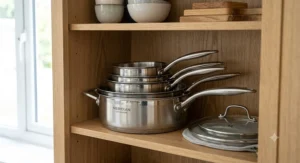
The 5-piece set includes deep casseroles in three sizes, a shallow casserole and a saucepan, all constructed with an aluminium core sandwiched between stainless steel layers for what the brand markets as fast, energy-efficient heat conduction with minimal hot spots even at low-to-medium settings. The riveted handle construction and all-round pouring rim are small but genuinely useful design touches that show up in daily use rather than on a spec sheet. Oven safety to 260°C and a lifetime guarantee on the steel body underline the “buy once” positioning.
Aggregated reviewer sentiment on Amazon.co.uk skews strongly positive, with buyers repeatedly describing the weight and finish as noticeably above mass-market alternatives; the recurring critical theme is simply price relative to functionally similar tri-ply sets from ProCook or Tramontina, since a chunk of the cost here is unavoidably brand premium rather than pure material or engineering difference.
Pros:
- ✅ Genuine tri-ply heat conduction with a lifetime guarantee on the steel
- ✅ Thoughtful design details — pouring rims, balanced riveted handles
- ✅ Strong resale and long-term brand value if you ever upgrade
Cons:
- ❌ Meaningful brand premium over functionally comparable tri-ply competitors
- ❌ Heaviest set on this list, which some smaller-handed cooks find tiring
At roughly £380–£480, this is the set for buyers who see cookware as a one-time purchase for the rest of their cooking life and are happy to pay for the finish and the name behind it.
7. All-Clad D3 Stainless Steel 10-Piece Cookware Set — best professional-grade set for ambitious cooks
If there’s a benchmark tri-ply set that professional and enthusiast reviewers keep returning to, it’s this one — America’s Test Kitchen has named the D3 range a co-winner in its cookware set testing, a genuinely rare level of external validation in this category.
The 10-piece set is fully clad rim-to-rim in three bonded layers of stainless steel and aluminium, with no exposed aluminium edge anywhere on the pan — a detail that matters because exposed aluminium can react with acidic foods over time. That full cladding is what delivers the famously even heat distribution the brand is known for: no cool rim, no scorched centre, just consistent heat across the whole cooking surface, including partway up the sides. The set is built and finished in the USA, and the polished stainless surface is genuinely tough enough for daily metal-utensil use without specialist coatings to protect.
Aggregated review sentiment across Amazon listings and independent culinary press is consistently strong on heat performance and durability, with the primary and near-universal criticism being price — this is cookware bought once and kept for decades, not a casual upgrade.
Pros:
- ✅ Independently tested as a category co-winner by America’s Test Kitchen
- ✅ Fully clad rim-to-rim construction with no exposed aluminium edge
- ✅ Genuinely metal-utensil safe with no coating to protect
Cons:
- ❌ Highest price on this list by a significant margin
- ❌ Heavier gauge steel means a real workout lifting the larger stockpot when full
At roughly £550–£700+ depending on UK stock and import pricing, this is the aspirational pick — the set you buy when you’ve decided you’re done buying pans.
What Is a Stainless Steel Pan Set?
A stainless steel pan set is a collection of cookware — typically frying pans, saucepans and a stockpot or casserole — made from 18/8 or 18/10 chromium-nickel steel, an alloy valued for its high heat tolerance and long-term durability. Most modern sets bond the steel around an aluminium or copper core for better heat distribution, a construction method known as tri-ply or multi-ply cladding.
Unlike non-stick cookware, stainless steel is non-reactive, meaning acidic ingredients like tomatoes or wine won’t pick up a metallic taste, and there’s no coating to scratch, flake or wear out over time. According to Wikipedia’s overview of stainless steel, the material’s corrosion resistance comes from a thin, self-repairing chromium oxide layer on its surface — which is also why a well-cared-for stainless pan can genuinely outlast the kitchen it started in.
How to Choose a Stainless Steel Pan Set
Picking the right set comes down to matching construction and coverage to how you actually cook, not chasing the longest piece count. Here’s the reasoning, step by step:
- Check the construction type first. Look specifically for “tri-ply” or “fully clad” in the description — single-clad, base-only aluminium cores (common in budget sets) heat unevenly up the sides, while tri-ply carries that even heat distribution across the whole pan.
- Match piece count to household size. A couple cooking mostly one-pan meals rarely needs a 12-piece set; a family batch-cooking on Sundays will use every saucepan size going.
- Decide on coated vs uncoated early. Uncoated tri-ply sears better and lasts indefinitely; hybrid non-stick sets like Circulon’s SteelShield trade a little of that searing edge for easier everyday cleanup.
- Confirm induction compatibility if relevant. Not every base is magnetic — check the listing explicitly rather than assuming, since a beautiful pan that won’t heat on your hob is a wasted purchase.
- Weigh the handles before you weigh the price. Riveted handles are typically more heat-resistant; welded, seamless handles (as on ProCook’s Elite range) are easier to keep clean but can transfer more heat if not properly insulated.
- Look at the guarantee length as a quality signal. ProCook offers 25 years, Le Creuset offers a lifetime guarantee on the steel — manufacturers rarely extend guarantees that long on cookware they expect to fail early.
- Factor in oven-safe temperature if you finish dishes under the grill. Ranges vary from 260°C to 500°F equivalents; check the lid material too, since glass lids typically max out lower than the steel body.
Digging deeper into that first point — Which?’s independent buying guide to stainless steel pans notes that pans combining layers of aluminium or copper with the steel achieve meaningfully more even heating across the surface, which lines up with what we found comparing the budget and tri-ply sets above.
Stainless Steel Pan Set vs Non-Stick: Which Wins in a UK Kitchen?
This is the debate that decides most cookware purchases, so it’s worth settling with specifics rather than vague preference.
| Factor | Stainless Steel | Non-Stick |
|---|---|---|
| Searing / browning | Excellent — high heat tolerance builds proper fond | Poor — high heat damages most coatings |
| Everyday ease (eggs, fish, pancakes) | Requires technique | Excellent, near-effortless |
| Lifespan with care | Decades, often lifetime | 1–3 years before coating degrades |
| Metal utensil safe | Yes (uncoated ranges) | Generally no |
| Acidic food safety | Fully non-reactive | Fine short-term, coating wears faster |
| Best For | Searing, sauces, roasting, longevity | Eggs, delicate fish, minimal-oil cooking |
The honest analysis here is that most kitchens benefit from both rather than picking a side. Stainless steel wins decisively on searing steak, building a fond for pan sauces, and simply outliving its coated rivals — a well-maintained tri-ply pan can genuinely last 20-plus years, while even a good non-stick coating typically needs replacing within three. Where non-stick still earns its keep is delicate egg cookery and low-fat cooking, which is exactly why hybrid sets like the Circulon SteelShield C Series exist as a middle path.
✨ Ready to stop replacing flaking pans every couple of years? Compare current prices on the sets above and pick your upgrade.

Tri-Ply Construction & Heat Distribution: The Engineering That Actually Matters
“Tri-ply” gets thrown around loosely in cookware marketing, so here’s what it actually means and why it’s worth paying for.
What tri-ply construction really is
Genuine tri-ply construction bonds three layers together under pressure: an outer layer of magnetic stainless steel (for induction compatibility), a core layer of aluminium or copper (for conductivity), and an inner layer of food-safe stainless steel. Critically, that sandwich needs to run the full height of the pan — base and sidewalls — not just the base, which is the shortcut budget manufacturers take to use the word “tri-ply” while still cutting costs. On the sets above, the Tramontina, ProCook Elite Signature, Le Creuset 3-Ply and All-Clad D3 all carry this full-height construction; the Amazon Basics and Tefal Jamie Oliver sets use base-only aluminium cores instead.
Why heat distribution changes how food actually cooks
Aluminium conducts heat roughly ten times faster than steel alone, so sandwiching it between steel layers spreads heat sideways across the pan almost as fast as it rises from the burner. In a base-only design, that lateral spread stops the moment it reaches the sidewalls — which is why food near the centre of a budget pan can be done while the edges lag behind, particularly noticeable when reducing sauces or cooking pancakes that need even browning edge to edge. In a fully clad pan, that same sauce reduces uniformly, without the scorched centre and raw edges that push a lot of new stainless steel cooks back toward non-stick out of frustration.
Best Stainless Steel Pan Set With Glass Lids
If you like to see what’s happening without lifting the lid and losing heat, glass-lidded sets deserve a specific look, since the lid material genuinely affects usability day to day.
Toughened glass lids let you monitor a simmering sauce or check when pasta water’s about to boil over without releasing steam and heat every time — a small convenience that adds up over years of cooking. Among the sets reviewed here, the Amazon Basics 11-Piece, Circulon SteelShield C Series and Tramontina Tri-Ply Clad 12-Piece all include tempered glass lids with steam-release vents as standard. The trade-off is oven safety: glass lids typically cap out lower than the steel body of the pan itself, so always check the lid’s individual oven-safe rating before sliding the whole thing under a grill, and never move a hot glass lid straight into cold water, which can cause it to shatter from thermal shock.
For buyers specifically prioritising visibility while cooking — batch sauces, risottos, anything requiring a watchful eye — the Tramontina Tri-Ply Clad 12-Piece offers the best combination of genuine tri-ply construction and full glass-lid coverage across its saucepans and Dutch oven.
Tri-Ply Stainless Steel Pan Set Review Roundup: What Real Owners Say
Pulling the aggregated review sentiment together across all four genuinely tri-ply sets on this list reveals a consistent pattern worth knowing before you buy.
| Set | Aggregated Sentiment Theme | Price Range |
|---|---|---|
| Tramontina Tri-Ply Clad 12-Piece | Strong value; occasional warm-handle complaints | £250–£320 |
| ProCook Elite Signature Tri-Ply 6-Piece | Strong hands-on press reviews vs. mixed third-party QC reports | £280–£320 |
| Le Creuset 3-Ply 5-Piece | Consistently praised finish; price seen as the main drawback | £380–£480 |
| All-Clad D3 10-Piece | Near-universal praise for even heat; price the only real objection | £550–£700+ |
The pattern across all four is that once you’re genuinely buying tri-ply construction, complaints shift almost entirely away from cooking performance and toward price or, in ProCook’s case specifically, batch-to-batch quality consistency reported on independent review platforms. That’s a meaningfully different conversation than the budget and hybrid sets earlier in this list, where reviewers still regularly flag actual cooking-performance issues like uneven heat or coating wear. It’s also echoed by wider food media testing — olivemagazine’s tested roundup of stainless steel frying pans similarly found that pans in this tri-ply price bracket consistently outperformed cheaper alternatives on heat conduction during hands-on testing.
Practical Usage Guide: Setup, Seasoning & the First 30 Days
Getting a new stainless steel pan set right in the first month sets the tone for how it performs for years afterward.
First use: Hand-wash every piece before first use to remove manufacturing residue, then dry thoroughly — stainless steel won’t rust easily, but water spots left to dry naturally can leave mineral marks that are annoying (if harmless) to remove later. Skip the dishwasher for this first wash even if the set is rated dishwasher-safe, since detergent residue on a brand-new surface can affect early cooking results.
The heat test that prevents 90% of sticking: Before adding oil, heat the empty pan on medium for two minutes, then flick a few drops of water onto the surface. If they skitter and dance across the pan, it’s ready; if they sit and slowly evaporate, give it another minute. This single habit solves more sticking complaints than any coating ever could.
Common first-month mistakes: Adding cold food straight from the fridge to a hot pan drops the surface temperature and causes sticking — let proteins come closer to room temperature first. Overcrowding the pan is the second big one, since it drops the temperature the same way; cook in batches rather than cramming everything in at once. Third, resist the urge to move food too early — properly seared food releases naturally once a crust has formed, and forcing it early is what tears food and leaves residue behind.
Maintenance schedule: Wipe with a soft cloth after each use, deep-clean weekly with a paste of bicarbonate of soda and water for stubborn marks, and avoid steel wool, which can scratch the surface permanently even on uncoated ranges. For genuinely stuck-on residue, deglaze the warm (not scorching) pan with a splash of water or vinegar and a wooden spoon rather than scrubbing cold.
Real-World Scenarios: Which Set Suits Your Kitchen?
The graduate in a first flat, cooking for one or two, budget under £120: The Amazon Basics 11-Piece covers every basic technique from a single purchase, and the aluminium-core base is genuinely fine for the simple weeknight meals — pasta, stir-fries, fried eggs — that make up most solo cooking. Save the tri-ply upgrade for when the budget allows.
The family of four batch-cooking on Sundays, budget around £250–£300: The Tramontina Tri-Ply Clad 12-Piece earns its keep here specifically because of scale — the range of saucepan sizes and the included stockpot mean one purchase covers everything from a small sauce to a full batch of bolognese for the freezer, all with genuine even heat distribution that matters when you’re reducing large volumes.
The enthusiast host who cooks three or four times a week and entertains regularly, budget £300+: Either the ProCook Elite Signature Tri-Ply or the Le Creuset 3-Ply suits this profile, depending on whether uncoated searing performance (ProCook) or long-term brand investment and finish (Le Creuset) matters more. Both reward the extra spend with searing performance that a dinner party audience will genuinely notice.
Common Mistakes When Buying a Stainless Steel Pan Set
Chasing piece count over construction quality. A 15-piece budget set with base-only cladding will underperform a well-chosen 5-piece genuine tri-ply set in almost every cooking scenario that matters.
Assuming all “stainless steel” cookware is uncoated. Several sets on the market, including some featured here, blend stainless steel bodies with non-stick coated frying pans — read the individual piece descriptions, not just the headline material claim.
Ignoring handle material in the excitement of the steel finish. Handles that aren’t properly insulated or riveted can become genuinely uncomfortable to grip during longer cooking sessions, something spec sheets rarely flag clearly.
Skipping the induction check. Not all stainless steel is magnetic enough for induction hobs — 18/0 steel typically works, but some polished decorative-grade steels don’t, so confirm explicitly rather than assuming from the material name alone.
Long-Term Cost & Maintenance: Total Cost of Ownership
The sticker price only tells part of the story. Because non-stick coatings degrade on a predictable timeline, replacing a coated set every two to three years adds up meaningfully against a tri-ply set’s much longer service life.
| Set Type | Purchase Price | Typical Lifespan | Approx. Cost Per Year |
|---|---|---|---|
| Budget hybrid (e.g. Tefal Jamie Oliver) | £110–£150 | 2–3 years before coating wears | £45–£65 |
| Mid-range tri-ply (e.g. Tramontina) | £250–£320 | 10–15+ years | £20–£25 |
| Premium tri-ply (e.g. All-Clad D3) | £550–£700+ | 20+ years, often decades | Under £30 |
Looking at that spread, the budget hybrid actually costs more per year of use than the mid-range tri-ply set once you factor in eventual replacement — a genuinely counterintuitive result that only shows up when you think in cost-per-year rather than sticker price. That’s not an argument against ever buying a coated set; it’s a reason to be clear-eyed about what you’re actually paying for over time, and to budget maintenance basics — a bottle of stainless steel cleaner, a decent scraper — into the true cost regardless of which set you choose.
Safety, Induction Compatibility & UK Regulations
Stainless steel cookware sold in the UK falls under general product safety regulations covering food-contact materials, and genuine 18/8 or 18/10 grade steel is inert enough that leaching concerns are minimal under normal cooking use, unlike the PFAS conversation currently surrounding some non-stick coatings. For induction compatibility specifically, check that the base is explicitly marketed as induction-ready — magnetic stainless steel grades vary, and a base that isn’t sufficiently magnetic simply won’t heat on an induction hob no matter how good the rest of the construction is.
For handling safety day to day, riveted or welded handles should stay reasonably cool during stovetop use but can still become hot enough to need a cloth or oven glove during extended cooking, particularly on oven-finished dishes. Sous Chef’s expert buyer’s guide to stainless steel pans is a useful additional read if you want a deeper dive into material grades and maintenance before committing to a specific set.
FAQ
❓ Is stainless steel or non-stick better for a UK kitchen?
❓ What does tri-ply mean on a stainless steel pan set?
❓ Are stainless steel pan sets induction compatible?
❓ How long should a good stainless steel pan set last?
❓ Can you use metal utensils on a stainless steel pan set?
Conclusion
There’s no single “best” stainless steel pan set — only the best match for how you actually cook and what you’re willing to spend upfront versus over time. If you’re furnishing a first kitchen on a tight budget, the Amazon Basics 11-Piece genuinely does the job. If you want the easiest possible transition from non-stick, the Tefal Jamie Oliver Cook’s Direct 5-Piece softens the learning curve without abandoning stainless steel entirely. And if you’re ready to commit to cookware you’ll still be using in twenty years, the Tramontina Tri-Ply Clad, ProCook Elite Signature, Le Creuset 3-Ply and All-Clad D3 all deliver genuine tri-ply construction and the even heat distribution that comes with it — the difference between them is largely finish, brand and how much you’re willing to pay for both. Whichever you choose, the fundamentals matter more than the price tag: check for tri-ply construction if even heating matters to you, confirm induction compatibility before you buy, and give yourself that first month to learn the pan’s particular habits. Good stainless steel rewards patience, and it tends to outlast the patience of whoever doubted it.
Recommended for You
- 7 Best Non-Stick Pan Sets UK 2026: Honest Buyer’s Guide
- Best Pan Sets 2026: 7 Brilliant Picks for Every UK Kitchen
- Reversible Griddle Pan: 7 Brilliant UK Picks Tested for 2026
Disclaimer: This article contains affiliate links. As an Amazon Associate, I earn from qualifying purchases. If you purchase products through these links, we may earn a small commission at no additional cost to you.
✨ Found this helpful? Share it with your friends! 💬🤗
