
In This Article
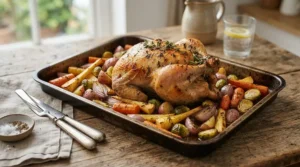
There’s a specific kind of quiet heartbreak that happens around 1pm on a Sunday, when you lift the foil off your chicken and find the underside sitting in a shallow puddle of its own fat. The top’s gone golden. The bottom’s gone soggy. And somewhere in your head, a small voice says: “there has to be a better way.” There is, and it’s been sitting in the bakeware aisle the whole time, slightly overlooked in favour of flashier kit. A roasting tin with rack does one unglamorous job brilliantly — it lifts your joint off the base of the pan so hot air can get underneath it, while fat and juices drip down and out of the way instead of stewing your dinner. It sounds almost too simple to matter. It matters enormously. This guide walks through what separates a genuinely useful roasting tin with rack from a flimsy imitation, compares seven real products currently sold in the UK, and digs into the techniques — basting, resting, rack positioning — that actually determine whether your Sunday roast sings or just gets through.
We’ve built this around real specifications, aggregated review sentiment, and honest side-by-side analysis rather than recycled marketing copy, because a roasting tin is one of those purchases people keep for a decade — it deserves more than a shrug and a five-star sort.
What Is a Roasting Tin With Rack?
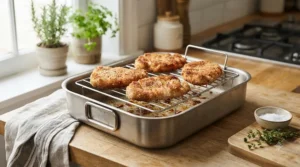
A roasting tin with rack is a deep metal tray paired with a raised, perforated or slatted insert that holds meat or poultry above the base of the pan. The elevation lets hot oven air circulate underneath the joint for more even browning, while fat drains through the rack into the tin below rather than pooling against the meat.
That gap between meat and metal is the whole story. Sit a chicken directly in a flat tin and the underside effectively steams in its own rendered fat — pale skin, soggy patch, no crunch. Lift it two or three centimetres and the same oven that’s crisping the top now gets a fair crack at the bottom too. As a general definition of the cookware category makes clear, the rack-and-pan combination has been a kitchen fixture for exactly this reason for well over a century.
Quick Comparison Table
| Product | Material | Size | Rack Type | Best For |
|---|---|---|---|---|
| KitchenCraft Roasting Tin with Rack | Stainless steel | 43 x 31cm | Removable, flat | Everyday family roasts |
| MasterClass Teflon Non-Stick Roasting Tin with Rack | Carbon steel, non-stick | 36 x 27.5cm | Removable, non-stick | Easy clean-up, gravy on the hob |
| Circulon Ultimum Roaster with Rack | Carbon steel, non-stick | 39.4 x 30.7cm | Removable, non-stick, folding handles | Roast + easy serving |
| Judge Speciality Roasting Pan with Rack | Stainless steel | 39 x 28cm | Removable, raised | Budget-conscious buyers |
| ProCook Stainless Steel Roasting Tin with V-Rack | 18/10 stainless steel | 41 x 28.5cm | V-shaped, removable | Whole birds and joints |
| Great British Bakeware Vitreous Enamel Tray Set | Vitreous enamel steel | 28/33/37cm (3-piece) | Sold separately | Multi-dish roasting days |
| Samuel Groves 14″ Professional Aluminium Roaster | Uncoated aluminium | 42 x 31cm | Compatible with standard racks | Heat-sensitive baking and pro results |
Analysis: if you cook one roast a fortnight for four people, the KitchenCraft Roasting Tin with Rack or Judge Speciality Roasting Pan with Rack cover the basics without asking you to spend big. Hosting bigger gatherings or doing a full Christmas spread changes the maths — the ProCook Stainless Steel Roasting Tin with V-Rack and the Great British Bakeware set both earn their higher price tags through capacity and versatility. Anyone chasing restaurant-level browning and gravy-making on the hob should look hardest at the MasterClass and Circulon Ultimum, since both combine non-stick coatings with hob compatibility that plain stainless steel tins can’t match.
💬 Found a favourite already? A quick tap on any link below takes you straight to current pricing.
Roasting Tin With Rack vs Without Rack
This is the single most common fork in the road when people shop for a roasting tin, and it’s worth settling properly before you spend a penny. A flat roasting tin without a rack is cheaper, stacks more easily in a cupboard, and works fine for pot roasts, casseroled joints, or anything meant to braise in its own liquid. But for a chicken, turkey, or any joint you want crisp-skinned rather than stewed, the rack isn’t a luxury add-on — it’s doing genuine mechanical work.
Without a rack, the underside of your meat sits in direct contact with the tin, which conducts heat differently to circulating air and traps rendered fat against the skin. Reviewers who’ve switched from flat tins to racked ones consistently describe the same “aha” moment: skin that was previously rubbery on the underside suddenly crisps evenly all the way round, because the rack lets the same hot air currents reach the bottom of the bird as reach the top.
There’s a knock-on benefit too. Fat and meat juices that collect below a rack are perfectly positioned for gravy-making — cleaner drippings than you’d fish out from underneath a flat-sitting joint, and less risk of burnt sediment sticking hard to the pan base while the meat cooks on top of it. The trade-off is storage: a two-piece rack-and-tin combo takes up more cupboard space than a single flat tray, and cheaper racks can warp under a heavy turkey if the gauge of metal is too thin. For anything beyond weeknight traybakes, though, the rack earns its keep.
Top 7 Roasting Tins With Rack: Expert Analysis
1. KitchenCraft Roasting Tin with Rack — best all-rounder for everyday roasts
The KitchenCraft Roasting Tin with Rack is the sort of sensible, unglamorous purchase that quietly outperforms flashier options for years. At 43 x 31cm with a 5.5-litre capacity, it’s built with a family Sunday roast in mind rather than a magazine photoshoot. The stainless steel construction means no non-stick coating to eventually scratch or flake, and the removable lift-out rack raises meat clear of the base so fat drains properly and air circulates underneath.
Reviewers consistently report that the polished stainless steel cleans up easily even after heavy roasting sessions, and several note the tin is sturdy enough to double as a gravy-making vessel directly on the hob, since it’s compatible with all heat sources except induction. Based on the spec comparison with cheaper own-brand tins, the noticeably thicker gauge steel here is what stops it warping under a full turkey — a common complaint with budget alternatives.
This is squarely the pick for anyone who wants one dependable tin that handles everything from a midweek chicken to a Christmas bird, without needing to think too hard about it. Families cooking for four to six will find the size close to ideal, and first-time buyers who don’t want to research three separate products will get most of what they need in this single purchase.
Pros:
- ✅ Large 5.5L capacity fits a substantial Christmas turkey
- ✅ Uncoated stainless steel resists scratching and flaking long-term
- ✅ Hob-compatible for making gravy straight after roasting
Cons:
- ❌ Not suitable for induction hobs
- ❌ Heavier to lift and wash than non-stick alternatives
Prices for the KitchenCraft Roasting Tin with Rack typically sit in the mid-£20s to low-£30s range at the time of research, and given the durability reviewers describe, it represents strong long-term value for a tin that’s likely to outlast several cheaper replacements.
2. MasterClass Teflon Non-Stick Roasting Tin with Rack — best for effortless clean-up
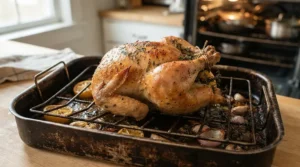
The MasterClass Teflon Non-Stick Roasting Tin with Rack solves the one genuine annoyance of stainless steel roasting — the scrubbing. Measuring 36 x 27.5cm and 7.5cm deep, it’s built from heavy-duty carbon steel finished with a three-layer Teflon Xtra non-stick coating that extends across both the tin and the removable rack.
What that coating means in practice is that roast potatoes cooked in rendered fat release cleanly rather than welding themselves to the base, and the rack itself wipes down rather than needing a soak. Reviewers who’ve used it on the hob after roasting describe the non-stick surface handling gravy-making without the usual sticking and scraping that plain steel involves — a detail the spec sheet doesn’t shout about but genuinely changes the post-dinner routine. The tin is backed by MasterClass’s 20-year guarantee and a separate five-year non-stick guarantee, which is a longer commitment than most competitors in this bracket offer.
This suits anyone who roasts often enough that washing-up time actually matters, and particularly households where potatoes are roasted directly in the meat fat — a technique that punishes uncoated tins but is exactly what this non-stick surface is built for.
Pros:
- ✅ Three-layer Teflon coating on tin and rack for easy release
- ✅ 20-year guarantee plus separate 5-year non-stick guarantee
- ✅ Compatible with all hobs except induction for gravy-making
Cons:
- ❌ Smaller capacity than some stainless steel rivals
- ❌ Non-stick coatings eventually degrade faster than bare steel
At around £50-£60, this sits at the premium end for a single tin, but the two-part guarantee and genuine time saved on washing-up make a reasonable case for the extra outlay if you roast weekly.
3. Circulon Ultimum Roaster with Rack — best for lifting and serving big joints
The Circulon Ultimum Roaster with Rack distinguishes itself with folding handles on the rack itself, a small design detail that turns out to matter a great deal once you’re wrestling a hot turkey out of an oven. At 39.5 x 30.5cm, the carbon steel tin is finished with Circulon’s Ultra Total non-stick system, described by the brand as a triple-layered coating designed for durability under repeated abrasion.
The practical upshot of the folding-handle rack is safer lifting — instead of trying to grip a flat, slippery rack edge with oven gloves while a joint threatens to slide off, the handles give you something to actually hold onto. Aggregated customer sentiment for the Circulon Ultimum range highlights consistent praise for even browning and food release, alongside occasional comments that the non-stick coating, while effective, requires gentler utensils than uncoated steel to preserve its lifespan. The tin carries a lifetime manufacturer’s guarantee against the non-stick coating failing, which is a meaningful reassurance given how central that coating is to the product’s appeal.
Anyone who’s ever nearly dropped a hot turkey mid-transfer to the carving board will understand immediately why this rack design earns its place on the list — it’s solving a real, slightly dangerous kitchen problem that most competitors ignore.
Pros:
- ✅ Folding rack handles make lifting hot joints safer
- ✅ Triple-layer non-stick system with lifetime coating guarantee
- ✅ Large enough for a medium Christmas turkey
Cons:
- ❌ Carbon steel base can be prone to minor warping over years of heavy use
- ❌ Non-stick surface needs wooden or silicone utensils only
Typically priced in the £20-£30 range, the Circulon Ultimum represents solid mid-tier value, particularly for anyone who’s found lifting hot roasts from flat racks stressful in the past.
4. Judge Speciality Roasting Pan with Rack — best budget-conscious pick
The Judge Speciality Roasting Pan with Rack proves that a sensible roasting tin doesn’t need to cost a fortune. Available in a few size variants around 32-42cm depending on retailer stock, the core version measures roughly 39 x 28 x 6cm and is built from 18/0 stainless steel with a raised, removable rack and lift-up twin handles designed to save space both in the oven and in storage.
The stainless steel construction here is genuinely uncoated 18/0 grade — chromium without nickel — which reviewers note holds up well to dishwasher cycles without the surface degradation that cheaper coated tins can show after a year or two. What most buyers overlook about budget stainless steel tins like this one is that the absence of a non-stick coating is often a durability feature rather than a shortcoming; there’s simply nothing to scratch off. Judge backs the pan with a 25-year guarantee, an unusually long commitment for a product typically priced under £25.
This is the sensible starting point for students, first-time homeowners furnishing a kitchen from scratch, or anyone who wants a reliable roasting tin without treating the purchase as a big-ticket decision.
Pros:
- ✅ 25-year guarantee on a genuinely budget-friendly product
- ✅ Uncoated stainless steel with no coating to wear off
- ✅ Space-saving lift-up handles for storage
Cons:
- ❌ Smaller capacity than premium rivals, less ideal for large turkeys
- ❌ Basic flat rack lacks the folding-handle convenience of pricier models
At roughly £18-£25 depending on size, the Judge Speciality is arguably the best pound-for-pound value on this list, especially given the guarantee length relative to price.
5. ProCook Stainless Steel Roasting Tin with V-Rack — best for whole birds and large joints
The ProCook Stainless Steel Roasting Tin with V-Rack takes a different approach to rack design entirely. Rather than a flat mesh insert, it uses a V-shaped rack that cradles a whole bird or rolled joint along its natural curve, which changes how evenly the meat browns compared with a flat-rack setup. The tin measures a generous 41 x 28.5cm and is made from heavy-gauge 18/10 stainless steel, rated to withstand temperatures up to 260°C.
The V-shape does something a flat rack can’t: it holds a chicken or turkey slightly on its side or cradled centrally rather than flat-bottomed, so heat reaches more of the surface area evenly rather than concentrating browning on the top and sides only. ProCook markets the tin as suitable for baking, poaching, and bain-marie cooking too, and the deep, high-sided walls mean fat splatter stays contained even with a well-basted bird. Reviewers highlight the buckle-resistant build quality as standing out from thinner competitors at a similar price point, a detail that matters once you’re lifting 5kg of turkey in and out of a hot oven repeatedly over a holiday period.
Buyers cooking whole birds regularly — rather than joints of beef or lamb, which sit fine on a flat rack — get the most out of this design, and the 25-year guarantee ProCook offers reflects real confidence in the gauge of steel used.
Pros:
- ✅ V-shaped rack improves even browning on whole birds
- ✅ Heat resistant to 260°C, versatile beyond roasting
- ✅ Heavy-gauge, buckle-resistant stainless steel
Cons:
- ❌ V-rack shape less suited to flat joints like beef briskets
- ❌ Not compatible with induction hobs
Around £40-£50 places this in the mid-premium bracket, but for households whose roasting is dominated by whole chickens and turkeys rather than joints, the shape genuinely justifies the price over a standard flat-rack tin.
6. Great British Bakeware Vitreous Enamel Roasting Tray Set — best for multi-dish roasting days
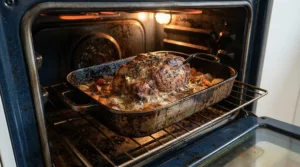
The Great British Bakeware Vitreous Enamel Roasting Tray Set takes the opposite strategy to a single do-everything tin — it gives you three trays (28cm, 33cm, and 37cm) made from heavy-duty vitreous enamel over steel, manufactured in England. Racks for this range are typically sold separately or as companion pieces sized to match, letting you build a set tailored to how you actually cook.
Vitreous enamel’s real-world advantage over plain steel or non-stick coatings is chemical resistance and scratch resistance simultaneously — it doesn’t react with acidic marinades the way bare aluminium can, and it doesn’t scratch the way Teflon-style coatings eventually do under metal utensils. Having three graduated sizes means a Christmas spread with turkey, a ham joint, and a tray of roast vegetables can all go in simultaneously without playing tin-shuffling Tetris with the oven shelves. Based on the spec comparison with single-tin options, the trade-off is upfront cost and cupboard space, since you’re storing three trays instead of one.
This suits households that host big multi-dish meals regularly — Christmas, big family Sundays, or anyone who’s tired of ferrying dishes in and out of a single oven one at a time.
Pros:
- ✅ Three graduated sizes cover everything from sides to a full turkey
- ✅ Vitreous enamel resists both scratching and acidic corrosion
- ✅ Made in England with heavy-duty steel base
Cons:
- ❌ Higher total cost than a single tin, even at a similar per-tray price
- ❌ Takes up considerably more storage space
Set pricing generally lands somewhere in the £40-£60 range for the trio, which works out reasonably per tin, though it’s a bigger single purchase than most people make on their first roasting tin.
7. Samuel Groves 14″ Professional Aluminium Shallow Roaster — best for precision heat and pro-level results
The Samuel Groves 14″ Professional Aluminium Shallow Roaster is aimed squarely at cooks who care about the physics of roasting as much as the result. Made in England from natural, uncoated aluminium and measuring 42 x 31 x 4cm, it’s a shallow-format roaster that pairs with a standard flat rack rather than shipping with a dedicated one.
Aluminium conducts heat roughly four times faster than stainless steel, which in practice means less time spent waiting for the pan itself to catch up with the oven’s actual temperature, and more even heat distribution across the base — fewer hot spots that scorch one corner of your roast potatoes while the other corner stays pale. The shallow 4cm depth is a deliberate choice too: it maximises the surface area exposed to circulating oven air compared with deep-walled tins, which favours crisping over steaming. What the spec sheet won’t tell you, but professional kitchens have long understood, is that uncoated aluminium develops a natural patina with use that many chefs consider a feature rather than a flaw, since it doesn’t affect performance and can’t flake off the way a coating would.
This is the pick for confident home cooks who already understand technique and want their equipment to get out of the way rather than compensate for it — less beginner-friendly than a non-stick option, but capable of genuinely professional results in the right hands.
Pros:
- ✅ Aluminium’s fast, even heat conduction reduces hot spots
- ✅ Shallow profile favours crisping over steaming
- ✅ Made in England to commercial-kitchen specifications
Cons:
- ❌ No rack included — needs a separately sized flat rack
- ❌ Uncoated aluminium reacts with acidic marinades if left standing
Prices for the Samuel Groves 14″ typically sit around £35-£45, and while the lack of an included rack is a genuine gap for first-time buyers, the pan itself is a strong long-term investment for anyone serious about roasting technique.
Practical Usage Guide: Getting the Most From Your Roasting Tin With Rack
Getting a new roasting tin with rack out of the box and straight into the oven is tempting, but a few habits from the first few uses set the tone for how well it performs — and how long it lasts.
Before the first roast, wash the tin and rack in warm soapy water and dry thoroughly, even if the manufacturer says it’s dishwasher safe out of the box; this clears any manufacturing residue. For non-stick tins like the MasterClass or Circulon Ultimum, a light coating of oil on the rack before the first few uses helps the coating “season” and improves food release early on, even though the coating itself doesn’t strictly need it long-term. Always place the rack inside the tin before adding meat, rather than lowering the joint onto an empty tin and fitting the rack around it — it sounds obvious, but it’s the single most common first-use mistake, and it usually ends with a scorched arm.
A common early mistake is overcrowding the rack with vegetables alongside the meat — this blocks the air circulation the rack exists to create, defeating the point entirely. Roast vegetables separately underneath the rack, in the fat and juices, rather than beside the joint on top of it. For maintenance, uncoated stainless steel and aluminium tins benefit from a soak in warm water with a splash of vinegar if baked-on residue builds up, while non-stick surfaces should stick to soft sponges only — anything abrasive shortens coating life significantly, regardless of what the guarantee promises to cover.
Crispy Skin Technique: What Actually Works
Crispy skin is arguably the entire reason racked roasting tins exist, and the technique matters as much as the equipment. Reviewers across multiple products in this guide independently mention the same pattern: skin browns more evenly on a rack than in a flat tin, but only if a few other basics are in place too.
Pat the skin completely dry with kitchen paper before it goes anywhere near the oven — moisture on the surface has to evaporate before browning can start, so wet skin simply delays crisping and can leave patches pale. Salting the skin an hour or more ahead, and leaving it uncovered in the fridge, draws out surface moisture in advance and firms the skin, a technique often called dry-brining that pairs particularly well with a rack because the air circulating underneath dries the underside too, not just the top. Independent testing by America’s Test Kitchen found that combining this drying step with a light dusting of salt and baking powder speeds up the browning reaction even further, though a rack and a properly dried bird will get most home cooks most of the way there on their own. High, consistent oven heat for the final 15-20 minutes of cooking — even if the bulk of roasting happens at a lower, gentler temperature — gives the Maillard browning reaction the heat spike it needs. On aluminium tins like the Samuel Groves, that final blast tends to come through faster and more evenly thanks to the metal’s conductivity, which is part of why professional kitchens favour it.
None of this works around a flat, coating-free tin without a rack — the moisture has nowhere to go and simply re-steams the underside regardless of technique. The rack is doing structural work that no amount of patting dry or seasoning can substitute for on its own.
Basting Methods: Which Suits Which Tin
Basting divides cooks fairly sharply into camps, and the roasting tin you’re using genuinely changes which method suits you best. Traditional basting — spooning hot fat from the base of the tin over the meat every 20-30 minutes — works well with any of the tins in this guide, but it’s noticeably easier with wider, shallower designs like the Samuel Groves, where the fat pool at the base is easy to reach with a spoon without disturbing the joint on the rack above.
Self-basting, where the fat rendering off the meat drips back down through the rack and is left to accumulate rather than actively spooned, suits deeper tins like the KitchenCraft or Judge Speciality better, since their higher walls contain splatter during longer, hands-off cooking. Butter or oil basting under the skin before cooking — worked gently between skin and flesh — is a technique independent of tin choice but works best paired with a rack, since the rendered fat has somewhere to actually drain to rather than pooling directly against the meat and softening the skin it’s meant to be crisping.
For anyone using a non-stick tin such as the Circulon Ultimum, be cautious with metal basting spoons or bulb basters with hard tips — the coating is durable but not indestructible, and repeated scraping against the base shortens its working life faster than the guarantee terms might suggest.
How to Choose a Roasting Tin With Rack
- Match capacity to what you actually cook. A tin sized for a whole Christmas turkey is unnecessarily large for a weekly midweek chicken, and oversized tins can actually cause food to spread out and dry faster. Measure your oven’s internal width before buying, too — a tin that’s too large simply won’t fit.
- Decide between non-stick and uncoated steel early. Non-stick options like the MasterClass or Circulon reduce washing-up time but need gentler utensils and eventually wear; uncoated stainless steel or aluminium lasts longer structurally but demands more scrubbing.
- Check the rack’s construction, not just the tin’s. A flimsy, thin-wire rack can bow under a heavy turkey over time, while a rack made from thicker gauge steel with a supportive cross-brace pattern holds its shape for years.
- Consider hob compatibility if you make gravy in the pan. Not every tin is safe to place directly on a gas or electric hob, and induction compatibility is rare across this category — check before assuming.
- Factor in storage space realistically. A three-piece set like the Great British Bakeware range delivers flexibility but needs cupboard room a single tin doesn’t.
- Look at the guarantee length as a genuine quality signal. Brands offering 20-25 year guarantees, like MasterClass and Judge, are backing the gauge of metal they’ve used with real confidence — it’s one of the more reliable proxies for build quality available before you buy.
- Weigh material against your typical cooking style. Aluminium suits precision, high-heat crisping; stainless steel suits durability and dishwasher habits; vitreous enamel suits acidic marinades and multi-dish flexibility.
Common Mistakes When Buying a Roasting Tin With Rack
The single most frequent mistake is buying based on price alone without checking capacity against actual oven dimensions — a tin that looks reasonably sized in product photos can turn out too large to close the oven door on, particularly in smaller UK kitchens. A close second is assuming every roasting tin comes with a rack included; several budget listings on Amazon are tin-only, and the “with rack” phrasing in a product title doesn’t always survive into what’s actually shipped, so it’s worth checking product images and specifications rather than the title alone.
Buyers also commonly underestimate how much heavier a fully loaded stainless steel tin gets once a turkey and its juices are inside — folding or awkwardly shaped handles that felt fine empty in the shop can become a genuine safety issue lifting 6-8kg out of a hot oven. Reviewers of several budget tins mention this specifically as an afterthought realisation. Finally, many buyers skip checking induction compatibility, assuming a stainless steel tin will automatically work — as this guide’s research shows, most roasting tins, including premium ones, explicitly exclude induction hobs, so anyone with an induction range needs to check this detail closely rather than assume.

Real-World Scenario: Matching the Tin to the Cook
The weeknight family cook. Roasting two or three times a month for four people, mostly chicken, occasionally a small joint of pork. Budget matters, storage space is limited, and washing-up time is precious on a weekday evening. The Judge Speciality Roasting Pan with Rack or KitchenCraft Roasting Tin with Rack both fit this profile well — durable, single-tin solutions that don’t demand a big upfront spend or extra cupboard real estate.
The Christmas host. Cooks a full turkey once or twice a year but goes all-in when they do — trimmings, a ham joint, trays of vegetables, the works. Storage space for occasional-use kit is available, and the priority is capacity and reliability on the one day it really counts. The ProCook Stainless Steel Roasting Tin with V-Rack, sized specifically for whole birds, or the Great British Bakeware three-tray set for handling multiple dishes at once, both suit this scenario better than a single mid-sized tin.
The technique-focused home cook. Roasts regularly, has read enough about crispy skin and Maillard browning to have opinions, and wants equipment that performs rather than just looks tidy in a cupboard. The Samuel Groves 14″ Professional Aluminium Shallow Roaster rewards this level of engagement, trading beginner-friendly non-stick convenience for genuinely faster, more even heat conduction.
Long-Term Cost & Maintenance
Cost-per-use is the honest way to think about roasting tins, because the cheapest option upfront isn’t always the cheapest over a decade. A £20 tin that needs replacing every three years due to warping or coating failure works out more expensive over ten years than a £50 tin backed by a 20-year guarantee and built from thicker-gauge metal. Based on the guarantee lengths and material quality across this list, the Judge Speciality and MasterClass options both represent particularly strong long-term value relative to their price points, since both back genuinely durable construction with guarantees stretching two decades or more.
Maintenance costs are mostly time rather than money — non-stick tins save scrubbing time but eventually need replacing once the coating degrades, typically after several years of regular use even with careful handling, while uncoated stainless steel and aluminium tins can realistically last a lifetime with basic care, at the cost of more elbow grease after each use. Vitreous enamel sits in between: highly durable against scratching and staining, but the enamel coating can chip if the tin is dropped or knocked hard against a hob edge, which isn’t a risk uncoated metal carries in the same way.
Safety Guidance for Roasting Meat and Poultry
Getting a crispy exterior is only half the job — the meat underneath needs to reach a genuinely safe internal temperature, and this is where a rack’s even heat circulation earns its keep beyond just texture. UK food safety guidance is clear that poultry, pork, and rolled joints must be cooked all the way through with no pink meat and clear running juices, checked in the thickest part — for a whole bird, that’s the area between the leg and the breast. A digital meat thermometer removes the guesswork entirely and is a worthwhile companion purchase to any of the tins in this guide.
Whole cuts of beef and lamb are treated differently under UK guidance, since bacteria on these cuts is generally confined to the surface rather than distributed through the meat, meaning a properly seared exterior is sufficient even if the centre remains pink. Rolled joints, however, need cooking all the way through regardless of the meat type, because the rolling process can introduce surface bacteria into what’s now the interior of the joint. A rack helps across all of these scenarios by promoting more even heat distribution, reducing the risk of a joint browning nicely on the outside while remaining underdone in patches shielded from direct airflow.
Features That Actually Matter (And Those That Don’t)
Marketing copy across this category leans hard on phrases like “restaurant quality” and “chef-grade,” most of which mean very little without checking the actual gauge of metal and construction underneath. What genuinely matters: metal thickness (thinner gauge warps under heavy joints over time), rack support structure (a rack with more cross-bracing holds heavy turkeys without sagging), handle design (folding or wide-grip handles are safer with hot, heavy loads), and honest guarantee length as a proxy for the manufacturer’s own confidence.
What matters considerably less than the packaging suggests: colour or decorative pattern on the exterior of the tin, which independent parent-tested roasting tin comparisons have repeatedly found has no bearing on cooking performance; branding partnerships or celebrity-endorsed ranges, which typically add cost without changing the underlying metal or construction; and claimed “non-stick forever” language, since all non-stick coatings degrade with metal utensil contact and high heat over time regardless of marketing claims to the contrary.
FAQ
❓ What size roasting tin with rack do I need for a turkey?
❓ Can I use a roasting tin with rack on an induction hob?
❓ Do I need to oil the rack before roasting?
❓ Is a non-stick roasting rack better than stainless steel?
❓ How do I stop my roasting tin with rack from warping?
Conclusion
A roasting tin with rack isn’t a glamorous purchase, but it’s one of those unshowy pieces of kitchen kit that quietly changes the outcome of every roast dinner you make afterwards. The right choice depends less on which product has the flashiest listing and more on how you actually cook — a family working through weeknight chickens wants something different from a household that goes all-out once a year for Christmas. Whether that’s the dependable, budget-friendly Judge Speciality Roasting Pan with Rack, the easy-clean MasterClass Teflon Non-Stick Roasting Tin with Rack, or the whole-bird-focused ProCook Stainless Steel Roasting Tin with V-Rack, the underlying principle stays the same: lift the meat, let the air move, let the fat drain away. Pair any of these tins with the crispy-skin and basting techniques covered above, and the soggy-bottomed roast dinner becomes a thing of the past.
✨ Ready to upgrade your Sunday roast?
Take a closer look at any of the tins above and check current pricing before your next big cook — your crispiest roast yet might just be one tin away! 🍗
Recommended for You
- Stainless Steel Roasting Trays: 7 Best Buys for UK Kitchens (2026)
- Stainless Steel Roasting Tray: 7 Best Picks for UK Kitchens (2026)
- Non-Stick Roasting Tins: 7 Best Picks for UK Kitchens (2026)
Disclaimer: This article contains affiliate links. As an Amazon Associate, I earn from qualifying purchases. If you purchase products through these links, we may earn a small commission at no additional cost to you.
✨ Found this helpful? Share it with your friends! 💬🤗
