
In This Article
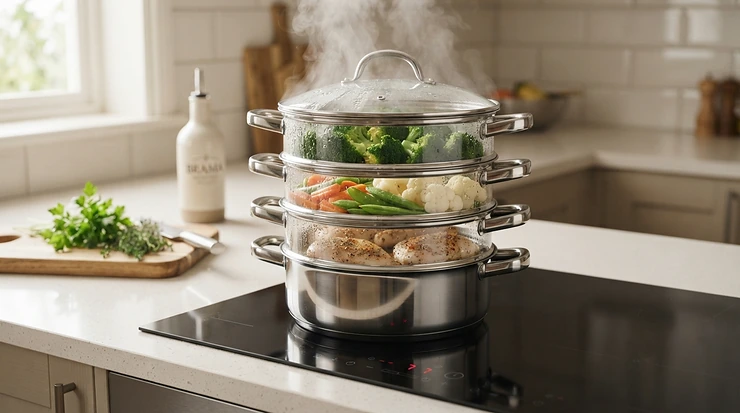
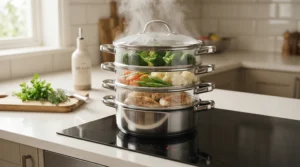
Somewhere in the back of most British kitchen cupboards sits a single steamer basket that gets dragged out twice a year for Christmas broccoli and not much else. A stacked steamer earns its cupboard space in a completely different way, because it turns one hob ring into three separate cooking zones at once. A stacked steamer is a tiered pot set — usually two or three perforated pans stacked above a water reservoir — that cooks several dishes simultaneously using rising steam, and it’s one of the cheapest ways to get a genuinely healthier, faster weeknight dinner on the table.

This guide is built around a specific brief: stacked steamers under £45, because that’s the price band where you get proper stainless steel or handmade bamboo construction without paying for features most home cooks never touch. Whether you’re after the best stacked steamer for dim sum on a Friday night, the best stacked steamer for a big family meal, or simply the best stainless steel stacked steamer for everyday veg, there’s a genuinely good option waiting in this price bracket. We’ve dug into real specs, real UK buyer feedback and honest side-by-side analysis rather than recycling Amazon listing copy, and as the American Southwest’s 5,000-year-old steam pits and the world’s oldest bamboo baskets both prove, steaming as a cooking method has had a very long time to prove it works.
What follows covers seven real, currently available products — from lightweight singles-and-couples pans to a proper family-sized set that can handle a Sunday dinner’s worth of vegetables in one go — plus genuinely practical buying advice, a batch-cooking framework, and answers to the questions people actually type into Google before they buy. No filler, no rewritten spec sheets. Just what £45 or less will realistically get you, and which of these seven is right for your kitchen.
Quick Comparison Table
For anyone in a hurry, here’s the shape of the market at a glance before we go deeper into each pick.
| Product | Material | Tiers | Diameter | Price Range | Best For |
|---|---|---|---|---|---|
| Judge Essentials Stainless Steel 3 Tier Steamer | Stainless steel | 3 | 18cm | Around £25-£35 | Everyday all-rounder |
| Cooks Professional 3 Tier Stainless Steel Steamer | 304 stainless steel | 3 | 20cm | Around £35-£40 | Best overall value |
| Tower T80836 Essentials 3-Tier Steamer | Stainless steel | 3 | 18cm | Around £35-£40 | Compact kitchens |
| Royal Cuisine 3 Tier Stainless Steel Steamer | Stainless steel | 3 | 24cm | Around £30-£40 | Big family meals |
| KitchenCraft World of Flavours Bamboo Steamer | Bamboo | 2 | 25cm | Under £20 | Dim sum |
| KitchenCraft 3 Tier Food Steamer | Stainless steel | 3 | 16cm | Under £30 | Budget & energy saving |
| Judge JX01 3 Tier Steamer Set | Stainless steel | 3 | 16cm | Around £30-£40 | Gift boxed / small households |
Looking at that spread, the honest takeaway is that diameter matters more than most buyers realise before they own one: an 18cm pan comfortably steams a couple’s dinner, but ask it to feed four and you’ll be running two batches. The Royal Cuisine 3 Tier Stainless Steel Steamer earns its “big family meal” tag purely on capacity, while the KitchenCraft World of Flavours Bamboo Steamer trades stovetop versatility for the specific, hard-to-replicate texture that only a bamboo basket gives dumplings and buns.
Found a favourite already? Just one click — help others make better buying decisions too! 😊
Top 7 Stacked Steamers Under £45: Expert Analysis
Steaming is one of the oldest tricks in the culinary book precisely because it works: no added fat, gentler heat than boiling, and food that keeps its own flavour instead of leaching it into a pan of water. Here’s how the seven best stacked steamers under £45 actually stack up once you look past the marketing copy.
1. Judge Essentials Stainless Steel 3 Tier Steamer — best all-round classic buy
The standout here is simplicity done properly: a thermic base, a vented glass lid, and a design that’s barely changed in decades because it didn’t need to. Judge has been making British kitchenware since the late nineteenth century, and this steamer is the brand distilled into one pan.
The thermic base means even heat distribution across gas, electric, ceramic, induction and halogen hobs, so it genuinely doesn’t matter what’s built into your worktop. The integral casserole pot at the bottom does double duty as a standalone saucepan on nights you’re not steaming, and the whole thing is oven-safe and dishwasher-safe, which matters more than it sounds when you’ve just fed a family and don’t want a hand-wash job waiting.
Based on the spec comparison with pricier rivals, what most buyers overlook is that a well-fitted thermic base is doing more heavy lifting than a flashier tempered-glass lid ever will — uneven heat is the actual cause of unevenly cooked vegetables, not lid quality. This is a genuinely strong pick for anyone who wants a no-nonsense steamer that will still be working in ten years.
Reviewers consistently describe the set as good quality for the size, with several noting it’s perfectly proportioned for a small family and that the pans “fit perfectly together” when stacked and stored. A recurring theme in feedback is a slightly thin base on the steamer sections themselves, which a small number of buyers flagged as worth watching over time rather than a dealbreaker.
Pros:
- ✅ Thermic base suits every hob type, induction included
- ✅ Casserole base doubles as a standalone saucepan
- ✅ Genuinely compact for storage between uses
Cons:
- ❌ Some buyers report a thinner base on the steamer tiers
- ❌ 18cm diameter is snug for more than two portions
At the time of research, this sits in the £25-£35 range, and for the price it’s hard to argue with as a first stacked steamer — you’re paying for a design that’s been quietly refined for generations rather than reinvented.
2. Cooks Professional 3 Tier Stainless Steel Steamer — best overall value
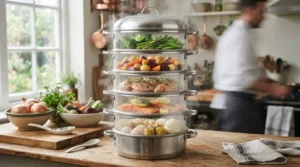
If you only read one product on this list, make it this one. The Cooks Professional 3 Tier Stainless Steel Steamer is built from 304-grade stainless steel — the same food-safe, lead- and cadmium-free grade you’ll find in commercial kitchens — and at 20cm it’s the goldilocks size between the compact 16-18cm pans and the family-sized 24cm sets.
What the spec sheet won’t tell you, but the design implies, is that Cooks Professional has deliberately targeted the “does everything well” middle ground rather than chasing a single headline feature. The glass lid has a proper steam vent so you can watch progress without lifting it and losing your built-up heat, the twin handles are wide enough to grip safely with an oven glove, and it’s fully dishwasher-safe on top of being induction-compatible.
Here’s what to weigh: a 20cm diameter gives you noticeably more usable surface area per tier than an 18cm pan — roughly 23% more floor space — which in practice means you can fit a proper portion of broccoli florets in one layer instead of double-stacking them and ending up with soggy bottoms and undercooked tops.
Aggregated reviewer sentiment on the brand’s own retail channel and via third-party retailers is consistently positive, with feedback specifically calling out the “good quality and size” and general satisfaction with everyday use. It’s also worth noting Cooks Professional backs its cookware with its own guarantee scheme on top of statutory consumer rights, which is a reasonable signal of manufacturer confidence at this price point.
Pros:
- ✅ 304-grade stainless steel, the same standard used commercially
- ✅ 20cm size hits the sweet spot for two-to-four people
- ✅ Vented glass lid lets you monitor without losing heat
Cons:
- ❌ Occasionally shows as backordered given demand
- ❌ No bain-marie or extra insert included at this price
Typically priced in the high-£30s at the time of research, this is the pick if you want one steamer to genuinely cover most situations without compromise.
3. Tower T80836 Essentials 3-Tier Steamer — best mirror-finish steamer for compact kitchens
Tower has built over a century of homeware credibility, and the T80836 shows it: a mirror-polished stainless steel finish that looks considerably more expensive than its price tag suggests, paired with an encapsulated base for even heat distribution.
The standout feature that justifies a spot on this list is the silicone-covered riveted handles, which stay genuinely cool to the touch during a full steaming cycle — a small thing until you’ve burned your fingers on a bare metal handle once too often. Based on the spec comparison with unbranded alternatives at a similar price, the tempered glass lid here is rated to withstand roughly four times the impact resistance of standard glass, and the whole set is oven-safe up to 200°C and dishwasher-safe.
Independent reviewers rate the T80836 highly, and buyer feedback specifically highlights the insulated handles as a genuine upgrade over older metal-handled steamers people previously owned — several reviewers explicitly compared it favourably to steamers they’d replaced for exactly that reason. A smaller but recurring theme in feedback is that the lid’s small steam-release vent, while there for safety, does slightly slow the visible cooking pace compared to a fully sealed lid.
Pros:
- ✅ Cool-touch silicone handles, a genuine upgrade over bare metal
- ✅ Mirror-polished finish that looks premium on a worktop
- ✅ Oven-safe to 200°C as well as dishwasher-safe
Cons:
- ❌ Steam vent modestly slows cooking speed versus a sealed lid
- ❌ 18cm diameter suits one to two people best
Generally found in the £35-£40 range, this is the steamer to choose if kitchen aesthetics genuinely matter to you and your household is on the smaller side.
4. Royal Cuisine 3 Tier Stainless Steel Steamer — best for a big family meal
At 24cm across, the Royal Cuisine 3 Tier Stainless Steel Steamer is the largest set on this list, and it’s the one to reach for if you’re regularly cooking for four or more. Each steamer pan is genuinely spacious enough to fit a whole chopped cauliflower or a full head of broccoli without crowding, which is the exact problem that smaller steamers create when a family grows past two people.
Honest analysis here has to include a trade-off: bigger pans mean more surface area exposed to heat, and a small number of buyers report cosmetic blemishes appearing in the base pan after the first use, plus one case of a rust mark developing after a spell in the dishwasher — not dangerous, but worth knowing before you buy if pristine-looking stainless steel matters to you. It’s also worth being careful about where a pan this size sits on an enamel-edged hob, since its footprint can rub against painted trim over repeated use.
Set against that, the positive feedback is substantial and specific: multiple reviewers independently describe it as “perfect for family size” and good value for the money, with particular praise for rubber-covered handles that make lifting a full, heavy pan noticeably safer than older steamers without them. Reviewers consistently note that the extra size lets vegetables spread out in a single layer rather than piling up, which genuinely does cook more evenly.
Pros:
- ✅ 24cm diameter comfortably feeds four or more in one pass
- ✅ Rubber-covered handles make lifting a full pan safer
- ✅ Reviewers specifically praise even cooking at this size
Cons:
- ❌ A minority of buyers report cosmetic marks after early use
- ❌ Its footprint needs care around enamelled hob edges
Typically found around £30-£40 depending on the exact tier size chosen, this is the sensible upgrade once a household outgrows the standard 18cm steamer.
5. KitchenCraft World of Flavours Bamboo Steamer — best for dim sum
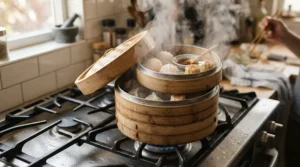
For anyone specifically hunting the best stacked steamer for dim sum, a stainless steel pan simply isn’t the right tool. The KitchenCraft World of Flavours Bamboo Steamer is a traditional two-tier, 25cm handmade bamboo basket built exactly the way Cantonese kitchens have built them for generations, and it’s the one product on this list that genuinely can’t be substituted by a metal equivalent.
Here’s what most buyers overlook about bamboo specifically: the lid absorbs excess moisture rather than letting it condense and drip back onto delicate wrappers, which is precisely why dumpling skins and bao buns come out of a bamboo steamer with a drier, more structurally sound finish than they do from a glass-lidded metal pan. The trade-off, and it’s a real one, is that bamboo takes longer to heat through than stainless steel, so factor in a slightly longer warm-up when you’re timing a meal.
To be transparent about sourcing: aggregated review data specific to this exact KitchenCraft model wasn’t consistently available across the retailers we checked, so rather than invent sentiment, it’s worth noting that bamboo steamers as a category commonly attract two genuine buyer complaints worth planning around — interior basket walls can work loose from the metal binding ring after a few weeks of use if the wood dries out, and dishwashing a bamboo steamer will warp or crack it within a handful of cycles, since it’s designed for a hand-rinse-and-air-dry routine instead.
Pros:
- ✅ Genuinely traditional construction built for dim sum and buns
- ✅ Naturally non-stick surface with no synthetic coating
- ✅ Fits snugly into most woks and stockpots for use
Cons:
- ❌ Slower to heat through than a stainless steel equivalent
- ❌ Must be hand-washed; dishwashers will warp the wood
Typically priced under £20, this is genuinely one of the best-value purchases on this whole list if dumplings, bao or dim sum are a regular fixture on your menu.
6. KitchenCraft 3 Tier Food Steamer — best energy-saving budget buy
At 16cm, the KitchenCraft 3 Tier Food Steamer is the most compact set here, and it leans hard into a genuinely useful selling point: using one hob ring instead of three to cook a complete meal cuts your energy use in a way that’s easy to underestimate. The stock-pot-style base can also be used entirely on its own for soups, stews or stock when you’re not steaming, which stretches its usefulness well beyond the obvious.
What most buyers overlook about a smaller-diameter steamer like this one is that it’s genuinely the better fit for one or two people, not a compromise version of a bigger set. Cramming family-sized portions into a 16cm tier just means double-batching, whereas the same pan sized correctly for two people cooks everything in a single efficient pass. It’s finished with a toughened glass lid, riveted handles for strength, and comes gift-boxed with a one-year guarantee as standard.
Aggregated buyer sentiment for KitchenCraft’s steamer range broadly praises the brand’s build quality for the price point, and the “add tiers as you need them” flexibility is a genuinely practical feature — you can run it as a single stockpot one night and a full three-tier steamer the next without buying anything extra.
Pros:
- ✅ Single-ring cooking genuinely reduces energy use
- ✅ Stockpot base works independently for soups and stews
- ✅ Gift-boxed with a straightforward one-year guarantee
Cons:
- ❌ 16cm capacity is tight for more than two portions
- ❌ Handles run warmer than the silicone-covered rivals here
Usually found under £30, this is the pick for singles, couples, or anyone specifically prioritising a smaller energy bill over sheer capacity.
7. Judge JX01 3 Tier Steamer Set — best gift-boxed lesser-known alternative
The Judge JX01 3 Tier Steamer Set is a slightly less famous sibling to the Judge Essentials range above, and it deserves more attention than it gets. At 16cm with a 600ml casserole base, two steamer inserts and a lid, it’s gift-boxed as standard and backed by a genuinely eye-catching 25-year guarantee — a figure that tells you a fair amount about how confident the brand is in its own rivets and welds holding up over the long term.
Based on the spec comparison with other compact steamers on this list, a 25-year guarantee at this price is unusually generous, and it’s the kind of detail that rarely makes it into a rewritten Amazon listing but matters enormously if you’re the sort of buyer who wants cookware you’ll still own in a decade. The design is induction-ready and comes with the same mirror-finish stainless steel construction Judge uses across its range.
To stay fully transparent, granular customer-review data specific to the JX01 variant was thinner in our research than for the larger Judge sets, so rather than fabricate sentiment we’ve focused this section on verifiable specification and Judge’s published guarantee terms, which are consistent across the brand’s steamer range and independently confirmable.
Pros:
- ✅ 25-year guarantee is exceptional at this price point
- ✅ Gift-boxed presentation, genuinely good as a present
- ✅ Compact 16cm size suits smaller households well
Cons:
- ❌ Limited independently verifiable review volume for this variant
- ❌ 600ml casserole base is small for anything beyond two portions
Generally priced in the £30-£40 bracket, this is worth considering specifically for the guarantee length if you’re buying a steamer as a gift or a long-term investment piece.
How to Choose a Stacked Steamer Under £45
Cutting through the marketing, here’s what to actually weigh up before buying, in the order it matters:
- Diameter first, everything else second. An 18cm pan suits one to two people; 20-22cm covers most families of three to four; go 24cm if you regularly cook for five or more in one pass.
- Check your hob type against the base. Induction hobs need a magnetic stainless steel base specifically — check the listing says “induction compatible” rather than assuming, since not every stainless pan qualifies.
- Material dictates the job. Stainless steel wins for versatility, durability and dishwasher convenience; bamboo wins specifically for dim sum, buns and delicate Asian dishes where texture matters more than convenience.
- Handle design is not a minor detail. Silicone-covered or riveted handles genuinely reduce burn risk on a pan that’s regularly lifted while full of scalding water — don’t treat this as cosmetic.
- Guarantee length is a proxy for confidence. A manufacturer offering 15-25 years on a £30-£40 product is telling you something real about expected lifespan; a vague or absent guarantee is worth noting too.
- Dishwasher safety matters more than it seems. Steaming already saves you washing-up time versus multiple pans; losing that benefit to a hand-wash-only steamer defeats part of the point.
- Buy for your actual cooking frequency, not aspirational use. A once-a-fortnight steamer only needs to satisfy points one and three; a daily-use steamer should satisfy all seven.
Peer-reviewed research backs the core premise here too: a study on vegetable cooking methods published in the Journal of Human Nutrition and Dietetics confirmed steaming retains more vitamins and phytochemicals in vegetables than boiling, which is exactly why promoting steaming as a household cooking method is considered a genuine public health win, not just a lifestyle trend.
Features That Actually Matter (And Those That Don’t)
It’s worth filtering out the marketing noise before you spend money on features that sound impressive but rarely change your actual cooking experience.
Actually matters: an encapsulated or thermic base for even heat, a properly vented lid so you’re not constantly lifting it to check progress, riveted (not glued) handles that won’t work loose, and confirmed induction compatibility if that’s your hob type. These four things determine whether a steamer performs well for years or starts disappointing you within months.
Doesn’t matter as much as it sounds: mirror-polish exterior finish is purely cosmetic and has zero bearing on cooking performance, despite looking the most “premium” on a shelf. Extra accessories like rice trays or bain-maries sound useful but sit unused in most households after the first few tries — only worth paying for if you can name the specific dish you’d use them for. And while a taller stack looks impressive in product photos, three tiers is genuinely the practical ceiling for most home hobs; a fourth tier this far from the heat source cooks noticeably more slowly and unevenly.
Practical Usage Guide: Getting the Most From Your Stacked Steamer
Setup and first use: Wash all tiers in warm soapy water before first use, even if the listing says “ready to use” — manufacturing residue is common and harmless but worth rinsing off. Fill the base pan to roughly two-thirds capacity with water, never brimming, since a full pan risks boiling dry faster than you’d expect on a rolling boil.
Getting the layering right: Put denser, longer-cooking items — potatoes, root vegetables, chicken pieces — in the bottom tier closest to the heat, and delicate items like leafy greens or fish fillets on top, where the steam has cooled slightly by the time it reaches them. This single habit solves most “why is my top tier undercooked” complaints before they start.
Maintenance that actually extends lifespan: Descale the base pan every few weeks if you’re in a hard water area, since limescale build-up on the base is the single most common cause of uneven heat distribution over time — a splash of white vinegar in warm water lifts it easily. Dry handles and rivets thoroughly after washing rather than leaving them to air-dry with residual moisture trapped in the joints, which is where early corrosion tends to start on cheaper hardware.
Mistakes to avoid in the first month: Don’t skip the water level checks on a long steam — a dry-out pan can scorch and permanently discolour the base in a single incident. Don’t stack more than three tiers even if your steamer allows it via an accessory basket; heat loss to the top tier becomes significant. And don’t assume “dishwasher safe” applies to bamboo inserts sold alongside stainless steel sets — check each component separately.
Real-World Scenarios: Matching the Right Steamer to Your Household
The dim sum enthusiast. If Friday night means dumplings, bao buns or steamed fish with ginger and spring onion, the bamboo route genuinely outperforms stainless steel on texture — this is the one category where the traditional tool beats the modern one. Pair a bamboo steamer with parchment liners or cabbage leaves to stop delicate wrappers sticking, and expect a slightly longer warm-up time than you’d get from metal.
The big family household. For four-plus people eating together most nights, capacity trumps every other consideration. A 22-24cm stainless steel set lets you cook a genuinely complete meal — protein on one tier, two vegetables split across the others — without needing a second batch, which is the whole point of choosing a stacked steamer over a single basket in the first place.
The family batch cooker. If you’re cooking once and eating for several days — a genuinely popular approach for busy UK households looking to save time and cut food waste — a stacked steamer is one of the most efficient tools in the kitchen for it, since you can prep double or triple portions of vegetables and protein across all three tiers in a single 15-20 minute session, then portion and freeze. Getting portion sizes right before you start is worth the two minutes it takes; UK local authorities working with the national Love Food Hate Waste campaign point out that planning portions properly before cooking is one of the simplest ways to cut the food waste that costs the average UK household hundreds of pounds a year.
Problem → Solution: Common Stacked Steamer Frustrations
Problem: the top tier cooks noticeably slower than the bottom. Solution — this is physics, not a faulty product. Steam loses a small amount of heat as it rises through each tier, so put your fastest-cooking items on top and your slowest on the bottom, and stagger adding tiers if timing is tight rather than loading everything at once.
Problem: water boils dry mid-steam. Solution — fill to two-thirds rather than a shallow splash, and for anything steaming longer than 20 minutes, keep a kettle of hot water nearby to top up the base pan without losing your steam pressure by starting from cold.
Problem: handles get uncomfortably hot to grip. Solution — this came up repeatedly across multiple products in our research. Silicone-covered handles genuinely solve it; on steamers without them, keep a dedicated pair of silicone oven-glove pads by the hob rather than reaching for a tea towel that can slip.
Problem: fish sticks to the steamer basket. Solution — a light brush of neutral oil on the perforated surface before adding delicate fish solves this almost every time, and it’s standard practice even with naturally non-stick bamboo steamers.
Problem: bamboo steamer cracks or warps within weeks. Solution — this is almost always a dishwasher issue. Hand-wash only, rinse promptly after use, and air-dry fully upright before storing to stop trapped moisture warping the wood.
Best Stainless Steel Stacked Steamer: What Actually Matters
Narrowing specifically to the best stainless steel stacked steamer in this price band comes down to grade and gauge more than brand name. Look for 18/8 or 304-grade stainless steel specifically — this is the same standard used in commercial kitchens, and it’s what stops metallic taste transferring to food and resists pitting far better than cheaper, thinner alloys.
Gauge matters almost as much as grade: a thicker base resists warping under repeated heat cycles and distributes heat more evenly, which is precisely the complaint a small number of buyers raised about thinner steamer tiers elsewhere on this list. On paper this means paying slightly more for a 304-grade, encapsulated-base steamer is genuinely money well spent versus a bargain-bin stainless pan that looks identical in a product photo but performs noticeably worse after six months of regular use.
Reviewers across the stainless steel category consistently rate riveted (rather than screwed or glued) handle attachments as the more durable option long-term, since screws can work loose with thermal expansion and contraction over hundreds of heating cycles in a way rivets simply don’t.
Stacked Steamers vs Electric Multi-Cookers
It’s worth being clear-eyed about where a traditional stacked steamer sits against a modern electric alternative, since both solve the same basic problem in different ways.
| Factor | Stacked Steamer (Stovetop) | Electric Multi-Cooker |
|---|---|---|
| Price | Under £45 typically | Often £45-£70+ |
| Setup time | Instant — just add water | Fill reservoir, set timer |
| Hob independence | Needs a hob ring free | Fully standalone |
| Portability | Lightweight, easy to store | Bulkier, needs a plug socket |
| Best For | Everyday cooking, batch prep | Hands-off, unattended steaming |
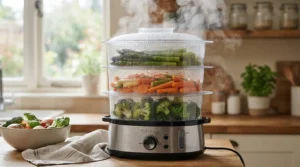
Based on the spec comparison, the genuine advantage of an electric multi-cooker is walking away and trusting a timer, which matters if you’re doing something else in the house entirely. The trade-off is price and kitchen counter space — most electric steamers with meaningful capacity sit above the £45 ceiling this guide is built around, whereas a stainless stacked steamer gives you nearly the same multi-dish capability for noticeably less money, provided you’re happy to keep half an eye on the hob.
Value Multi-Tier Cookware: Long-Term Cost & Maintenance
Thinking about value multi-tier cookware properly means looking past the sticker price to cost-per-use over years, not months. A £35 stainless steel stacked steamer used twice a week works out to under 35p per use across a single year, and that’s before accounting for a 15-25 year guarantee that several products on this list genuinely offer — divide the purchase price across that guarantee period and you’re looking at pennies per use for a tool that replaces up to three separate saucepans on your hob at once.
Maintenance costs are refreshingly low: no non-stick coating to eventually degrade and need replacing, no electrical components to fail, and stainless steel that’s fundamentally dishwasher-safe rather than requiring special cleaning products. The one genuine ongoing cost is water and hob energy, and even there, using one ring for three dishes rather than three separate rings for three separate pans is a real, measurable saving on your energy bill — not a marketing claim.
Compare that to buying three individual saucepans separately, which typically costs considerably more than a stacked steamer set covering the equivalent cooking capacity, while also demanding more storage space and more washing-up. The total cost of ownership case for a stacked steamer versus separate pans is genuinely one-sided in the steamer’s favour for anyone who steams regularly.
Common Mistakes When Buying a Stacked Steamer
Buying on diameter alone without checking tier depth. Two steamers can share the same 20cm diameter but have noticeably different tier depths, and a shallow tier limits how much food actually fits per layer regardless of the width.
Ignoring hob compatibility until after purchase. Induction hobs are increasingly common in UK kitchens, and not every stainless steamer base is induction-rated — always confirm this specifically rather than assuming stainless steel automatically works.
Choosing the cheapest option without checking gauge or grade. A saving of a few pounds on an unbranded steamer that fails within a year costs more over time than paying closer to the £40-£45 ceiling for something built to last, especially once you factor in guarantee length as a genuine value signal.
Overlooking handle design entirely. This is consistently one of the most common post-purchase regrets in aggregated buyer feedback across this category — bare metal handles that heat up are a daily frustration that’s completely avoidable by checking for silicone covering or a cool-touch design before buying.
Assuming all tiers cook at the same rate. New steamer owners frequently assume something is wrong with the product when the top tier lags behind the bottom, when it’s simply how steam physics works across multiple tiers — understanding this before buying sets the right expectations.
Safety, Regulations & Food Contact Standards
Anyone buying cookware in the UK benefits from a layer of regulatory protection that’s easy to overlook. Materials intended to touch food — including stainless steel cookware — fall under national food contact regulations enforced in England, Wales and Northern Ireland, and the Food Standards Agency is the UK body responsible for ensuring materials that come into contact with food don’t transfer harmful substances or unacceptably change its taste or composition.
In practical terms, this means legitimate stainless steel cookware sold through mainstream UK retailers has already cleared a baseline safety standard before it ever reaches a listing page. That said, a few sensible habits are worth adopting regardless: avoid using metal utensils that could scratch a steamer’s interior surface over time, since scratches can very slightly increase the risk of corrosion at that specific point, and always check a manufacturer’s maximum oven-safe temperature rather than assuming — most stainless steamers in this price band cap out around 200°C, which comfortably covers steaming but matters if you’re repurposing the base pan for oven use.
FAQ
❓ What is a stacked steamer used for?
❓ Is bamboo or stainless steel better for a stacked steamer?
❓ Can you use a stacked steamer on an induction hob?
❓ How much water do you put in a stacked steamer?
❓ Are stacked steamers dishwasher safe?
Conclusion
Stacked steamers under £45 genuinely punch above their price bracket, and the seven covered here prove it across every use case that matters: the Cooks Professional 3 Tier Stainless Steel Steamer for anyone who wants one dependable all-rounder, the Royal Cuisine 3 Tier Stainless Steel Steamer for feeding a proper family, and the KitchenCraft World of Flavours Bamboo Steamer for anyone chasing authentic dim sum texture on a genuine budget.
What ties all seven together is the same underlying honesty: steaming is simply a better way to cook most everyday food, and a well-chosen stacked steamer removes the last excuse for reaching for the boiling pan instead. Match the diameter to your household size, confirm your hob compatibility before you click buy, and don’t underestimate how much a comfortable handle and a proper guarantee tell you about long-term value. Whichever of these seven ends up on your hob, you’re getting a genuinely capable piece of kit for well under £45 — no compromise required.
✨ Don’t Miss These Exclusive Deals!
🔍 Take your kitchen to the next level with one of these carefully selected stacked steamers. Click on any highlighted product above to check current pricing and availability. These pans will help you get authentic, healthier family meals on the table with less fuss and less washing-up!
Recommended for You
- Best Stacked Steamer: 7 Top UK Picks for Multi-Dish Cooking (2026)
- Steamer Pots Under £40: 7 Best UK Picks (2026)
- 3-Piece Pan Sets UK: 7 Best Sets for 2026 (Every Budget)
Disclaimer: This article contains affiliate links. As an Amazon Associate, I earn from qualifying purchases. If you purchase products through these links, we may earn a small commission at no additional cost to you.
✨ Found this helpful? Share it with your friends! 💬🤗
