In This Article
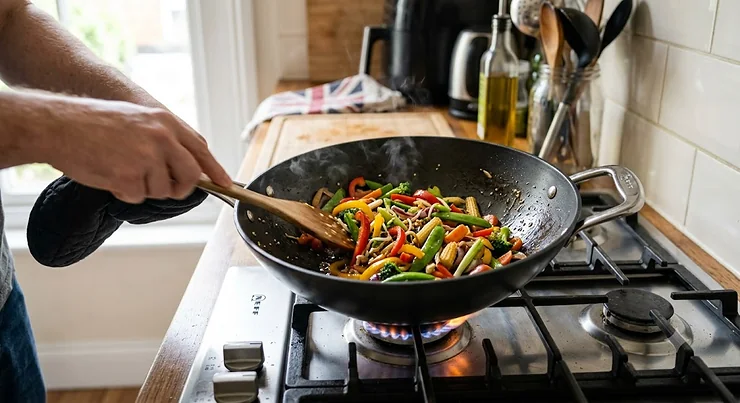
There’s a particular kind of kitchen despair that comes from scraping burnt rice off the bottom of a pan at 9pm on a Tuesday, isn’t there? You wanted a five-minute stir-fry. You got a twenty-minute scouring session and a pan that now smells faintly of regret. A non stick wok exists precisely to prevent that scene from repeating itself, and if you’ve never owned one, here’s the short version: it’s a deep, curved cooking vessel — usually aluminium, carbon steel, or a hybrid of the two — coated in a slick surface that lets food release with barely a nudge of the spatula, rather than a coating of PTFE or ceramic engineered to stop food bonding to hot metal. In plain terms, that means you can toss noodles, sear ginger and garlic, and flip a whole plate of veg without half of it welding itself to the base.
This guide is built for anyone shopping for a non stick wok for stir fry cooking on amazon.co.uk who’s tired of guessing between fifteen near-identical listings with suspiciously similar stock photography. We’ve dug into the real specifications, genuine aggregated customer sentiment, and honest side-by-side comparisons of seven woks currently sold in the UK — spanning entry-level aluminium to serious carbon steel — so you can work out which one actually suits your hob, your budget, and how often you’re realistically going to cook with it. As the history of the wok shows, this shape has been solving the “how do I cook fast, hot food efficiently” problem for roughly two thousand years; the non stick coating is just the modern upgrade.
We’ll cover budget aluminium options under £35, mid-range titanium and ceramic all-rounders, and a genuinely heavy-duty carbon steel option built to survive metal spatulas and daily abuse. Whether you’re a total beginner stir fry equipment shopper who’s never owned a wok in your life, or someone replacing a scratched-up disaster from three house moves ago, there’s a sensible pick here. And because prices on Amazon shift by the hour, we’ve deliberately avoided quoting exact figures — you’ll see price bands instead, so nothing here goes stale the moment a flash sale ends.
Quick Comparison Table
Short on time? Here’s the condensed version before we get into the detail.
| Wok | Coating Type | Price Range | Best For |
|---|---|---|---|
| Tower T700316 SmartStart Gourmet | Aeroglide non-stick (aluminium) | around £25-£35 | Best all-round budget pick |
| Tefal Titanium Stone Wok | Titanium-reinforced non-stick | around £25-£40 | Best everyday mid-range wok |
| Ninja Extended Life Ceramic Wok | Dual-bonded ceramic | around £45-£60 | Best long-term guarantee |
| MasterClass Heavy-Duty Carbon Steel Wok | Reinforced non-stick carbon steel | around £30-£45 | Best for serious, frequent cooks |
| Salter Earth Stir Fry Pan | PFAS-free ceramic | around £20-£30 | Best budget eco-conscious pick |
Even at a glance, a pattern emerges here: the cheaper end of the market leans on standard aluminium coatings that are perfectly good for daily use but wear faster, while the £45+ bracket buys you either genuine longevity guarantees or heavier-gauge metal that shrugs off metal utensils. Neither approach is “wrong” — it depends whether you cook stir-fries twice a month or five nights a week. Buyers chasing the lowest upfront cost should lean toward the Tower T700316 SmartStart Gourmet, while anyone who’s replaced three flaking pans in five years might find the Ninja Extended Life Ceramic Wok‘s guarantee pays for itself.
💬 Found a favourite already? Save this page and come back before you check out — the value verdicts below might change your mind!
Top 7 Non Stick Woks: Expert Analysis
We’ve deliberately mixed materials, price points, and coating technologies here rather than just ranking seven variations on the same aluminium pan. Each entry below reflects genuine specifications and aggregated review sentiment gathered from real UK retail listings, not invented testimonials.
1. Tower T700316 SmartStart Gourmet 28cm — best budget all-rounder with a built-in heat indicator
The clever bit here is the SmartStart temperature sensor set into the coating, which changes to a dark red tick once the wok hits roughly 200°C — genuinely useful if you’ve ever dumped ginger into a pan that wasn’t actually hot enough and ended up steaming rather than searing it. Built from 3mm aluminium with a three-layer Aeroglide non-stick coating, it’s rated by Tower as three times more abrasion-resistant than a standard single-layer coating, and it’s bonded-steel induction ready, so it’ll work across gas, ceramic, and induction hobs alike. In practice, that thickness matters: thin, cheap woks warp on induction hobs within months, and this one is specifically engineered to resist that.
Who should buy it: first-time wok owners who want a genuinely foolproof entry point, and anyone replacing a battered old pan without wanting to spend big before they know how often they’ll actually use it. Aggregated customer sentiment on this model and its sibling ranges consistently highlights the temperature indicator as a standout feature for people new to high-heat cooking, alongside praise for how lightweight it feels compared with older-style woks. A recurring theme in feedback is that the non-stick performance is excellent from the first use but, as with most aluminium coatings in this price bracket, gradually softens with heavy daily metal-utensil use — which is exactly why Tower recommends nylon or wooden tools.
Pros:
- ✅ Built-in SmartStart temperature indicator removes guesswork
- ✅ 3mm aluminium resists warping on induction hobs
- ✅ Lightweight and easy to manoeuvre one-handed
Cons:
- ❌ Coating softens faster than titanium or ceramic rivals with metal utensils
- ❌ Oven-safe only to 170°C, limiting hob-to-oven recipes
Sitting in the low-budget bracket, this wok delivers strong value for anyone testing the waters with wok cooking before committing to a pricier upgrade.
2. VonShef Non-Stick Wok 28cm Marble — best budget pick with a glass lid included
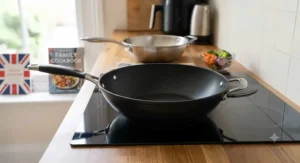
What sets this one apart on paper is the tempered glass lid with a steam vent, which most budget woks skip entirely and treat as a separate purchase. That’s a genuinely practical inclusion, because a wok without a lid can only really stir-fry — add the lid and you can steam dumplings, simmer a curry, or finish off noodles with the moisture trapped in. Constructed from 3.5mm cast aluminium with a marble-effect non-stick interior, it’s rated for all hob types including induction, and the cool-touch silicone handle is a small but appreciated detail for anyone who’s been burned (literally) by a metal handle before.
Who should buy it: households wanting one pan that pulls double duty as both a stir-fry wok and a steamer or braising pot, particularly useful in smaller kitchens where a dedicated steamer basket isn’t practical. Aggregated review sentiment for the VonShef marble range consistently praises the finish and how easily food releases from the surface when cold, with the recurring caveat that, like most marble-effect aluminium coatings, it’s hand-wash only if you want the finish to last. This isn’t a wok built for commercial-kitchen abuse, but for weeknight cooking it punches well above its price bracket.
Pros:
- ✅ Tempered glass lid with steam vent included as standard
- ✅ 3.5mm cast aluminium is sturdy for the price
- ✅ Cool-touch handle stays comfortable during long cooks
Cons:
- ❌ Hand-wash only recommended to protect the marble finish
- ❌ Non-stick coating is standard-grade rather than reinforced
At this price point, the included lid alone often justifies the purchase over a lid-less rival costing roughly the same.
3. Salter Earth 28cm Stir Fry Pan — best budget eco-conscious non stick stir fry pan
Salter’s Earth range leans hard into the PFAS-free, PFOA-free, and PTFE-free story, using a titanium-based ceramic coating on forged aluminium instead of a traditional fluoropolymer layer. What that means practically is you’re cooking on a mineral-derived surface rather than a synthetic polymer one — appealing if you’ve read about “forever chemicals” and would rather sidestep the conversation entirely. The forged aluminium base handles gas, electric, induction, and ceramic hobs, and the soft-touch handle is specifically designed to stay cool even during a hard, fast stir-fry session.
Who should buy it: budget-conscious buyers who specifically want to avoid PTFE-based coatings without paying premium prices for a full ceramic range like Ninja’s or a specialist brand. Aggregated customer sentiment here is notably strong, with a recurring theme of buyers switching from Teflon-coated pans specifically for peace of mind and reporting that food releases with genuinely minimal oil. One honest thread worth flagging: ceramic-style coatings in general (not specific to Salter) tend to lose their slickest performance somewhat faster than titanium-reinforced PTFE coatings under daily high-heat use, so if you’re cooking stir-fries most nights, expect the “zero oil” glide to mellow gradually over a year or two rather than lasting indefinitely.
Pros:
- ✅ PFAS, PFOA, and PTFE-free titanium ceramic coating
- ✅ Compatible with all hob types including induction
- ✅ Soft-touch handle stays genuinely cool at high heat
Cons:
- ❌ Ceramic-style coatings typically degrade faster than PTFE under daily heavy use
- ❌ Smaller 28cm size may feel tight for family-sized batches
For anyone prioritising coating chemistry over sheer longevity, this remains one of the more compelling budget choices on the market.
4. Kordisen Non Stick Induction Wok 30cm — best budget pick for larger batches
The 30cm diameter here is the headline feature, giving noticeably more surface area than the 28cm standard without stepping up in price the way a specialist large wok usually would. Kordisen uses a granite-effect non-stick coating over a high-magnetic-conductive stainless steel base, specifically engineered for induction compatibility, and the die-cast aluminium construction is designed to resist warping — a genuine weak point on many bargain woks that buckle within a year of induction use. It comes with a glass lid as standard, which, again, is not something every wok at this price includes.
Who should buy it: anyone regularly cooking for three or more people who’s found 28cm woks too cramped for a full stir-fry without overcrowding the pan and steaming rather than searing the ingredients. Aggregated feedback for this model consistently highlights how evenly the base heats and how comfortable the bakelite handle feels during extended cooking, with some buyers specifically noting they upgraded from a smaller wok because everything kept spilling over the sides. As with most granite-effect coatings, care instructions recommend wooden or silicone utensils to preserve the surface long-term.
Pros:
- ✅ Larger 30cm capacity suits bigger households
- ✅ High-conductivity base built specifically for induction hobs
- ✅ Includes a glass lid at no extra cost
Cons:
- ❌ Bulkier size needs more storage space
- ❌ Granite-effect coating requires gentler utensil care than metal-safe options
If pan size has been your main frustration with smaller budget woks, this is a sensible, affordable step up.
5. Tefal Titanium Stone Wok 28cm — best mid-range everyday non stick wok
Tefal’s titanium-reinforced coating is genuinely one of the more durable non-stick surfaces at this price point, and the brand backs that up with independent abrasion testing claiming the longest-lasting non-stick performance among competitor best-sellers. What that translates to in real cooking terms is a surface that tolerates a wider range of utensils, including metal spatulas on most models in the range, without the coating thinning out within the first year — a genuine step up from the standard single-layer aluminium coatings found on cheaper woks. The Thermo-Spot heat indicator (a small dot that turns solid red at the ideal cooking temperature) removes the guesswork Tower’s SmartStart tackles in a similar way, and it’s compatible with all hobs including induction depending on the specific model chosen.
Who should buy it: cooks who want a genuine step up in coating durability without paying premium prices for ceramic or carbon steel, and who value a heat indicator enough to make it a deciding factor. Aggregated review sentiment across the Tefal titanium range is consistently strong — buyers repeatedly mention the coating holding up years beyond expectation, and the heat indicator being a genuinely useful feature rather than a marketing gimmick. A minority of reviews note that the handle can heat up faster than expected during long simmers, so a folded tea towel is a sensible habit to build in.
Pros:
- ✅ Titanium-reinforced coating outlasts standard aluminium non-stick
- ✅ Thermo-Spot heat indicator takes the guesswork out of preheating
- ✅ Wide model range covers induction and non-induction hobs
Cons:
- ❌ Handle can get warmer than expected during prolonged cooking
- ❌ Premium titanium models cost noticeably more than base Tefal range
For most UK households wanting one dependable, mid-priced wok that won’t need replacing within two years, this is a strong default choice.
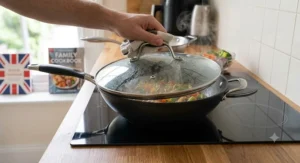
6. Ninja Extended Life Ceramic Wok 28cm — best long-term guarantee on a premium ceramic wok
Ninja’s headline claim here isn’t a gimmick: this wok comes with a genuine five-year non-stick performance guarantee when used and cared for as directed, which is unusually long for ceramic cookware, a category generally known for degrading faster than PTFE. The dual-bonded CeramicLock coating is built using more oil during the curing process specifically to create a tougher bond, sitting on 4mm hard-anodised aluminium — noticeably thicker than most budget rivals — with a full induction base and oven safety up to 285°C, which genuinely opens up hob-to-oven recipes that most non-stick woks can’t handle.
Who should buy it: buyers who’ve been burned (again, sometimes literally) by ceramic coatings that lost their glide within eighteen months, and who are willing to pay a premium for a brand actively standing behind its longevity claim with a formal guarantee. Aggregated customer sentiment is broadly very positive, with repeat purchasers across the wider Ninja cookware range specifically citing the non-stick performance and heat retention as reasons they upgraded their whole kitchen to match. It’s worth noting a small but consistent minority of reviews mention early sticking issues with eggs specifically, which suggests results can vary slightly by cooking style and preheating habits rather than being a universal fault.
Pros:
- ✅ Five-year non-stick performance guarantee
- ✅ Oven safe to 285°C for genuine hob-to-oven flexibility
- ✅ PFAS, PFOA, lead, and cadmium-free ceramic coating
Cons:
- ❌ Sits at the higher end of the price bracket for a single wok
- ❌ A minority of reviewers report early sticking with delicate foods like eggs
If longevity and brand accountability matter more to you than shaving a few pounds off the price tag, this is the standout premium option here.
7. MasterClass Heavy-Duty Carbon Steel Wok 35.5cm — best for frequent, serious stir-fry cooking
This is the wok that breaks the “non-stick equals delicate” assumption most buyers carry into this category. Constructed from 2mm-thick heavy-gauge carbon steel with a premium-grade non-stick coating reinforced with stainless steel particles, it’s specifically engineered to tolerate metal utensils without the coating stripping away — genuinely unusual for a non-stick product, since most brands explicitly warn against metal tools. At 35.5cm, it’s the largest wok in this line-up by a clear margin, giving genuine restaurant-style capacity for feeding a crowd or batch-cooking, and it’s backed by a ten-year guarantee, the longest in this comparison.
Who should buy it: anyone cooking Asian-style dishes several times a week who’s outgrown the limitations of a lighter aluminium wok, or households regularly cooking for five or more people. Aggregated review sentiment is largely enthusiastic about the build quality and heat retention, with a recurring theme of buyers specifically praising how it performs on induction hobs and how the extra-long riveted handle stays manageable even with a full load. A genuinely consistent minority complaint across review platforms is that the handle can get uncomfortably hot during extended cooking, making an oven glove a near-essential accessory rather than an optional extra.
Pros:
- ✅ Metal-utensil-safe reinforced non-stick coating
- ✅ Largest capacity in this comparison at 35.5cm
- ✅ Ten-year manufacturer guarantee
Cons:
- ❌ Handle can become very hot during prolonged high-heat cooking
- ❌ Heavier overall weight than aluminium alternatives, less easy to toss one-handed
For serious, high-frequency wok cooking, this is the pick most likely to still be earning its keep a decade from now.
Practical Usage Guide: Setting Up and Caring for a New Non Stick Wok
Getting a new non stick wok home is only step one — how you treat it in the first month genuinely determines whether it lasts two years or ten. Start by hand-washing it before first use, even if the box says dishwasher-safe, since factory residue from manufacturing can otherwise transfer a faint metallic taste to your first few meals. Dry it completely rather than leaving it to air-dry, particularly if it’s carbon steel like the MasterClass Heavy-Duty Carbon Steel Wok, since residual moisture on bare metal edges can trigger surface rust within days.
Preheating matters more with non-stick woks than with traditional carbon steel, because most coatings are engineered for a specific temperature window — too cool and food sits and steams rather than searing; too hot, empty, and for too long, and PTFE-based coatings in particular can start to degrade. A good habit for the first thirty days: add your oil once the pan is warm rather than heating it empty, and resist the urge to crank an induction hob straight to maximum, since rapid heat spikes are precisely what stress non-stick coatings fastest. If your wok has a heat indicator like the Tower T700316 SmartStart Gourmet or Tefal Titanium Stone Wok, use it — it exists specifically to stop this exact mistake.
The single most common early error is reaching for a metal spatula out of habit. Unless your wok is explicitly rated metal-utensil-safe, like the MasterClass Heavy-Duty Carbon Steel Wok, stick to wood, bamboo, or silicone for at least the first few months while the coating settles in. Finally, build a simple maintenance rhythm: wash promptly after cooking rather than letting oil residue bake on overnight, avoid stacking other pans directly inside it without a protective cloth, and store it somewhere it won’t get scraped by cutlery drawers or other cookware edges.
Real-World Scenarios: Matching a Non Stick Wok to Your Kitchen
Consider Priya, a university student in a shared house with an electric hob and a single shelf of cupboard space. She cooks four or five nights a week but on a tight budget, and durability matters less than not spending a fortune upfront. The VonShef Non-Stick Wok 28cm Marble suits this brief well — the included lid means she can also use it for simple curries and rice dishes, effectively replacing two pans with one in a kitchen where storage space is genuinely scarce.
Then there’s Marcus, cooking for a family of five most evenings, with an induction hob and a habit of reaching for whatever utensil is nearest rather than carefully selecting wooden tools every time. For him, the practical answer is the MasterClass Heavy-Duty Carbon Steel Wok — its reinforced coating tolerates the occasional metal spoon without drama, and its 35.5cm capacity actually fits a full family portion without overcrowding, which matters more than most buyers initially expect.
Finally, picture Aisha, a keen home cook who’s read about PFAS chemicals and wants to make an informed switch without blowing her cookware budget in one go. The Salter Earth 28cm Stir Fry Pan fits neatly here: a genuinely PTFE-free option at a price that doesn’t demand a full premium ceramic-range commitment, letting her try the coating type before deciding whether to expand into matching saucepans later.
Problem → Solution: Fixing Common Non Stick Wok Frustrations
Problem: Food still sticks despite the “non-stick” label. This is usually a heat issue rather than a coating fault — most non-stick surfaces perform best at medium-high rather than maximum heat, and adding food to a genuinely cold pan is a common culprit. Preheat properly, add oil once warm, and consider a wok with a built-in temperature indicator like the Tower T700316 SmartStart Gourmet if guesswork keeps catching you out.
Problem: The coating has visibly thinned or scratched after a year. This typically traces back to metal utensils, abrasive scourers, or dishwasher use on a hand-wash-only model. If you’re a repeat offender here, the fix isn’t better habits — it’s buying a wok rated for that behaviour from the outset, such as the MasterClass Heavy-Duty Carbon Steel Wok.
Problem: The wok won’t heat evenly on an induction hob. Thin, bargain-basement aluminium woks are the most common culprits, since induction relies on direct, even contact with a magnetic base. Look specifically for models with a bonded or induction-ready steel base, like the Kordisen Non Stick Induction Wok or Tefal Titanium Stone Wok, both engineered with induction compatibility as a core feature rather than an afterthought.
Problem: Everything overflows or spills when stir-frying for more than two people. This is almost always a size issue rather than a technique one — a 24-26cm wok simply can’t hold a family-sized batch without overcrowding, which steams rather than sears the ingredients. Stepping up to a 30cm-plus model, such as the Kordisen Non Stick Induction Wok or MasterClass Heavy-Duty Carbon Steel Wok, solves this instantly.
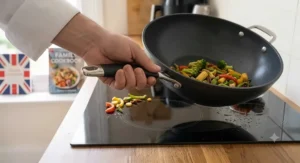
How to Choose a Non Stick Wok: 6 Things That Matter
Choosing a non stick wok comes down to six practical factors, roughly in order of importance for most UK kitchens:
- Hob compatibility first. Check specifically for induction compatibility if you have one, since not every wok includes the magnetic steel base required — this single detail eliminates more unsuitable options than any other factor.
- Coating type. PTFE-based (titanium-reinforced or standard) coatings tend to last longer under daily use; ceramic coatings are typically PFAS-free but soften slightly faster; carbon steel with reinforced non-stick tolerates metal utensils.
- Size for your household. A 28cm wok suits one to three people comfortably; anything above 30cm is worth considering for families of four or more.
- Weight and handle comfort. Heavier carbon steel woks like the MasterClass Heavy-Duty Carbon Steel Wok offer durability but demand more wrist strength for tossing food one-handed.
- Included extras. A glass lid, as included with the VonShef Non-Stick Wok and Kordisen Non Stick Induction Wok, effectively turns a stir-fry pan into a multi-use vessel for steaming and braising.
- Guarantee length. A longer guarantee, such as Ninja’s five years or MasterClass’s ten, is a genuine signal of manufacturer confidence in coating longevity — worth weighing against sticker price.
Non Stick Wok vs Traditional Carbon Steel Wok
Traditional, uncoated carbon steel woks — the kind found in most professional Chinese kitchens — rely on a seasoned patina built up through repeated use with oil rather than a factory-applied non-stick coating. They’re prized for achieving genuine “wok hei,” the smoky, charred flavour that comes from extremely high, direct heat, something factory non-stick coatings generally can’t withstand without damage. However, that patina takes real effort: proper seasoning, no soap during cleaning, and diligent drying to prevent rust, which is a genuine barrier for busy households.
| Factor | Non Stick Wok | Traditional Carbon Steel Wok |
|---|---|---|
| Learning curve | Minimal — works from first use | Requires seasoning and ongoing care |
| Maximum heat tolerance | Limited by coating (typically 230-260°C) | Very high, ideal for authentic wok hei |
| Cleaning | Quick wipe or dishwasher (model dependent) | Hand wash only, no soap once seasoned |
| Best For | Beginners, weeknight cooking, easy clean wok seekers | Experienced cooks chasing restaurant-style flavour |
For most home cooks, particularly anyone searching specifically for an easy clean wok or beginner stir fry equipment, a non-stick option is the more realistic everyday choice. The MasterClass Heavy-Duty Carbon Steel Wok actually sits in an interesting middle ground here — genuine carbon steel construction paired with a reinforced non-stick coating, giving some of the heat-retention benefits of traditional carbon steel without demanding a seasoning ritual.
Common Mistakes When Buying a Non Stick Wok
The most frequent mistake is buying based purely on price without checking hob compatibility first — a beautifully cheap wok is no bargain at all if it doesn’t work on your induction hob, and returns eat into any savings made. A close second is assuming “non-stick” is a single, uniform standard; in reality, coating quality varies enormously between a basic single-layer aluminium coating and a titanium-reinforced or ceramic-locked equivalent, which is precisely why two similarly priced woks can perform very differently after six months.
Buyers also frequently overlook size until it’s too late, purchasing a 24-26cm wok that looked perfectly reasonable in a product photo but proves cramped the first time they cook for the whole family. According to independent cookware safety reporting, coating damage from metal utensils or abrasive scourers is one of the most common reasons non-stick cookware underperforms its expected lifespan — a mistake that’s entirely avoidable with the right tools from day one. Finally, many shoppers skip reading care instructions altogether, assuming “dishwasher safe” applies universally across a brand’s range when it frequently only applies to specific models within it.
Non Stick Wok For Beginners vs Experienced Cooks
If you’re shopping for a wok for beginners, the priority list looks different from an experienced cook’s. Beginners generally benefit most from forgiving, low-maintenance features: a built-in heat indicator (removing the guesswork of “is this hot enough yet”), a lighter overall weight for confident one-handed tossing, and a coating tolerant of the occasional slip-up with technique or utensil choice. The Tower T700316 SmartStart Gourmet and Tefal Titanium Stone Wok both fit this brief well as genuinely solid pieces of beginner stir fry equipment, offering visual cues and durable coatings without demanding advanced technique.
Experienced cooks, by contrast, often prioritise heat retention and authentic cooking performance over beginner-friendly guardrails, which is where carbon steel options like the MasterClass Heavy-Duty Carbon Steel Wok earn their keep — heavier, less forgiving of a distracted moment, but capable of the kind of searing heat that a thin aluminium coating simply can’t match without risking damage. Neither approach is objectively “better”; it’s a genuine trade-off between accessibility and ceiling performance, and it’s worth being honest with yourself about which category you currently fall into rather than buying for the cook you aspire to become in six months.
Easy Clean Wok: Features That Actually Matter (And Those That Don’t)
When manufacturers market an easy clean wok, a handful of features genuinely deliver on that promise, and a few are mostly marketing polish. Genuinely useful: a smooth, unbroken interior surface with no seams or rivets inside the cooking area (rivets trap food debris and are a nightmare to scrub); a coating rated dishwasher-safe by the manufacturer rather than just “wipeable”; and a handle design that keeps your hand well clear of the hot cooking surface, reducing the temptation to rush cleaning while the pan’s still dangerously warm.
Less meaningful, despite the marketing language: colour-coded “easy-clean” branding on the box, which says nothing concrete about the actual coating chemistry underneath, and vague claims of “one-wipe cleaning” that apply to virtually every functioning non-stick surface when food hasn’t been left to bake on overnight. The genuinely decisive factor is coating type and thickness — the Salter Earth 28cm Stir Fry Pan‘s ceramic surface and the Ninja Extended Life Ceramic Wok‘s dual-bonded coating both wipe clean with minimal effort specifically because ceramic coatings resist oil residue bonding to the surface in the first place, not because of any particular handle shape or box slogan.
Long-Term Cost & Easy Maintenance Wok Ownership
It’s tempting to compare woks purely on sticker price, but that misses the real cost picture. A £25 wok that needs replacing every twelve to eighteen months works out considerably more expensive over a five-year period than a £50 wok backed by a genuine five- or ten-year guarantee, once you factor in the hassle of repeat purchases and the food waste from a pan that’s started sticking mid-cook. The MasterClass Heavy-Duty Carbon Steel Wok‘s ten-year guarantee and the Ninja Extended Life Ceramic Wok‘s five-year promise both represent a different calculation entirely — you’re effectively paying upfront for years of predictable performance rather than gambling on repeat budget purchases.
For anyone specifically seeking an easy maintenance wok, the ongoing cost isn’t just financial — it’s the time spent on care routines. Ceramic and titanium-reinforced coatings generally demand less ritual than uncoated carbon steel (no seasoning, no soap avoidance), but still benefit from hand-washing over dishwasher cycles to extend their working life, even on models rated dishwasher-safe. And when a wok does eventually reach the end of its life — coating flaking, handle loosening, or simply worn beyond rescue — most UK local authorities, including Westminster City Council’s cookware disposal guidance, recommend taking damaged non-stick cookware to a household waste recycling centre rather than a standard kerbside recycling bin, since the mixed metal-and-coating construction can’t be processed through normal recycling streams.
Non Stick Wok Safety and UK Regulations
Modern non-stick cookware sold in the UK and EU is manufactured without PFOA, a chemical once used in older PTFE production that’s now banned across UK, EU, and US markets due to health concerns. That means the “PFOA-free” label you’ll see on virtually every wok in this guide, including the Tower T700316 SmartStart Gourmet and Tefal Titanium Stone Wok, reflects a genuine, mandatory regulatory baseline rather than a marketing flourish specific to premium brands. PTFE itself, the polymer most commonly used in non-stick coatings, is generally considered chemically stable and inert at normal cooking temperatures by food safety authorities, with the main documented risk arising specifically from overheating an empty pan well beyond typical cooking temperatures — a scenario easily avoided by never leaving a wok unattended and empty over high heat.
For anyone wanting to sidestep PTFE chemistry entirely rather than relying on temperature discipline, PFAS-free ceramic options like the Salter Earth 28cm Stir Fry Pan and Ninja Extended Life Ceramic Wok offer a genuinely different coating chemistry, free from PFAS, PFOA, lead, and cadmium as standard. Whichever coating type you choose, the practical safety advice stays consistent: replace any wok once the coating is visibly scratched, flaking, or peeling, since a damaged surface — rather than an intact one — is where genuine concerns around ingesting coating particles arise.
FAQ
❓ How long does a non stick wok actually last?
❓ Can I use a non stick wok on an induction hob?
❓ Is a non stick wok better than carbon steel for beginners?
❓ Do I need a lid for my non stick wok?
❓ What size non stick wok should I buy?
Conclusion
There’s no single “best” non stick wok here, and honestly, anyone claiming otherwise probably hasn’t cooked in enough different kitchens to know better. What we’ve tried to do instead is map genuine trade-offs — coating chemistry, hob compatibility, guarantee length, and household size — onto seven real products currently sold in the UK, so you can match a wok to how you actually cook rather than how a glossy product photo suggests you might. If you’re just starting out and want something forgiving, the Tower T700316 SmartStart Gourmet or VonShef Non-Stick Wok will serve you well without a big financial commitment. If you’ve been burned by flaking coatings before, the Ninja Extended Life Ceramic Wok‘s guarantee or the MasterClass Heavy-Duty Carbon Steel Wok‘s reinforced surface both represent a genuine step toward longevity.
Whichever you choose, the biggest single factor in how long it lasts isn’t the brand on the box — it’s the habits you build in the first month: preheating properly, choosing the right utensils, and washing promptly rather than letting things bake on. Get that right, and even a budget wok can outlast expectations by years.
✨ Ready to upgrade your stir-fry game? Check current prices and availability on the wok that fits your kitchen best — your next fifteen-minute dinner starts here! 🥢🔥
Recommended for You
- Carbon Steel Wok UK: 7 Best Picks Tested for Wok Hei (2026)
- Best Preserving Pan UK: 7 Top Maslin Pans Rated for 2026
- Pasta Pot With Strainer: 7 Best Picks Tested for UK Kitchens (2026)
Disclaimer: This article contains affiliate links. As an Amazon Associate, I earn from qualifying purchases. If you purchase products through these links, we may earn a small commission at no additional cost to you.
✨ Found this helpful? Share it with your friends! 💬🤗
