
In This Article
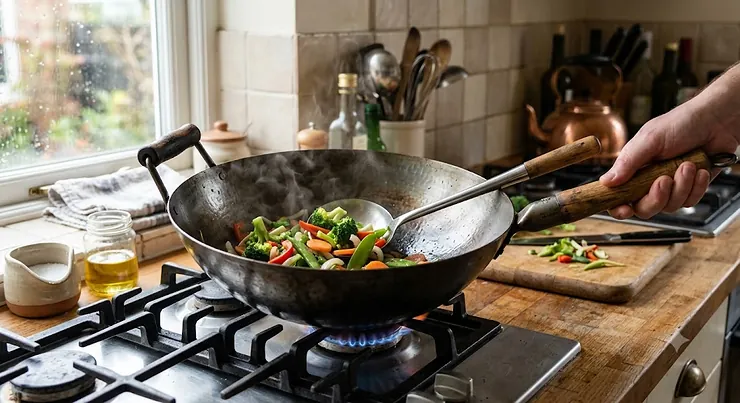
There’s a particular kind of kitchen heartbreak that comes from watching a limp, greasy stir-fry steam itself into submission in a cheap non-stick pan. No sizzle. No char. No fight. If you’ve ever eaten proper Cantonese-style fried rice at a takeaway and wondered why yours never tastes the same, the answer is usually sitting on the hob, not in the recipe. It’s the pan.

A carbon steel wok is a thin, hammered or spun sheet of steel alloy formed into a deep, sloped bowl shape, designed to heat almost instantly and cool down just as fast. Unlike cast iron, it’s light enough to toss one-handed, and unlike non-stick coatings, it can be driven to genuinely high heat without breaking down. That combination is precisely what lets home cooks chase the elusive “wok hei” flavour that restaurant kitchens produce almost by accident.
This guide is built for British kitchens specifically, because that context matters more than most buying guides let on. A wok built for a raging gas ring in Guangzhou doesn’t automatically behave itself on a flat induction hob in Leeds. So below you’ll find seven real, currently available options pulled from amazon.co.uk, spanning proper budget starter woks through to hand-hammered traditional pieces, alongside honest analysis of specs, aggregated review sentiment, and the practical stuff — seasoning, hob compatibility, round versus flat bases — that actually determines whether you’ll love the thing or shove it in a cupboard after three uses. Whether you’re shopping on gas, induction, or a fussy ceramic hob, there’s a route through here that suits your setup.
Quick Comparison Table
Before the deep dive, here’s the shortcut version for anyone who wants to skim and buy. This snapshot covers base shape, hob compatibility, and who each wok genuinely suits — because “best” always depends on your stove, your storage space, and how much faffing about you’re willing to do before your first stir-fry.
| Wok | Base & Hob Fit | Price Range | Best For |
|---|---|---|---|
| Yosukata 34cm Blue Carbon Steel Wok | Flat bottom; gas, induction, electric | £45-£60 range | All-round induction and gas performer |
| Craft Wok Hand Hammered 14″ Round Bottom | Round bottom; gas/wok ring only | £55-£75 range | Purists chasing authentic wok hei |
| Ken Hom Carbon Steel Wok 32cm Excellence | Flat bottom; induction, gas, electric | £35-£50 range | UK cooks who want a trusted household name |
| Souped Up Recipes Carbon Steel Wok | Flat bottom; gas, induction, electric | £40-£55 range | First-time wok owners who want hand-holding |
| Kordisen 32cm Carbon Steel Wok with Lid | Flat bottom; induction, gas, electric | £35-£45 range | Family cooking with a lid included |
| Jobin 32cm Wok with Lid | Flat bottom; induction, gas, electric | £35-£45 range | Budget buyers who still want a lid and spout |
| Amazon Basics Carbon Steel Wok 32cm | Flat bottom; all cooktops | Under £30 | Cheapest genuine carbon steel entry point |
Looking across the table, the split isn’t really about quality tiers so much as intent. The Craft Wok is the outlier here because its round base rules out flat induction and electric hobs entirely, so it only belongs in gas households or ones with an outdoor burner. Everything else is flat-bottomed and induction-friendly, which is honestly the more sensible default for most UK kitchens. If price is your main filter, the Amazon Basics Carbon Steel Wok and Kordisen 32cm Carbon Steel Wok with Lid sit at the accessible end, while the Craft Wok and Yosukata 34cm Blue Carbon Steel Wok justify their higher price with thicker gauge steel and better heat retention.
💬 Found a favourite already? Scroll down for the full breakdown, or jump straight to checking current pricing and availability on Amazon.
Top 7 Carbon Steel Woks: Expert Analysis
Reaching for a wok on amazon.co.uk can feel like wading through identical-looking black pans with wildly different construction quality hiding underneath. The seven below were chosen to cover the full spread: hand-hammered traditionalists, pressed-steel value picks, a famous British chef’s own range, and a couple of genuinely good starter kits for anyone who’s never seasoned a pan in their life.
1. Yosukata 34cm Blue Carbon Steel Wok — best all-rounder for induction and gas hobs
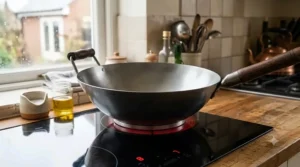
The standout here is versatility: this is one of the few carbon steel woks that genuinely performs on a British-style induction hob without you needing a wok ring or a prayer. Built from 1.5mm (16-gauge) steel with a flattened base, it strikes a sensible middle ground between the paper-thin responsiveness professional chefs love and the thicker gauge that home cooks need for forgiving, even heating.
At 1.5mm, the steel heats quickly enough for a proper sear but holds enough thermal mass that it won’t scorch garlic the instant it hits the surface — a common complaint with ultra-thin traditional woks in inexperienced hands. The New Zealand beech handle stays notably cooler than the steel helper handles found on some rivals, which matters when you’re tossing food one-handed over a screaming-hot ring. Based on the spec comparison with other flat-bottomed 34cm options, this model’s factory pre-seasoning at high temperature gives it a genuine head start, though it still benefits from a home seasoning pass before first use.
Reviewers consistently report that the flat base sits stable on induction without wobbling, and several mention the handle staying cool even during extended stir-frying sessions. A recurring theme in aggregated feedback is confusion over how “pre-seasoned” the factory finish actually is, with some buyers expecting a fully non-stick surface out of the box rather than a starting point that improves with use.
Pros:
- ✅ Flat base genuinely stable on induction and electric hobs
- ✅ 1.5mm gauge balances responsiveness with forgiving heat retention
- ✅ Cool-touch beech handle for safer one-handed tossing
Cons:
- ❌ Pre-seasoning is a starting point, not a finished non-stick surface
- ❌ Heavier than ultra-thin traditional Cantonese woks
At around £45-£60, this sits in the mid-range bracket, and for buyers without a gas hob it’s arguably the safest first purchase in this entire list — you’re paying for hob compatibility as much as steel quality.
2. Craft Wok Hand Hammered 14″ Round Bottom — most authentic for gas hobs and wok hei
The standout feature is the hand-hammering process itself: each wok is beaten into shape by craftspeople in Guangzhou rather than pressed by machine, which produces a slightly uneven, dimpled surface that many traditionalists insist heats and seasons better than a perfectly smooth pressed pan.
At 1.8mm (15-gauge), this is noticeably thicker and heavier than the flat-bottomed options here, weighing around 2.1kg without the lid it doesn’t come with. That thickness matters for durability but also means it takes real heat and real technique to get moving — this is not a wok for someone hoping to fry an egg gently on a low setting. The classic curved bottom is designed to sit inside a wok ring or directly over an open gas flame, concentrating heat at the centre exactly the way stir-fry technique assumes it will.
What most buyers overlook about round-bottom woks like this one is that they are simply incompatible with flat electric or induction hobs — not inconvenient, but genuinely unusable, since there’s no stable contact point for heat transfer. Aggregated reviews are largely positive on build quality and authenticity, with several buyers noting the surface develops a proper non-stick patina faster than expected once seasoned correctly. A recurring complaint in user reviews concerns the wooden handle loosening after a few weeks as the wood dries out, a known issue with humidity-sensitive handle fittings that’s usually fixable by re-tightening the screws.
Pros:
- ✅ Thick 1.8mm hand-hammered steel built for serious longevity
- ✅ Curved base ideal for authentic wok hei on gas
- ✅ Steel helper handle doubles as a hanging hook for storage
Cons:
- ❌ Completely unsuitable for flat induction or electric hobs
- ❌ Wooden handle can loosen and needs occasional retightening
Priced around £55-£75, this is the premium pick on the list, and the value case only stacks up if your hob is gas or you own a dedicated wok burner.
3. Ken Hom Carbon Steel Wok 32cm Excellence — best-known British name in wok cooking
The standout advantage is brand trust: Ken Hom popularised wok cooking on British television decades ago, and this range is designed specifically with UK kitchens and UK hob types in mind, rather than being a generic import with English text bolted on.
The 32cm diameter sits comfortably between compact and family-sized, with a flat base engineered for induction compatibility alongside gas and electric. Based on the spec comparison with other mid-range flat-bottomed woks, the beech handle and metal-tool-safe surface are sensible, practical choices rather than flashy marketing additions — you can use a metal spatula without immediately scarring the seasoning, which is a genuine convenience for anyone used to cooking with steel utensils. What the spec sheet won’t tell you, but reviewer patterns suggest, is that the “natural patina non-stick” claim requires the same seasoning discipline as any other bare carbon steel pan; it isn’t pre-treated to skip that step entirely.
Reviewers consistently note the recognisable branding gives buyers confidence, particularly first-timers who feel reassured cooking with a name they’ve seen on television rather than an unfamiliar import brand. A common theme in feedback is that the handle, while ergonomic, runs slightly shorter than expected for tossing technique, which taller cooks in particular have flagged as a minor adjustment period.
Pros:
- ✅ Trusted, recognisable British cookery brand
- ✅ Metal-tool-safe surface for spatula and wok ladle use
- ✅ Genuinely induction-compatible flat base
Cons:
- ❌ Handle length slightly shorter than some rival woks
- ❌ Requires full home seasoning despite “non-stick” branding
At roughly £35-£50, this is solid mid-range value, particularly for cooks who want the reassurance of a household name without paying hand-hammered premium prices.
4. Souped Up Recipes Carbon Steel Wok — best for total beginners
The standout feature is hand-holding: this wok arrives with a lid, spatula, and an accompanying video guide, addressing the single biggest barrier to carbon steel ownership — not knowing what on earth to do with it once it’s out of the box.
Specs-wise it’s a fairly standard flat-bottomed carbon steel pan compatible with electric, induction, and gas hobs, so the steel itself isn’t doing anything unusual. What differentiates it is the ecosystem around the pan: a linked video walkthrough removes the guesswork from the initial seasoning method, which is precisely where most first-time buyers give up and quietly relegate an unseasoned wok to the back of a cupboard. For beginners specifically, that structured onboarding is worth more than a marginally thicker gauge of steel would be.
This model carries an unusually large volume of aggregated customer ratings compared with rivals on this list, and the consistent thread in reviews is that new cooks found the seasoning process far less intimidating than expected once they followed the included guide. A recurring criticism is that the accompanying spatula, while a nice inclusion, is thinner and less durable than a dedicated wok spatula purchased separately.
Pros:
- ✅ Video guide removes the guesswork from first seasoning
- ✅ Lid and spatula included as a complete starter kit
- ✅ Large volume of aggregated positive buyer feedback
Cons:
- ❌ Included spatula is flimsier than a standalone tool
- ❌ Steel gauge is unremarkable compared with premium picks
Priced around £40-£55, the value here is in the education, not the metallurgy — genuinely useful if you’ve never owned carbon steel cookware before.
5. Kordisen 32cm Carbon Steel Wok with Lid — best budget lidded wok for families
The standout feature is the nitrogen-treatment process, which the manufacturer uses instead of a chemical coating to create a naturally smoother surface straight out of the box, paired with a lid that most budget woks skip entirely.
At 32cm diameter and 9.5cm depth, this is sized comfortably for cooking three to six portions, which suits most UK households better than the oversized 36cm-plus woks aimed at commercial kitchens. The flat base is built for induction, gas, and electric compatibility, and the included lid is a genuinely practical addition for anyone who wants to steam vegetables or keep a finished stir-fry warm while plating up rice — something none of the pure hand-hammered traditional woks in this guide offer. Reviewers consistently note that the wok heats quickly and holds temperature well once hot, which lines up with what you’d expect from thinner-gauge carbon steel construction.
A common theme in aggregated feedback is genuine surprise at how well the “naturally non-stick” nitrogen treatment performs before any home seasoning has even taken place, though most experienced cooks still recommend a proper seasoning pass for long-term durability. Some buyers flagged that the lid’s glass panel, while handy for monitoring food without lifting it, adds a moderate amount of extra weight to store.
Pros:
- ✅ Nitrogen-treated surface performs well even before seasoning
- ✅ Lid included, unusual at this price point
- ✅ Family-friendly 32cm capacity for 3-6 portions
Cons:
- ❌ Thinner gauge steel than premium hand-hammered options
- ❌ Glass lid adds noticeable extra weight and storage bulk
At around £35-£45, this is genuinely good value for a lidded wok, and the family-sized capacity makes it a sensible everyday pick rather than an occasional-use novelty.
6. Jobin 32cm Wok with Lid — best budget value with pouring spout
The standout feature is the pouring spout built into the rim, a small design touch that makes decanting sauces or draining oil considerably less messy than wrestling a full wok over the sink, which is a problem every carbon steel owner eventually encounters.
Weighing around 2.3kg complete with lid, this sits in the middle of the weight range for 32cm woks — heavy enough to hold heat steadily but not so dense it becomes a wrist workout during a long tossing session. The textured, slightly ridged interior surface is designed to increase contact between food and metal, which the manufacturer claims speeds even cooking, and this is grounded in real materials science: more surface contact does genuinely improve heat transfer efficiency, even if the effect is modest rather than transformative. It’s compatible across electric, induction, gas, and ceramic hobs, covering essentially every UK kitchen setup without exception.
Aggregated review sentiment is broadly positive on the “no chemical coating” claim, with buyers appreciating that the wok relies on genuine carbon steel seasoning rather than a synthetic non-stick layer that will eventually flake. A recurring theme in feedback is that first-time buyers unfamiliar with carbon steel occasionally mistake the initial matte, uneven colouring after seasoning for a manufacturing fault, when it’s actually the expected and desirable patina forming.
Pros:
- ✅ Pouring spout genuinely useful for sauces and draining oil
- ✅ No chemical coating — pure carbon steel seasoning
- ✅ Broad hob compatibility including ceramic
Cons:
- ❌ Textured interior can complicate reaching full even seasoning coverage
- ❌ Handle is functional but unremarkable compared with wooden alternatives
Sitting around £35-£45, this competes directly with the Kordisen 32cm Carbon Steel Wok with Lid on price, with the spout as its main point of differentiation.
7. Amazon Basics Carbon Steel Wok 32cm — cheapest reliable entry point
The standout feature is simply the price-to-authenticity ratio: this is a genuine pre-seasoned carbon steel wok, not a non-stick imitation dressed up in similar branding, sold at a price point that removes almost all financial risk from trying wok cooking for the first time.
Built with an acacia wood handle and marketed as compatible with all cooktop types, the 32cm flat-bottomed design covers the same basic specification territory as several pricier rivals on this list, without any of the extras — no lid, no spatula, no video guide. Here’s what to weigh: buying own-brand cookware from a retailer the size of Amazon carries less individual craftsmanship story than the Craft Wok, but it also carries fewer quality-control surprises than an unfamiliar third-party import brand, since Amazon applies its own baseline manufacturing standards to Basics-line products.
Because this is a relatively new listing compared with long-established competitors, the aggregated review volume is smaller and the sentiment data less mature; what’s verifiable is the specification sheet — pre-seasoned finish, acacia handle, all-hob compatibility — rather than years of accumulated user testimony. Early feedback trends toward satisfaction with the straightforward, no-frills approach, though buyers should treat this as an honest entry-level pick rather than an heirloom purchase.
Pros:
- ✅ Lowest price point of any genuine carbon steel wok here
- ✅ Pre-seasoned finish reduces first-use effort
- ✅ Backed by Amazon’s own manufacturing standards
Cons:
- ❌ No lid, spatula, or guide included
- ❌ Smaller pool of long-term verified reviews so far
At under £30, this is the obvious pick for anyone who wants to test whether they’ll actually use a wok before committing to a pricier option.
Seasoning a Carbon Steel Wok: Your First-Use and Maintenance Guide
Seasoning a carbon steel wok intimidates more people out of buying one than the price tag ever does, which is a shame, because the carbon steel seasoning method is genuinely more forgiving than most first-timers assume. The process builds a layer of polymerised oil — essentially oil that’s been heated past its smoke point and chemically bonded to the metal — creating a natural, chemical-free non-stick surface that actually improves with every use rather than degrading like a synthetic coating.
Start by washing off the factory protective coating with hot, soapy water and a scouring pad; this is the one time you’re allowed to use detergent on the wok, because you’re removing rust-prevention oil, not seasoning. Dry it completely, then place it on your highest heat setting until it changes colour — you’ll see wisps of smoke and a gradual shift from silvery-grey toward a mottled blue-black. That colour change is the metal’s oxide layer forming, and it’s meant to look uneven, even patchy, rather than uniformly glossy.
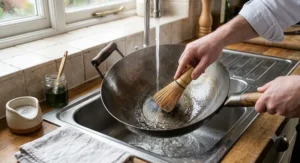
Once the whole interior has changed colour, remove the wok from heat, let it cool slightly, then wipe a thin layer of high smoke-point oil — rapeseed, groundnut, or sunflower all work well in a British kitchen — across the entire cooking surface with a paper towel. Return it to high heat until the oil begins to smoke, then tilt and rotate the pan so every surface gets exposed to that smoking point. Repeat this oiling-and-heating cycle two or three times for a genuinely durable first seasoning layer. Afterwards, avoid soap for daily cleaning; hot water and a soft sponge or bamboo brush is sufficient, and drying the wok over heat immediately after washing prevents rust from ever taking hold.
✨ Ready to put the technique into practice? Check current availability on any of the seven woks above and start building your patina this week.
Common Wok Problems and How to Fix Them
Even a well-chosen carbon steel wok throws up a handful of predictable frustrations in its first month, and knowing the fix in advance saves a lot of unnecessary panic-buying of replacement cookware.
Food sticking despite seasoning. This almost always means either the wok wasn’t hot enough before food went in, or too much food was added at once, dropping the surface temperature. Heat the empty wok until it’s genuinely smoking before adding oil, and cook in smaller batches than you’d use in a non-stick pan.
Rust spots appearing after storage. Carbon steel’s biggest enemy is trapped moisture. Always dry the wok over heat for thirty seconds after washing, then wipe a few drops of oil across the surface before storing. If rust does appear, it’s rarely fatal — scrub the affected area with a scouring pad, re-oil, and reheat as though re-seasoning that section.
Uneven, patchy colouring after seasoning. This is cosmetic, not a fault. Genuine carbon steel patina builds unevenly at first, often darker near the handle end where heat concentrates. Continued cooking evens it out over weeks, not days.
Wobbling on an induction hob. This usually means a round-bottomed wok has been paired with a flat hob, or a warped flat-bottomed wok is being used. Check base compatibility before buying, and for flat hobs, stick strictly to genuinely flat-bottomed models like the Yosukata 34cm Blue Carbon Steel Wok or Ken Hom Carbon Steel Wok 32cm Excellence.
Loose wooden handles. A known issue with models like the Craft Wok Hand Hammered 14″ Round Bottom, caused by wood naturally drying and shrinking. Remove the retaining screws, twist the handle slightly to reposition it snugly in its metal sleeve, and re-tighten.

How to Choose a Carbon Steel Wok
Cutting through marketing claims to what actually matters takes a handful of genuinely important criteria, most of which have nothing to do with brand prestige.
- Check your hob type first. Induction and flat electric hobs need a genuinely flat base; gas hobs work with either flat or round bases, ideally paired with a wok ring for round-bottomed models.
- Prioritise steel gauge over brand name. Anything between 1.2mm and 1.8mm is workable, with thinner gauges heating faster but scorching more easily, and thicker gauges being more forgiving but slower to respond.
- Decide whether you want pre-seasoning or a blank canvas. Pre-seasoned woks save initial effort but still benefit from a home seasoning pass; unseasoned woks give more control over the final patina.
- Think about size relative to your hob’s output. A 34-36cm wok looks impressive but needs serious BTU output to heat evenly; most UK domestic hobs suit 30-32cm better.
- Consider whether a lid earns its keep. If you’ll use the wok for steaming or keeping food warm, a lidded model like the Kordisen 32cm Carbon Steel Wok with Lid pays for itself quickly.
- Factor in handle material and length. Wooden handles stay cooler but can loosen over time; steel handles are more durable but need a cloth or glove at high heat.
- Read aggregated review patterns, not star averages alone. A 4.3-star rating with consistent praise for heat distribution tells you more than a 4.8-star rating with vague, generic five-word reviews.
Carbon Steel Wok vs Cast Iron Wok
The carbon steel vs cast iron wok debate comes down almost entirely to weight and responsiveness, because both materials season similarly and both develop a genuine non-stick patina over time. Carbon steel typically weighs roughly half what an equivalent cast iron wok does, which matters enormously for stir-fry technique specifically, since the tossing and flipping that builds wok hei simply isn’t practical with a heavy cast iron pan full of vegetables.
Where cast iron pulls ahead is heat retention and stability for slower techniques — deep-frying, braising, or maintaining a steady oil temperature for tempura benefits from cast iron’s thermal mass, which resists sudden temperature drops when cold ingredients are added. Carbon steel, by contrast, responds almost instantly to changes in burner heat, which is exactly what fast, high-heat stir-frying demands but makes it slightly less forgiving for beginners still learning to read visual cues for temperature.
For most UK home cooks prioritising genuine stir-fry results over slow-cooked dishes, carbon steel is the more practical choice, and every product in this guide reflects that reality. If your cooking leans toward long braises or deep-frying more than quick tosses, a cast iron alternative might suit your patterns better, though you’d sacrifice some of the manoeuvrability that makes wok cooking distinctive in the first place.
Wok for Gas Hob vs Induction and Electric Hobs
Finding a wok for gas hob use is genuinely the easier problem to solve, because gas flame wraps around a curved base naturally, replicating the concentrated central heat that traditional round-bottomed woks were designed for centuries before induction technology existed. Round-bottomed models like the Craft Wok Hand Hammered 14″ Round Bottom are built specifically for this setup, ideally with a wok ring to stabilise the pan when it’s not actively being tossed.
Induction and flat electric hobs are a different story entirely, and this is where buyers most commonly go wrong. A round-bottomed wok simply cannot make sufficient contact with a flat heating element, leaving most of the pan cold while a small central point overheats. What you need instead is a genuinely flat-bottomed, magnetic carbon steel wok — carbon steel is naturally ferromagnetic, so material compatibility isn’t usually the issue, but base geometry is. Models like the Yosukata 34cm Blue Carbon Steel Wok, Ken Hom Carbon Steel Wok 32cm Excellence, and Kordisen 32cm Carbon Steel Wok with Lid are all built with this flattened design specifically to solve that problem.
Which?, the UK’s independent consumer body, notes that some induction hobs now include a dedicated wok-shaped indentation that a round-bottomed pan can sit inside, effectively bridging the gap between traditional and modern cooking setups — worth checking for if you’re hob-shopping alongside your wok. Absent that feature, flat-bottomed carbon steel remains the sensible default for the vast majority of British kitchens.
Round vs Flat Bottom Wok: Which Base Suits Your Kitchen?
The round vs flat bottom wok question sounds like a minor style choice but is actually the single most consequential decision in this entire buying process, because it determines whether a wok works on your hob at all.
Round-bottomed woks, the traditional Chinese design referenced throughout culinary history, concentrate heat at a single curved point, which lets ingredients slide naturally toward the centre during tossing and produces the most authentic stir-fry motion. The trade-off is stability: without a wok ring or a gas burner shaped to cradle the curve, a round-bottomed wok simply won’t sit still, let alone heat evenly.
Flat-bottomed woks are a compromise born of necessity, adapted for Western and increasingly Asian domestic kitchens where flat-surface hobs dominate. The flattened section sacrifices some of the pure heat concentration of a true curve but gains genuine stability across gas, electric, and induction hobs alike. For anyone without a dedicated gas wok burner, this compromise is the more sensible practical choice, even among cooks who’d prefer the purist round-bottomed experience in principle.
If you’re torn, the deciding question is simple: do you have gas, and are you willing to buy a wok ring? If yes, a round-bottomed option like the Craft Wok Hand Hammered 14″ Round Bottom rewards you with more authentic technique. If no, every flat-bottomed model in this guide will serve you better.
Wok Hei and High Heat Cooking: What to Expect at Home
Wok hei, literally “the breath of the wok,” is the smoky, faintly charred flavour that separates a proper Cantonese stir-fry from a merely competent one, and it’s the single biggest reason carbon steel dominates this category of cookware. The flavour comes from polymerised oil on a well-seasoned surface reacting with intense, rapid heat, alongside genuine caramelisation of natural sugars in vegetables and sauces under that same heat.
Here’s the honest caveat that most marketing copy skips: true restaurant-level wok hei typically requires burners producing far more raw heat output than a standard UK domestic hob can generate, whether gas or induction. That doesn’t mean the effort is wasted at home — it means expectations need calibrating. Stir frying as a technique still rewards a hot, well-seasoned carbon steel surface even at moderate domestic heat output, producing genuinely better results than a heavy-bottomed frying pan ever could, just with a gentler version of that smoky intensity.
To get the most from a domestic hob, preheat the empty wok until it’s smoking before oil goes in, work in smaller batches than feels intuitive, and keep ingredients moving constantly rather than letting them sit and steam in their own moisture. A carbon steel wok’s low thermal mass means it recovers heat between additions faster than cast iron or stainless steel, which partially compensates for a domestic burner’s more modest output.
Common Mistakes When Buying a Carbon Steel Wok
The same handful of buying errors crop up repeatedly across UK reviews and forums, and most are entirely avoidable with a bit of forward planning.
Buying a round-bottomed wok for an induction hob is the single most common and most frustrating mistake, usually made because the buyer didn’t realise base shape mattered until the pan arrived and wouldn’t sit flat. Always confirm base geometry against your hob type before purchasing, not after.
Assuming “pre-seasoned” means “fully non-stick out of the box” trips up a lot of first-time buyers. Pre-seasoning is a manufacturing head start, not a finished product, and skipping a home seasoning pass typically leads to sticking and disappointment in the first few uses.
Choosing size based on appearance rather than hob output is another recurring issue. A 36cm wok looks dramatic in product photography but needs serious heat to perform well; on a modest domestic burner, a smaller 30-32cm wok will actually heat more evenly and respond faster.
Washing a newly seasoned wok with dish soap and a scouring pad, treating it like any other pan, strips away the very patina that took effort to build. It’s a habit worth unlearning early, ideally before the first proper seasoning layer ever gets scrubbed off.
Finally, ignoring aggregated review patterns in favour of star rating alone means missing genuinely useful signal. A wok with slightly fewer stars but consistent praise for heat distribution is usually a safer bet than one with a higher average built on vague, generic feedback.
Long-Term Cost and Maintenance: Is a Carbon Steel Wok Worth It?
Judged purely on upfront price, a budget non-stick wok often looks cheaper than any carbon steel cookware option in this guide. Judged on cost per year of actual use, the calculation flips entirely. Non-stick coatings typically degrade within two to four years of regular use, particularly with metal utensils or high heat, at which point the entire pan needs replacing. A well-maintained carbon steel wok, by contrast, can genuinely last decades, with the seasoning improving rather than degrading through years of cooking.
The maintenance cost is time, not money. Drying over heat after washing takes under a minute; re-oiling takes seconds. There’s no ongoing cost for replacement coatings, no specialist cleaning products, and no need to baby the surface away from metal utensils the way non-stick demands. Even the Craft Wok Hand Hammered 14″ Round Bottom, the priciest option here at around £55-£75, works out considerably cheaper per year of use than replacing a £25 non-stick wok every three years across the same period.
The one genuine ongoing cost is oil for seasoning maintenance, which is negligible, and the occasional need to re-season a section that’s seen heavy use or accidental rust. Weighed against a decade or more of service, carbon steel represents one of the better value propositions in cookware, provided the buyer is willing to put in the modest ongoing care it asks for.
Carbon Steel Wok for Beginners vs Experienced Cooks
What a beginner needs from a carbon steel wok is genuinely different from what an experienced cook wants, and buying the wrong one for your skill level is a common source of early disappointment.
Beginners benefit most from structured support over raw specification: a model like the Souped Up Recipes Carbon Steel Wok, with its included video guide, spatula, and lid, removes the guesswork that causes most first-timers to abandon carbon steel within weeks. Pre-seasoned finishes, like those on the Yosukata 34cm Blue Carbon Steel Wok or Amazon Basics Carbon Steel Wok 32cm, also lower the initial barrier by giving new cooks a head start rather than a completely blank, rust-prone sheet of steel to manage from day one.
Experienced cooks, particularly those who already understand seasoning technique from cast iron or previous woks, often prefer to skip the training wheels entirely. The Craft Wok Hand Hammered 14″ Round Bottom rewards that confidence with a more authentic, purist experience — hand-hammered surface texture, genuine round-bottom heat concentration, and none of the beginner-focused extras that experienced cooks tend to view as unnecessary padding rather than added value.
Frequently Asked Questions
❓ Can I use a carbon steel wok on an induction hob?
❓ How do I stop my carbon steel wok from rusting?
❓ Is a carbon steel wok better than non-stick for stir-frying?
❓ What size carbon steel wok should I buy for a UK kitchen?
❓ Do I need to season a pre-seasoned carbon steel wok?
Conclusion
Choosing between these seven options really comes down to two honest questions: what’s your hob, and how much hand-holding do you want on day one? For flat induction or electric hobs, the Yosukata 34cm Blue Carbon Steel Wok and Ken Hom Carbon Steel Wok 32cm Excellence both deliver genuine flat-base stability without asking beginners to compromise on quality. For anyone lucky enough to cook on gas and chasing the most authentic possible wok hei, the Craft Wok Hand Hammered 14″ Round Bottom rewards the extra care it demands.
Budget-conscious buyers shouldn’t feel like they’re settling for less, either — the Amazon Basics Carbon Steel Wok 32cm and Kordisen 32cm Carbon Steel Wok with Lid both deliver genuine carbon steel performance at prices that make experimenting low-risk. And if you’ve never seasoned a pan in your life, the Souped Up Recipes Carbon Steel Wok exists specifically to make that first attempt painless. Whichever you land on, the payoff is the same: better stir-fries, a pan that improves rather than degrades with age, and finally, that elusive charred, smoky flavour making an appearance in your own kitchen rather than just the takeaway menu.
✨ Don’t Miss These Exclusive Deals!
🔍 Take your wok cooking to the next level with any of the carbon steel picks above. Click through to check current pricing and availability on Amazon, and start building that first patina this weekend. These pans will help you bring genuinely authentic stir-fry flavour into meals your family will actually ask for again!
Recommended for You
- Best Preserving Pan UK: 7 Top Maslin Pans Rated for 2026
- Pasta Pot With Strainer: 7 Best Picks Tested for UK Kitchens (2026)
- Stainless Steel Stockpot UK: 7 Best Picks Tested & Compared (2026)
Disclaimer: This article contains affiliate links. As an Amazon Associate, I earn from qualifying purchases. If you purchase products through these links, we may earn a small commission at no additional cost to you.
✨ Found this helpful? Share it with your friends! 💬🤗
