In This Article
Picture a wet Tuesday, quarter past six, and a beef stew that normally demands three patient hours. A stovetop pressure cooker turns that into a job you finish before the news starts. No plug, no app, no firmware update. Just a heavy pan, a locking lid and a flame you control yourself.

The idea is hardly new. Denis Papin built his “steam digester” in 1679 and presented it to the Royal Society of London two years later. Then came a century of rattling jiggler weights and kitchen-folklore horror stories. Modern cookers are a different animal: quieter, interlocked, and fitted with backup safety valves. That’s why a well-chosen stovetop pressure cooker is a serious buy again, especially now that electric multi-cookers dominate the shelves and people are asking whether the old-school pan can still compete.
This guide compares seven real models sold in the UK, from a budget stainless pan to a Swiss heirloom. It draws on published specifications, manufacturer safety documentation, expert round-ups and the recurring themes in owner reviews, not on claimed hands-on testing. Along the way we’ll settle the stovetop pressure cooker vs electric pressure cooker debate, work out the best stovetop pressure cooker for gas hobs, and decode pressure release valves without the jargon.
Prices are indicative ranges at the time of research and change often, so always check current price before buying.
Stovetop Pressure Cooker Quick Comparison: 7 Picks at a Glance
| Model | Material | Capacity | Hob compatibility | Price range | Best For |
|---|---|---|---|---|---|
| Kuhn Rikon Duromatic | 18/10 stainless steel, aluminium sandwich base | 5L (other sizes sold) | All hobs incl. induction | £150-£250 | Buy-once, cook-weekly households |
| Fissler Vitaquick | Stainless steel | 6L | All hobs incl. induction | £200-£250 | Speed and repeatable results |
| Tefal Secure 5 Neo | Stainless steel | 6L | All hobs incl. induction | £70-£110 | Nervous first-timers |
| Prestige Smart Plus | Stainless steel | 6L | All hobs incl. induction | £60-£100 | Families switching to induction |
| Tower T80244 | Stainless steel | 6L | All hobs incl. induction | £30-£50 | Tight budgets |
| Prestige High Dome | Polished aluminium | 6L | All except induction | £35-£60 | Large joints on gas |
| Hawkins Contura | Aluminium, inner-lid design | 5L | Gas, electric, ceramic, halogen (not induction) | £40-£70 | Curries and dals on gas |
Looking at the comparison above, the Tower T80244 and Prestige Smart Plus deliver the most induction-ready value under £100, while the Fissler Vitaquick and Kuhn Rikon Duromatic justify their price only if you’ll use them weekly for years. The two aluminium models, Prestige High Dome and Hawkins Contura, are cheaper still, but the induction exclusion is a hard stop if your hob is glass.
💬 Just one click — help others make better buying decisions too!😊
Top 7 Stovetop Pressure Cookers: Expert Analysis
Each entry below weighs the specifications against the themes that recur in owner reviews, and says who should buy and who should skip.
1. Kuhn Rikon Duromatic — built once, used for decades
Swiss-made and priced like it, the Kuhn Rikon Duromatic is the cooker other cooks name when someone asks what “buy once” looks like. The 5L pan pairs 18/10 stainless steel with an aluminium sandwich base that spreads heat evenly and works on every hob, induction included. A spring-loaded valve and integrated lid lock keep operation quiet and stop the lid opening under pressure, and the manufacturer lists four separate steam-release safeguards. Fill marks at half and two-thirds inside the pan turn the most important safety rule into something you can see.
Based on the spec comparison, this suits someone who pressure-cooks weekly and wants to stop thinking about it. The thick base forgives wobbly gas flames, and replacement gaskets are widely stocked. What it won’t do is win on price or gadgetry.
Reviewers consistently praise its quiet running and longevity, and a Mumsnet community round-up names it the most durable option. A recurring gripe is staining when food is reheated in the pan.
Pros:
- ✅ Quiet spring-loaded valve operation
- ✅ Solid all-hob base, induction included
- ✅ Half and two-thirds fill marks inside
Cons:
- ❌ Premium price compared with rivals
- ❌ Reports of staining when reheating food
Expect roughly £150-£250 depending on size, so check current price; spread over a decade of weekly cooking, the cost per meal is modest.
2. Fissler Vitaquick — fastest to pressure in expert testing
If speed is your religion, the Fissler Vitaquick is the pew. In Consumer Reports’ comparison it was the only cooker to earn an Excellent overall score and the fastest of those tested. The 6L German-made pan has two cooking levels, and its indicator is deliberately simple: one ring for low, two for high. A lock indicator clicks and turns green once the lid seals, which removes the “did I close that properly?” doubt.
The release button is the clever bit. It lets you drop pressure without running cold water over the lid, useful when a stew’s vegetables go in late. One owner comparing it with the Kuhn Rikon reported needing less heat adjustment on a gas hob once at pressure, though that’s one voice, not a verdict.
Amazon UK’s review summary at the time of research leans towards ease of use and time saved, drawn from several hundred ratings. Isolated complaints mention a loose handle, so it’s worth checking the fixings on arrival.
Pros:
- ✅ Consistently fast to reach pressure in expert testing
- ✅ Clear indicators and audible lock click
- ✅ Button release avoids cold-water quick-release
Cons:
- ❌ Among the priciest models in this list
- ❌ Button release still demands oven gloves and care
Roughly £200-£250, so check current price; it’s a premium buy that pays off for frequent, precision-minded cooks.
3. Tefal Secure 5 Neo — easiest lid to lock of the bunch
Traditional stovetop lids can feel like a puzzle. The Tefal Secure 5 Neo solves it with an auto-lock that clicks audibly once sealed, and reviewers highlight its one-handed opening and closing. This 6L stainless pan works on every hob including induction, offers two programmes (one for vegetables, one for meat) and lists a five-point safety system. The pot itself is dishwasher-safe and carries a 10-year warranty, according to the manual listing.
Those two programmes matter more than they sound. They mean you don’t need to think in psi, which makes this a friendly on-ramp. Interestingly, reviewers disagree on the audience: one UK round-up recommends it for experienced cooks, another for stovetop beginners. My reading is that it suits confident cooks who want fewer moving parts to worry about.
Dutch retailer Coolblue lists an 8.9/10 average from around 130 reviews. Complaints centre on gasket seating and, in one case, a plastic regulator part that broke without a repair route.
Pros:
- ✅ Auto-lock clicks audibly when sealed
- ✅ Two simple programmes, no psi arithmetic
- ✅ Dishwasher-safe stainless pot
Cons:
- ❌ Plastic regulator parts draw occasional durability complaints
- ❌ Some owners find gasket seating fiddly
Around £70-£110, check current price; strong value if the easy lid appeals.
4. Prestige Smart Plus — the sensible everyday induction-ready all-rounder
Sometimes sensible wins. The Prestige Smart Plus in stainless steel is a 6L all-hob cooker with two weights, 8 lb and 12 lb, plus a steamer, divider and trivet. Safety features include a mechanical lock, optical pressure indicator, zero-pressure safety device, directional regulator and seal release. Prestige lists a lifetime guarantee on the stainless range.
Here’s the detail buyers overlook: 12 lb tops out below the 15 lb of older classic cookers. Per Wikipedia’s temperature table, that’s roughly 117°C against 121°C, which is why owners upgrading from ancient high domes report longer cooking times. Mumsnet’s round-up nonetheless names it best stovetop pick, and for anyone whose old aluminium pan died with a new induction hob, it’s the least surprising replacement.
Owner reviews describe a light, quiet, easy-to-use pan with spares readily available. A few report a seal that wouldn’t form, and one long-term owner lost the pressure housing after 11 years.
Pros:
- ✅ Stainless steel works on induction
- ✅ Steamer, divider and trivet included
- ✅ Spares widely stocked
Cons:
- ❌ 12 lb maximum means longer cooking than 15 lb models
- ❌ Lid isn’t dishwasher-safe
Roughly £60-£100, so check current price; dependable value for most families.
5. Tower T80244 — best budget cooker for first-timers
The Tower T80244 proves you needn’t spend much to join the pressure-cooking club. The 6L/22cm stainless pan has an encapsulated aluminium-and-steel base, phenolic handles, two pressure settings (70 and 100 kPa, roughly 10 and 14.5 lb) and a steamer basket with stand. It suits induction, though it’s hand-wash only. Tower says registering online unlocks a 10-year guarantee, according to owner reports.
That 100 kPa setting is near full strength, so stews and beans cook in roughly a third of conventional time. Mumsnet and a separate UK round-up both name it best budget buy. The trade-off, per one owner comparison, is a pressure indicator harder to read than rising-gauge rivals, though that owner adapted quickly.
Reviews on UK retailer pages describe good value, sturdy steel and a secure lid lock. Some Amazon Q&A threads mention leaks at the seal, usually traced to food trapped under the gasket.
Pros:
- ✅ Near-full 14.5 lb pressure at a low price
- ✅ Steamer basket and stand included
- ✅ Simple, dead-easy controls
Cons:
- ❌ Indicator harder to read than rising-gauge models
- ❌ Hand-wash only
Around £30-£50, check current price; the cheapest sensible way in.
6. Prestige High Dome — the old-school classic for big joints on gas
The Prestige High Dome is the pan your grandmother probably owned, and it still works the same way. This 6L polished aluminium cooker has a raised lid for extra space and a three-piece weight for 5, 10 and 15 lb pressure. It comes with a separator, divider and trivet, and suits every hob except induction. It carries a 10-year guarantee.
The high dome earns its keep with a large gammon or beef joint that would foul a flat lid. Two cautions: aluminium reacts with acidic foods and isn’t dishwasher-safe, and the listing’s “bottling and canning” line deserves scepticism, since ordinary pressure cookers aren’t generally recommended for canning because of botulism risk.
Owners on Argos and eBay describe multi-decade loyalty and lower gas bills. The commonest complaint is buying it before discovering it won’t work on induction.
Pros:
- ✅ Three weights cover gentle to full 15 lb pressure
- ✅ High dome fits larger joints
- ✅ Lightweight, affordable and 10-year guaranteed
Cons:
- ❌ Not compatible with induction hobs
- ❌ Aluminium reacts with acidic foods
Roughly £35-£60, so check current price; great value if you cook on gas.
7. Hawkins Contura — inner-lid classic that loves a gas flame
Popular in Indian kitchens and lesser known on British high streets, the Hawkins Contura has curved sides that make stirring far easier than in straight-walled pans. Its lid fits inside the body and is pressed shut by the pressure itself, with a safety valve under the handle bar and a vent weight on top. The 5L size suits four to five people, according to the maker’s size guide. The UK aluminium version works on gas, electric, ceramic and halogen, but not induction.
The curved walls are a practical gift for browning onions and spices for a curry or dal before sealing the lid. The manufacturer also says the inner-lid design spares the gasket from rubbing during opening and closing, so it should last longer, though that’s a claim worth treating cautiously.
Feedback on the brand’s own UK store is positive, but that’s the manufacturer’s site, so read it with care. The overall UK review pool is smaller than for the big names.
Pros:
- ✅ Curved sides make stirring and browning easier
- ✅ Inner lid tightens as pressure rises
- ✅ Wide size range from 1.5L to 12L
Cons:
- ❌ Aluminium versions don’t work on induction
- ❌ Smaller UK review pool than big-name rivals
Roughly £40-£70, check current price; a strong gas-hob specialist.
Practical Usage Guide: Your First 30 Days With a Stovetop Pressure Cooker
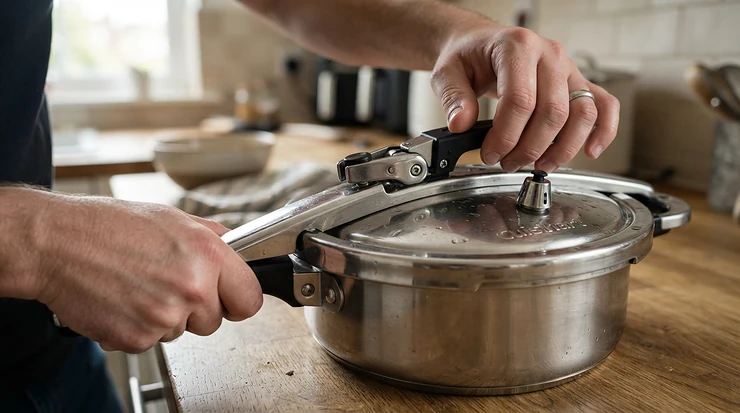
The first month decides whether a stovetop pressure cooker becomes a weekly habit or a cupboard ornament. Start with a trial run: heat a little water, seal the lid and watch the cooker reach pressure, so you learn the sounds and indicator before food is involved. Inspect the valves and gasket before every use, and rinse them after.
Filling is where beginners slip. Michigan State University Extension advises filling only two-thirds full, or half for foods that expand like beans and rice, and always adding liquid so steam can form. Then follow the rhythm: heat high until the indicator shows pressure, drop to the lowest flame that holds it, and start your timer only at that moment.
Begin with forgiving recipes. At 15 psi, small boiled potatoes take about seven minutes and green beans roughly three, so vegetables and stock make ideal week-one dishes. Cookers with a 12 lb ceiling need a little longer.
Common first-month mistakes:
- ✅ Forgetting minimum liquid, so pressure never builds
- ✅ Thickening sauces before cooking, which then scorch on the base
- ✅ Opening early instead of waiting for the pressure to drop fully
Add pulses on a natural release rather than the cold-water method, because sudden pressure loss can split their skins.

Real-World Scenarios: Three UK Kitchens, Three Cookers
The student flat. A £40 budget, an induction hob and stews three nights a week. The Tower T80244 fits: it’s induction-ready, comes with a steamer basket, and its budget price makes it a low-risk experiment. Just hand-wash it and keep the gasket clean.
The family of four on gas. Sunday joints, midweek curries and a hob that’s been gas since the 1990s. Here the Prestige High Dome handles the big cuts, while the Hawkins Contura is arguably better for daily dal and curry because of its stirrable curved sides. Both are inexpensive, and neither needs an induction-compatible base.
The keen cook replacing an old pan. A new induction hob has killed a decades-old aluminium cooker. If £70 to £100 is the ceiling, the Prestige Smart Plus is the easy switch. If cooking under pressure is a weekly ritual and £200 or more is acceptable, the Fissler Vitaquick offers speed and clarity, while the Kuhn Rikon Duromatic offers longevity.
What Is a Stovetop Pressure Cooker?
A stovetop pressure cooker is a sealed, lockable pan that traps steam so the pressure inside rises above normal atmospheric levels, lifting the boiling point of water from 100°C to roughly 117-121°C. Because it sits on your own hob, you control the heat, and food typically cooks in around a third of the usual time.
The numbers matter. At 12 psi, water boils at about 117°C, and cooking time drops to roughly 31% of conventional boiling; at 15 psi it reaches 121°C and about 23%. That’s why the pressure setting on the cooker you buy changes how recipes behave.
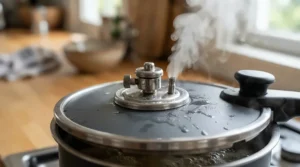
Two design generations still coexist. Older cookers use a weighted “jiggler” valve that rattles as excess steam escapes, while modern ones use spring-loaded valves that stay near-silent and use indicators to show pressure. Both are safe when used correctly and maintained, but they feel very different in daily use.
How to Choose a Stovetop Pressure Cooker
- Match the base to your hob. Induction needs a magnetic base; aluminium models like the Prestige High Dome don’t qualify. Use a hob ring no larger than the base diameter.
- Choose the material. Stainless steel is durable and dishwasher-friendlier; aluminium is lighter and cheaper but reacts with acidic foods.
- Pick the size. Five to six litres suits most households of three to four, remembering you can only fill to two-thirds.
- Check the pressure settings. Dual-setting cookers add flexibility; a 12 lb maximum means longer cooking times than 15 lb.
- Inspect the safety features. Look for a lid lock, backup pressure release valves and CE or UKCA marking.
- Verify spares and guarantees. Gaskets wear out, so check they’re stocked and read the guarantee terms.
- Prioritise a readable indicator. America’s Test Kitchen found brightly coloured, raised indicators easiest to read from across a kitchen.
Stovetop Pressure Cooker vs Electric Pressure Cooker
The stovetop pressure cooker vs electric pressure cooker debate comes down to speed against convenience. One UK round-up puts stovetop pressure at 13-15 psi against 8-12 psi for electric, with natural release taking about 10 minutes against 25. Consumer Reports found electric models sometimes took almost three times longer to reach pressure, though they’re near-silent while cooking.
Electric multi-cookers win on hands-off convenience and extras like slow cooking and sauté; Mumsnet’s overall winner is an electric Instant Pot. Stovetop wins on searing, durability and storage. Note that electric pressure cooker energy use can be as much as 70% lower than conventional pan cooking, so the running-cost gap is smaller than people assume.
| Factor | Stovetop | Electric | Best For |
|---|---|---|---|
| Speed to pressure | Faster | Slower | Fissler Vitaquick buyers |
| Typical pressure | 13-15 psi | 8-12 psi | Stovetop for tender braises |
| Searing | In the same pan | Built-in sauté | Either |
| Hands-off use | Needs attention | Set and forget | Electric for busy homes |
| Upfront cost | Often lower | Usually higher | Tower T80244 buyers |
Looking at the table, stovetop suits cooks who value speed, durability and a single pan for searing and pressure. Electric suits anyone who wants to walk away. If your budget is tight, a Tower T80244 costs a fraction of most multi-cookers.
Best Stovetop Pressure Cooker for Gas Hobs
Gas is where a stovetop pressure cooker shines, because you can drop the flame the instant the indicator shows pressure. That responsiveness means less wasted heat and a steadier simmer. For the best stovetop pressure cooker for gas hobs, the answer depends on how much you want to spend.
At the premium end, the Fissler Vitaquick and Kuhn Rikon Duromatic both use thick bases that tolerate flame fluctuations. The Hawkins Contura is recommended by its maker for gas stoves, and the Prestige High Dome is a cheap, proven partner for large joints. For mid-range buyers, the Tefal Secure 5 Neo works on gas as easily as induction.
Some gas-specific habits help. Keep the flame under the base rather than licking up the sides, and match the hob ring to the pan. On some second-generation cookers, the gasket expands to release excess pressure downwards, and that release can extinguish a gas flame. If it happens, switch the gas off and ventilate before relighting.
Best Traditional Stovetop Pressure Cooker Review: Weights, Inner Lids and Spring Valves
“Traditional” can mean two things: the classic weighted-valve pans, or simply the pan-on-the-hob style as opposed to electric. For the best traditional stovetop pressure cooker review, both meanings deserve a verdict.
If you want the genuinely old-school experience, the Prestige High Dome delivers weighted 5, 10 and 15 lb settings and a high dome that suits large cuts. The Hawkins Contura offers the inner-lid tradition with its curved body. Both are gas-hob favourites and remain excellent value.
If you want the tradition of a pan on the hob but with modern refinements, Mumsnet’s community-led round-up points to the Prestige Smart Plus as best stovetop pick, the Kuhn Rikon Duromatic as most durable and the Tower T80244 as best budget buy. My reading is that the Kuhn Rikon Duromatic is the best all-round traditional stovetop pressure cooker for people who’ll keep it for years, while the Prestige Smart Plus is the better everyday value.
Pressure Release Valves Explained: Safety, Regulations and Release Methods
Pressure release valves are the reason modern cookers are safe. A calibrated primary valve regulates pressure, while backup devices such as fusible plugs, resettable spring devices or an expanding gasket provide escape routes if the vent clogs. A lid interlock stops you opening the pan while pressure remains.
Valve style shapes daily use. Weighted valves rattle audibly; spring-loaded designs stay near-silent and rely on indicators. Wikipedia notes that pressure cookers sold in the EU must comply with the Pressure Equipment Directive, so look for CE or UKCA marking and follow the manual.
Three release methods exist:
- ✅ Natural release, taking roughly 10-15 minutes, best for foamy foods, rice, legumes and meat
- ✅ Quick release via a button or valve, useful for adding fast-cooking vegetables, but avoid it with foaming foods
- ✅ Cold-water release, with water running over the lid edge only, never submerged, and never for pulses
Overfilling is the classic cause of valve trouble. Keep to two-thirds for solids, half for foamy foods and one-third for pulses, and clear the vent before each use.
Traditional Cookware Methods vs Pressure Cooking
Traditional cookware methods, such as simmering in a saucepan, braising in the oven or using a slow cooker, still have their place. Pressure cooking simply compresses time. At 15 psi, cooking takes about a quarter of conventional boiling time, and the small amount of liquid needed reduces energy use compared with boiling.
But a pressure cooker isn’t a universal replacement. Pan-frying, roasting and deep frying don’t work under pressure, and browning happens at temperatures above what a pressure cooker reaches, so sear first in the open pan. Starchy sauces can catch on the base, so thicken after cooking.
Where traditional cookware methods win is texture control and flexibility. A slow cooker suits all-day, no-attention meals, and an oven braise develops crusts a sealed pan cannot. The smart approach is complementary: pressure cook the tough cuts and pulses, then finish in an open pan. Many cooks find that combination beats any single one of the traditional cookware methods used alone.
Features That Actually Matter (And Those That Don’t)
What matters:
- ✅ A properly bonded base. It spreads heat and works with your hob type.
- ✅ A positive lid lock. An audible click or clear indicator removes doubt.
- ✅ Readable pressure indication. You’ll glance at it constantly.
- ✅ Spare-part availability. A cooker without an obtainable gasket becomes scrap.
- ✅ Internal fill lines. They make safe filling automatic, as the Kuhn Rikon Duromatic shows.
What doesn’t:
- ❌ Marketing percentages. Claims like “90% less fuel” or “95% of vitamins” are manufacturer statements, not independent measurements, so treat them as directional.
- ❌ Extra programmes. Two settings cover almost every recipe, and the Tefal Secure 5 Neo‘s two programmes are convenience rather than necessity.
- ❌ Bundled accessories alone. Most cookers, from the Tower T80244 upwards, include a steamer, so don’t pay extra for one.
- ❌ Non-stick interiors. They add cost and rarely improve results.
Focus your budget on the base, the lock and the spares.
Long-Term Cost & Maintenance
A stovetop pressure cooker is one of the few kitchen buys where spending more can genuinely cost less per meal. If you keep a cooker for ten years, the cost per year works out as follows.
| Model | Price range | Cost per year (10-year life) | Best For |
|---|---|---|---|
| Kuhn Rikon Duromatic | £150-£250 | £15-£25 | Longevity seekers |
| Fissler Vitaquick | £200-£250 | £20-£25 | Frequent, precise cooks |
| Tefal Secure 5 Neo | £70-£110 | £7-£11 | Easy-lid buyers |
| Prestige Smart Plus | £60-£100 | £6-£10 | Everyday families |
| Tower T80244 | £30-£50 | £3-£5 | Budget starters |
| Prestige High Dome | £35-£60 | £3.50-£6 | Gas-hob joint cooks |
| Hawkins Contura | £40-£70 | £4-£7 | Curry cooks on gas |
These are illustrative calculations, not lifespan guarantees, and gaskets are extra. Even the priciest cooker costs about the price of a takeaway coffee each month over a decade. The bigger question is whether a cheap model will last that long, and that’s where owner reports of durability matter.
Maintenance is simple. Replace the gasket about once a year, or sooner if it splits, and when you do, replace the overpressure plug too, as Michigan State University Extension advises. Wash the gasket and valves after each use, store the lid upside down on the pan so the rubber isn’t compressed, and keep aluminium models out of the dishwasher.
Stovetop Pressure Cooker FAQs
❓ Is a stovetop pressure cooker safe to use on an induction hob?
❓ How often should I replace the gasket on a stovetop pressure cooker?
❓ Which size stovetop pressure cooker suits a family of four?
❓ How much does a good stovetop pressure cooker cost in the UK?
❓ Is a stovetop pressure cooker worth it if I already own an air fryer or slow cooker?
Conclusion
The best stovetop pressure cooker depends less on prestige than on your hob, your habits and your patience for gadgets. Gas-hob households after a proven classic should look at the Prestige High Dome or Hawkins Contura. Induction owners on a budget can start with the Tower T80244, while the Prestige Smart Plus and Tefal Secure 5 Neo suit families wanting dependable everyday cookers. If you cook under pressure weekly and want to buy once, the Kuhn Rikon Duromatic and Fissler Vitaquick justify their premiums.
Whichever you choose, the fundamentals stay the same: match the base to your hob, respect the fill lines, look after the gasket and learn how your pressure release valves behave. Do that, and a stovetop pressure cooker will repay you with faster, more tender meals for years.
✨ Ready to Cook Faster?
🍲 Choose the stovetop pressure cooker that fits your hob and budget, then click any highlighted product name to check current pricing and availability. Your quickest, most tender weeknight dinners are waiting! 🔥
Recommended for You
- Pressure Cookers Under £80: 7 Best Buys For UK Kitchens (2026)
- Best Pressure Cookers UK: 7 Genuinely Worth Buying (2026)
- Universal Steamer Inserts: 7 Proven Picks For UK Kitchens (2026)
Disclaimer: This article contains affiliate links. As an Amazon Associate, I earn from qualifying purchases. If you purchase products through these links, we may earn a small commission at no additional cost to you.
✨ Found this helpful? Share it with your friends! 💬🤗
