In This Article
Here’s the question behind the search for the best crepe pan: why does your first crêpe always come out like a crumpled tea towel? Usually it’s the pan, not you. The best crepe pan is a wide, shallow, low-sided pan, typically 24-30 cm across. It heats evenly, releases a paper-thin layer of batter cleanly and lets a spatula slide under the edge with no wall in the way. Non-stick suits beginners. Carbon steel, spun iron and cast iron suit cooks who want a pan for life.

The humble pancake is ancient business. British cookery books were already describing pancakes in 1439, so you’d think we’d have the pan question sorted by now. We haven’t. Walk into any kitchen shop and you’ll meet a wall of options: coated aluminium, French carbon steel, British spun iron, enamelled cast iron, copper that costs more than a weekend away. Each one promises the best crepe pan experience. Few explain what that means on your hob.
This guide sorts it out. I’ve researched seven real, widely available pans across budget, mid-range and premium tiers. I’ve combined their specs with the review themes that keep surfacing in buyer guides, and I’ve worked out who each one suits. Along the way we’ll cover how a crêpe pan differs from a regular frying pan, why even heat distribution decides almost everything, and how carbon steel seasoning works. We’ll also look at what Pancake Day traditions have to do with your kit.
One note on honesty before we start. I haven’t cooked on these pans and I won’t pretend otherwise. What follows is analysis grounded in specifications, retailer data and aggregated buyer feedback. Where I couldn’t verify something, I’ll say so.
Quick Comparison: Best Crepe Pan Options at a Glance
Short on time? This table puts the seven picks side by side. Prices are indicative ranges at the time of research. Stock and sellers on Amazon UK change often, so always check the current listing.
| Pan | Material | Size | Induction | Price range | Best For |
|---|---|---|---|---|---|
| KitchenCraft MasterClass | Ceramic-coated aluminium | 24 cm | Not listed | Under £20 | Tight budgets, gas hobs |
| SENSARTE Nonstick Crepe Pan | Granite-coated aluminium | 10 or 12 in | Yes | Roughly £20-£30 | Beginners wanting a spreader |
| Lodge Cast Iron Crêpe Pan | Pre-seasoned cast iron | 26 cm | Yes | Mid-£30s to low £40s | Lifetime durability on a budget |
| de Buyer Mineral B | Carbon steel | 24 or 26 cm | Yes | Roughly £25-£45 | Keen cooks who enjoy patina |
| Netherton Foundry Spun Iron | Spun iron | 26-28 cm | Yes (with care) | Around £85-£95 | Light, British-made, pre-seasoned |
| de Buyer Choc Resto | Thick aluminium, non-stick | 26 cm | Yes | Around £55-£65 | Induction non-stick, no fuss |
| Mauviel M’150S | Copper, stainless lining | 30 cm | No | Mid-£300s | Heirloom copper devotees |
Looking at the table, the KitchenCraft MasterClass and the SENSARTE Nonstick Crepe Pan win on pure price and ease. Both trade lifespan for convenience. The Lodge Cast Iron Crêpe Pan and de Buyer Mineral B cost little more but can outlast you if you learn their quirks. At the top, the Mauviel M’150S is a luxury for people who already know why they want copper.
💬 Just one click — help others make better buying decisions too!😊
Top 7 Best Crepe Pan Picks for UK Kitchens: Expert Analysis
1. KitchenCraft MasterClass — best ultra-cheap starter pan
The big pull here is the price. The KitchenCraft MasterClass 24 cm ceramic non-stick pan sits comfortably under £20.
On paper it’s a 24 cm pan of ceramic-coated aluminium weighing about 0.78 kg, with a stay-cool plastic handle. That weight is the real story. It’s light enough to swirl one-handed, which matters because crêpes demand a quick tilt to spread the batter before it sets. The comparison data I reviewed lists it as not induction compatible, so check the listing before buying if you cook on induction.
My take: this is the pan for someone cooking crêpes a handful of times a year, probably around Pancake Day. Ceramic coatings are slick when new, but they’re generally less durable than traditional carbon steel. The supplier data also notes it isn’t suited to very high heat, which for crêpes is fine, since medium is where you want to be anyway.
On buyer sentiment, I couldn’t verify a large pool of Amazon UK reviews for this exact listing. The published roundup coverage I found praises its balance of price and release performance.
Pros:
- ✅ Very low price for a dedicated crêpe pan
- ✅ Light enough to swirl and flip comfortably
- ✅ Slick ceramic surface for easy release
Cons:
- ❌ Not listed as induction compatible
- ❌ Coated aluminium won’t last decades
Price check: under £20. Value verdict: outstanding for occasional use, a false economy if you’re making crêpes weekly.
2. SENSARTE Nonstick Crepe Pan — best budget pan with a spreader in the box
The thing people notice is the extra: many SENSARTE Nonstick Crepe Pan listings include a batter spreader, which spares you a separate purchase.
The pan uses a Swiss granite-style non-stick coating over aluminium and comes in 10-inch and 12-inch sizes. It’s induction compatible and has a stay-cool handle. Induction compatibility means a bonded magnetic base, which also tends to resist warping better than a bare thin disc. The 10-inch (about 25 cm) is the better all-rounder for family kitchens, while the 12-inch gives you the bigger canvas for Breton-style galettes.
Analytically, this is the pan I’d suggest to a beginner on an induction hob who doesn’t want to think about seasoning. The spreader lets you nudge the batter into a thin, even disc before it sets, which is the whole game with the best crepe pan for thin pancakes.
For sentiment, multiple buyer guides rank it near the top for beginners and call out its light weight. I couldn’t verify Amazon UK star ratings for a specific size, so check recent reviews yourself. One roundup flagged the larger size as slightly heavy.
Pros:
- ✅ Spreader often included in the box
- ✅ Induction compatible with stay-cool handle
- ✅ Suits beginners who dread sticking
Cons:
- ❌ Granite-style coating still wears over time
- ❌ Metal utensils will damage the surface
Price check: roughly £20-£30, depending on size and seller. Value verdict: excellent for the money, especially for beginners.
3. Lodge Cast Iron Crêpe Pan — best pan for life under £50
This is the pan for people who suspect their grandchildren will inherit their cookware. The Lodge Cast Iron Crêpe Pan is a 26 cm round griddle cast in a single mould, so handle and pan are one piece with nothing to loosen.
It’s pre-seasoned, works on every hob including induction, and goes in the oven. That single-piece build is why it can last generations. Cast iron also holds heat superbly, which is what gives crêpe edges their lacy, golden crispness. The trade-off is weight, plus a short handle that gets hot.
My analysis: this is the best crepe pan for someone who wants carbon-steel-style longevity without the first-use fuss, because it arrives seasoned. It’s a slower starter than non-stick, so give it a proper preheat. For the first five to ten uses, don’t skimp on oil, as the surface slowly builds its natural release.
On aggregated feedback, buyer guides consistently single it out as great value and durable. They also repeatedly warn about the hot handle, so keep a cloth or silicone grip nearby. I couldn’t verify a clean Amazon UK review sample for this exact pan.
Pros:
- ✅ One-piece construction built to last generations
- ✅ Pre-seasoned and oven-safe
- ✅ Works on gas, induction and Aga
Cons:
- ❌ Handle gets hot and is quite short
- ❌ Heavy for flipping and swirling
Price check: mid-£30s to low £40s. Value verdict: top-tier value if you accept the weight.
4. de Buyer Mineral B — best for building your own patina
French chefs rate it for good reason: the de Buyer Mineral B is thinner than cast iron, so it responds faster when you turn the heat up or down.
It comes in 24 cm and 26 cm and has a long, curved handle that stays relatively cool. It works on all hobs including induction. Unlike the Lodge, it isn’t sold pre-seasoned, so seasoning is mandatory before first use. The upside is watching the pan transform from grey to black as the patina builds. A heat-responsive pan lets you react quickly when a crêpe starts browning too fast. Heat that responds also means you must manage it.
Note the oven caveat: the handle is rated for only around ten minutes at 200°C, so season on the hob rather than in a long oven session.
My verdict: this is the carbon steel seasoning pan to buy if you enjoy the ritual. It rewards patience, and it punishes a lazy washing-up routine. Review coverage describes it as good value and beloved by cooks, though I couldn’t verify a robust Amazon UK sample.
Pros:
- ✅ Heat-responsive and satisfyingly easy to control
- ✅ Long handle, easy to manoeuvre
- ✅ Gets better with use as patina builds
Cons:
- ❌ Must be seasoned before first use
- ❌ Handle limits oven use
Price check: roughly £25-£45 depending on size and seller. Value verdict: arguably the smartest long-term buy here.
5. Netherton Foundry Spun Iron — best British-made, light and pre-seasoned
Think of it as cast iron’s slimmer cousin. The Netherton Foundry Spun Iron crêpe pan is made in Shropshire using traditional British ironmongery processes, and it’s markedly lighter than cast iron.
It arrives pre-seasoned, has a stay-cool handle and is easy to lift and manoeuvre. That lightness is a quiet superpower for crêpes: you can swirl the batter without a forearm workout. It’s also more heat-responsive than thick cast iron. The catch is induction. Because the spun construction is thinner, sudden heat changes, such as jumping from low to boost, can warp it. It isn’t oven-compatible either.
My take: this is for the cook who wants the carbon-steel feel with fewer steps, and a British maker’s name on the base. If you cook on gas, it’s close to ideal. On induction, heat gently and avoid boost.
Review-wise, retailer buying guides praise its lightness and pre-seasoned convenience. I couldn’t verify a meaningful Amazon UK review pool, so check the current listing.
Pros:
- ✅ Made in England with a lifetime-pan feel
- ✅ Pre-seasoned and light to lift
- ✅ Heats responsively, great for crêpes
Cons:
- ❌ Can warp with sudden induction heat changes
- ❌ Not oven-compatible
Price check: around £85-£95. Value verdict: premium but fair for hand-made British ironwork.
6. de Buyer Choc Resto — best induction non-stick with a thick base
The base is the star here. The de Buyer Choc Resto 26 cm is made from extra-thick aluminium with a magnetic stainless steel base, which is why it behaves so well on induction.
Five layers of non-stick coating mean crêpes turn out easily and cleaning is a rinse. Thick aluminium spreads heat across the pan better than a thin stamped disc, and a rigid base reduces the doming and warping that make batter pool to one side. It’s oven-safe only briefly, up to about ten minutes at 280°C, and metal utensils are a no.
My analysis: this is the best non-stick crepe pan for induction users who want to spend a little more for sturdier construction. It’s a sensible step up from budget coated pans without leaping into copper money. Like all non-stick, it has a finite lifespan, though careful use stretches it.
Buyer guides generally describe it as very easy to clean and needing little oil. I couldn’t verify Amazon UK review volume for this exact listing.
Pros:
- ✅ Thick base suited to induction hobs
- ✅ Very easy to clean, little oil needed
- ✅ Stay-cool handle, French-made
Cons:
- ❌ Limited oven time
- ❌ Coating limits long-term durability
Price check: around £55-£65. Value verdict: good mid-range choice for induction households.
7. Mauviel M’150S — best premium copper for heat response
Copper is the show-off of the pan world, and the Mauviel M’150S 30 cm is the heritage example.
Copper heats and cools almost instantly and spreads heat evenly, which is exactly what delicate crêpes want. The interior is lined with stainless steel, so it isn’t non-stick: use generous butter or oil, and only flip once the underside is properly set. It doesn’t work on induction.
My honest read: you buy this for the experience, not the economics. A good non-stick pan will make an identical crêpe for a fraction of the cost. But if you cook on gas, already own copper and love the way it responds, this is a pan that can last a lifetime. Retailer coverage describes its heat responsiveness as unmatched. I couldn’t verify review volume on Amazon UK.
Pros:
- ✅ Unmatched heat responsiveness for fine control
- ✅ Beautiful heritage French construction
- ✅ Built to last a lifetime
Cons:
- ❌ Not compatible with induction hobs
- ❌ Not non-stick and very expensive
Price check: mid-£300s. Value verdict: a luxury, not a necessity.
Top 7 Best Crepe Pan Picks Compared
| Pan | Care level | Heat response | Oven use | Best For |
|---|---|---|---|---|
| KitchenCraft MasterClass | Low | Quick, light | Limited | Occasional cooks |
| SENSARTE Nonstick Crepe Pan | Low | Quick | Check listing | Beginners on induction |
| Lodge Cast Iron Crêpe Pan | Medium | Slow, steady | Yes | Durable, budget-friendly |
| de Buyer Mineral B | Medium-high | Responsive | About 10 min at 200°C | Patina lovers |
| Netherton Foundry Spun Iron | Medium | Responsive | No | Light, British-made |
| de Buyer Choc Resto | Low | Even, stable | About 10 min at 280°C | Induction non-stick |
| Mauviel M’150S | Medium | Near-instant | Check listing | Copper devotees |
Read down the “Care level” column and a pattern emerges. The easiest pans, the KitchenCraft MasterClass, the SENSARTE Nonstick Crepe Pan and the de Buyer Choc Resto, are the shortest-lived. The pans needing more attention, the Lodge Cast Iron Crêpe Pan and de Buyer Mineral B, are the ones that improve with age. Decide how much ritual you enjoy before you decide how much you spend.
How to Choose the Best Crepe Pan
The best crepe pan for you depends on your hob, your patience and how often you cook crêpes. Work through these six steps in order:
- Match the pan to your hob. Induction needs a magnetic base. Copper like the Mauviel M’150S won’t work, while the de Buyer Choc Resto is built for it.
- Pick a size. 24-26 cm is the sweet spot for single-serve, thin crêpes. 28-30 cm suits galettes and bigger households.
- Choose your surface. Non-stick for ease, carbon steel or iron for longevity.
- Check the weight. You’ll be tilting and swirling constantly, so a pan you can’t lift one-handed will wear you out.
- Look at the handle. Long and stay-cool beats short and scorching.
- Be honest about maintenance. If you won’t dry and oil an iron pan, buy a coated one.
Notice that price isn’t on the list. Cost follows these decisions rather than leading them.
Best Non-Stick Crepe Pan: What to Look For
If non-stick is your route, the best non-stick crepe pan combines a decent coating with a rigid, flat base. The coating decides how long the pan stays slippery. The base decides whether the batter spreads evenly in the meantime.
Three things to check. First, base thickness: thicker aluminium, like the de Buyer Choc Resto, resists warping and spreads heat. Second, coating type. Ceramic, granite-style and PTFE-based coatings all work, each with different durability. Third, utensil advice: all of them prefer wood or silicone.
On safety, the German Federal Institute for Risk Assessment explains that PTFE-coated pans pose a risk mainly when strongly heated while empty. In that case the coating can overheat and release gases harmful to health. Crêpes are naturally cooked at medium heat, which suits non-stick well. Never preheat an empty non-stick pan on full blast, and replace it if the coating starts flaking.
A final practical point: a non-stick surface is usually the lifespan trade-off. Expect a few years of good service, longer with careful hand-washing.
Crepe Pan vs Regular Frying Pan: What’s the Real Difference?
You can make crêpes in a regular frying pan. Plenty of people do. The question is how much fun you’ll have doing it.
The core difference is geometry. A regular frying pan has tall, sloping sides, which trap steam and block the spatula. A crêpe pan has a nearly flat cooking surface with a very low rim. The steam escapes, the edges brown rather than sweat, and you can slide a spatula or palette knife straight under a thin crêpe without wrestling a wall.
| Feature | Crêpe pan | Regular frying pan |
|---|---|---|
| Side height | Very low | Tall, sloped |
| Batter spreading | Easy, even disc | Pools, thickens at the edges |
| Spatula access | Clean slide under the edge | Awkward, risks tearing |
| Browning | Crisp, lacy edges | More steaming, paler results |
| Versatility | Crêpes, tortillas, flatbreads, griddling | Frying, sautéing, sauces |
| Best For | Anyone making crêpes regularly, e.g. the Lodge Cast Iron Crêpe Pan | Occasional pancakes, small kitchens |
Weighing the table up, a regular frying pan is fine for the occasional thick American-style pancake. For thin crêpes, though, the low sides of a pan like the de Buyer Mineral B save you real frustration. And a crêpe pan isn’t a one-trick tool. It doubles as a griddle for tortillas, chapatis and flatbreads, so the cupboard space is easier to justify.
✨ Don’t Miss These Great Pan Options!
🔍 Ready to upgrade your Pancake Day game? Click on any highlighted pan above to check current pricing and availability on Amazon UK. Choose the one that fits your hob and your patience, and you’ll be flipping lacy-edged crêpes in no time!
Even Heat Distribution: Why It Decides Everything
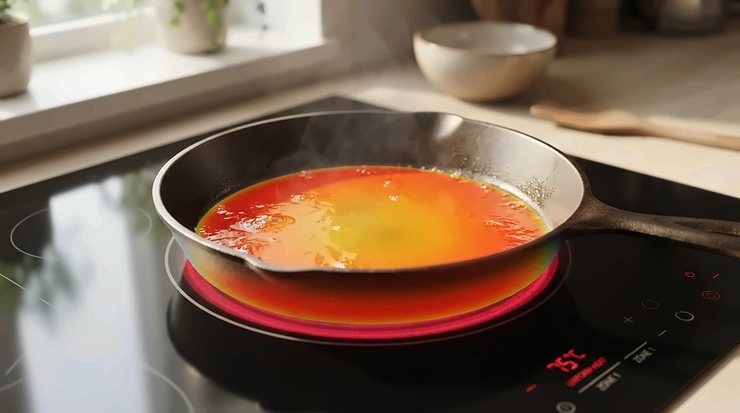
Ask any crêperie cook what separates good pans from bad and the answer is nearly always heat. Even heat distribution means the whole cooking surface sits at the same temperature, so your crêpe browns uniformly instead of leopard-spotting. Poor distribution gives you a pale centre and a scorched rim, or the reverse.
Different materials solve this differently. Copper spreads heat fastest and reacts almost instantly, which is why the Mauviel M’150S is so prized. Cast iron has the opposite personality. It heats slowly but holds heat steadily, so the Lodge Cast Iron Crêpe Pan won’t lose temperature when cold batter touches it. Thin carbon steel and spun iron sit in between, with the de Buyer Mineral B and Netherton Foundry Spun Iron reacting quickly while still holding a decent reserve.
Aluminium is the budget workhorse. A thick, bonded aluminium base, as on the de Buyer Choc Resto, spreads heat well. A thin stamped one can create hot spots, especially on a gas flame smaller than the base. Match your burner to the pan: a small ring under a wide pan guarantees uneven cooking. Preheat for a couple of minutes on medium so the heat has time to equalise before the first ladle goes in.
Best Crepe Pan for Thin Pancakes: What Actually Matters
If thin, delicate pancakes are the goal, three things matter more than anything else: surface flatness, a low rim and controllable heat.
Flatness is the sleeper. A pan with the slightest dome or dish will push batter toward one side as it cooks, and no technique fixes that. Thicker bases and one-piece construction, like the cast Lodge Cast Iron Crêpe Pan, tend to stay flat longer. Thin spun iron needs care on induction, as the Netherton Foundry Spun Iron buyer guidance warns that rapid heat changes may warp it.
A low rim lets you swirl and spread without batter climbing the walls. A good spreader helps too, which is why the extras bundled with the SENSARTE Nonstick Crepe Pan are more useful than they sound. Finally, heat control: thin crêpes cook in under a minute, so a pan that reacts quickly gives you a margin for error.
For genuinely thin results, thin your batter as well. A runnier mix needs a hot, well-prepared surface, and a pan that holds a steady medium heat will do more for you than any technique tweak.
Carbon Steel Seasoning: A Step-by-Step Guide
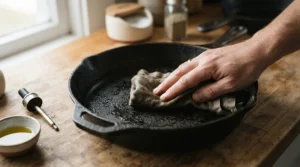
If you’ve chosen carbon steel, spun iron or cast iron, seasoning is the skill that makes it non-stick. It’s simpler than the internet makes it sound. Seasoning is just a thin layer of oil polymerised onto the metal by heat, and it grows with every use.
Before first use
- Wash off any factory coating with hot water, then dry thoroughly.
- Rub a thin layer of vegetable oil over the whole inside surface. Thin matters: too much goes sticky.
- Heat over medium-high until the oil looks absorbed and the surface darkens slightly.
- Let it cool, wipe off any excess and repeat two or three times.
Borough Kitchen’s seasoning guide also describes an oven method: oil the pan, place it upside down at 175°C for an hour, with a tray underneath. That’s fine for a Lodge Cast Iron Crêpe Pan. For a de Buyer Mineral B, stay on the hob, since its handle is rated for only about ten minutes at 200°C.
Ongoing care
- Avoid washing-up liquid. Hot water and a soft brush do the job. For stuck-on bits, use salt or bicarbonate of soda.
- Dry immediately and wipe a whisper of oil over the surface.
- For the first five to ten uses, don’t skimp on oil. The patina builds with use.
Expect the first few crêpes to be imperfect. After that, the pan starts working with you.
Real-World Scenarios: Which Pan Suits Which Cook?
Specs only help if they meet a real kitchen. Here are three profiles.
The student in a rented flat. Induction hob, a small budget, crêpes a few times a month. The SENSARTE Nonstick Crepe Pan is the obvious fit: induction compatible, spreader included, and you can wash it in thirty seconds. Budget around £20-£30.
The Pancake Day family on gas. Cooking for four once a year, plus the occasional weekend. The KitchenCraft MasterClass at under £20 keeps costs low and is light enough for children to help with. It’s also gentle enough that a first-timer isn’t punished for mistakes.
The enthusiast who cooks crêpes weekly. Gas hob, a love of kit, and a liking for tinkering. The de Buyer Mineral B at roughly £25-£45 gives a lifetime of improving performance. If you prefer lighter and pre-seasoned, step up to the Netherton Foundry Spun Iron.
Notice how none of these cooks needs the most expensive pan. The best crepe pan is the one matched to your habits.
Crêpe Troubleshooting: Common Problems and Fixes
Most crêpe failures are fixable. Here’s a quick problem-to-solution guide.
The batter sticks. On iron or carbon steel, the pan probably isn’t hot enough or lightly oiled enough. Heat it properly and oil lightly but thoroughly, and keep going for the first few uses. On non-stick, the coating may be worn. Check the surface for scratches.
The first crêpe always fails. It’s the test run. The pan wasn’t evenly hot yet. Let a Lodge Cast Iron Crêpe Pan preheat longer than you think necessary.
Crêpes tear when you flip. The underside isn’t set. Wait until the edges lift and the surface looks matte, rather than glossy.
Pale centre, burnt rim. Classic uneven heat. Check the burner is sized to the pan, and on induction avoid boost mode.
The pan wobbles or the batter pools. Warping, often from sudden heat changes. This is a particular concern for thin spun iron like the Netherton Foundry Spun Iron on induction, so heat gradually.
Pancake Day Traditions and the Pan Behind Them
Pancake Day traditions are older than most of our cookware. Shrove Tuesday, the day before Lent begins, was historically about using up eggs, milk and butter before the fast. In 2027 it falls on 9 February, so you’ve plenty of time to shop.
The traditions are gloriously odd. Historians note that in parts of Britain children went “shroving”, singing or reciting in exchange for food. Pancake races are the most famous custom. Olney in Buckinghamshire is the best-known, with runners flipping pancakes in frying pans as they sprint. Legend says it all began with a woman who ran to church flipping a pancake when the bell rang.
There’s a lesson for your kitchen here. Those racers carry a flat pan with low sides for a reason: it makes tossing a thin pancake possible. If you’re planning to flip, a light pan like the KitchenCraft MasterClass or SENSARTE Nonstick Crepe Pan makes the theatre far easier than cast iron. And it’s worth remembering that whatever the pan, the pancake on the day is usually the thin British style, so a pan built for thin crêpes serves the tradition best.
Long-Term Cost and Maintenance
The cheapest pan isn’t the cheapest pan. Cost per use is what matters.
| Tier | Example | Price range | Typical lifespan | Best For |
|---|---|---|---|---|
| Budget non-stick | KitchenCraft MasterClass | Under £20 | A few years | Occasional use |
| Mid non-stick | de Buyer Choc Resto | Around £55-£65 | A few years, longer with care | Induction households |
| Iron and carbon steel | Lodge Cast Iron Crêpe Pan | Mid-£30s to low £40s | Decades | Long-term value |
| Premium | Mauviel M’150S | Mid-£300s | A lifetime | Copper devotees |
Look at what the table implies. A pan lasting a few years and costing under £20 beats a mid-priced coated pan on pure cost. But a £35-£45 iron pan lasting decades beats both, if you’ll keep it dry and lightly oiled. Retailers describe non-stick lifespans as a few years, stretching toward a decade with careful use, while iron and carbon steel can last a lifetime. Budget for a replacement non-stick pan, or for fifteen minutes of aftercare per iron pan session.
Common Mistakes When Buying a Crepe Pan
A few errors repeat. Avoid them and you’ll buy once.
Ignoring your hob. Buying copper for induction is an expensive mistake. Check compatibility first.
Going too big. A 30 cm pan on a small burner will cook unevenly. Match pan to ring.
Buying carbon steel without wanting the aftercare. If you’ll put it in the dishwasher, it will rust. Choose a coated pan.
Overpaying for a pan you’ll use once a year. The KitchenCraft MasterClass exists for this.
Using high heat. Crêpes cook at a steady medium. High heat damages non-stick and burns the batter.
Skipping the spreader. A £5 tool turns the best crepe pan into a consistently thin, even result.
Best Crepe Pan FAQs
❓ What size is the best crepe pan for family cooking?
❓ Can I use a crêpe pan on an induction hob?
❓ Is a cast iron crêpe pan better than non-stick?
❓ Do I need to season a pre-seasoned pan?
❓ Where can I buy a crêpe pan before Pancake Day?
Conclusion: Choosing Your Best Crepe Pan
So, which is the best crepe pan? The honest answer is the one that matches your hob, habits and patience. For most beginners and induction cooks, the SENSARTE Nonstick Crepe Pan is the easiest win, with the KitchenCraft MasterClass as the cheaper alternative for occasional use. For a pan that outlives your kitchen, the Lodge Cast Iron Crêpe Pan and de Buyer Mineral B are the standout value picks, provided you embrace the seasoning routine. If lighter and British-made appeals, the Netherton Foundry Spun Iron deserves a look, and the de Buyer Choc Resto is the sturdy induction non-stick choice. The Mauviel M’150S is for copper devotees only.
Whichever you choose, remember the fundamentals: even heat distribution, a flat low-rimmed surface and steady medium heat. Get those right and Pancake Day, or any Tuesday, becomes a pleasure rather than a gamble. Prices and availability change, so check current listings on Amazon UK before you buy.
Recommended for You
- Fondue Sets Under £45: 7 Brilliant Picks For UK Homes (2026)
- Best Fondue Set: 7 Proven Picks For UK Dinner Parties (2026)
- Paella Pans Under £35: 7 Brilliant Budget Picks For UK Cooks (2026)
Disclaimer: This article contains affiliate links. As an Amazon Associate, I earn from qualifying purchases. If you purchase products through these links, we may earn a small commission at no additional cost to you.
✨ Found this helpful? Share it with your friends! 💬🤗
