In This Article
A silicone cake mould for easy release is a flexible bakeware tin, usually made from food-grade or platinum silicone. You peel the sides away and push the base, and the sponge slips out whole. Most are heat resistant to around 220-230°C, freezer-safe and dishwasher-friendly.

Anyone who has watched half a Victoria sponge stay behind in a metal tin knows why people switch. The greasing, flouring, lining, tapping and praying exists because metal grips. Silicone rubber is an elastomer, so it simply gives way. A good silicone cake mould for easy release lets the cake leave on its own terms.
Not every mould deserves your cupboard, though. Some are floppy and slosh batter on the way to the oven. Others smell odd, or carry a heat rating that is more marketing than maths. A few are lovely, but only for one shape of cake.
This guide compares seven real options on what actually matters. That means platinum silicone quality, flexible base support, whether each one is genuinely oven safe to 230°C, and whether it works as a flexible silicone mould for sponge cake. It also covers the less glamorous question of which ones are still worth owning after fifty bakes.
One honest note before we start. This is a research-based comparison built on published specifications, retailer listings and aggregated review sentiment. I haven’t baked in these moulds, and I won’t pretend otherwise. Where I couldn’t verify something, I say so. Where reviews were thin, I tell you that too, rather than inventing a consensus.
Quick Comparison: Silicone Cake Moulds for Easy Release at a Glance
| Product | Format | Listed heat rating | Price tier | Best For |
|---|---|---|---|---|
| Lékué Round Cake Mould 20cm | 20cm round, handles | 220°C | Mid-range | Everyday sponges |
| Silikomart Round Silicone Mould 20cm with Ring | 20 x 4cm round, support ring | -60°C to 230°C | Mid-range | Layers and frozen desserts |
| Silikomart Cloud | 20 x 20 x 5.5cm novelty | -60°C to 230°C | Premium | Showpiece cakes |
| Lakeland Reinforced 12-Cup Mini Loaf Pan | 12 mini loaves, steel frame | Check label | Mid-range | Wobble-free handling |
| Judge Silicone Round Cake Tin 23cm | 23cm round, metal frame | 220°C | Mid-range | Big family cakes |
| SILIVO 4-Piece Cake Mould Set | 4, 6, 8, 10 inch rounds | About 230°C (450°F) | Budget to mid | Rainbow and tiered cakes |
| Lékué Deep Silicone Gugelhupf Mould 22cm | 22cm, 11cm deep ring | Check label | Mid-range | Bundt-style bakes |
Looking at the table, the Lékué Round Cake Mould 20cm and the Silikomart Round Silicone Mould 20cm with Ring are the safest starting points for a standard sponge. If floppy silicone has ever betrayed you, the Lakeland Reinforced 12-Cup Mini Loaf Pan and the Judge Silicone Round Cake Tin 23cm are the ones to watch, because both hide a metal frame in the rim. Budget buyers should note that the SILIVO 4-Piece Cake Mould Set trades brand pedigree for sheer versatility.
💬 Just one click — help others make better buying decisions too!😊
Top 7 Silicone Cake Moulds for Easy Release: Expert Analysis
Every pick below is judged on release performance, build, heat rating and who it actually suits. Prices are ranges only, so check the current price before you buy.
1. Lékué Round Cake Mould 20cm — platinum silicone with grippy handles
The headline feature is the pair of shiny handles. Carrying a full tin of batter to the oven with two nervous hands is a very British kitchen pastime, and this mould takes the drama out of it.
It is made from 100% platinum silicone and is listed as suitable for oven, microwave and dishwasher. Retailers quote a ceiling of 220°C, which is comfortable for any sponge, brownie or traybake. The plain 20cm round also means recipes written for an 8-inch tin translate directly.
Based on the spec comparison, this is the sensible pick if you want an easy release silicone cake mould without fuss. Its weakness is the lack of a rigid rim, so always set it on a baking sheet before filling.
On review sentiment, I couldn’t verify a large UK review base for this exact size. Retailer descriptions stress stability and shape retention, but treat that as marketing until you see independent reports.
Pros:
- ✅ 100% platinum silicone for odour resistance
- ✅ Handles make oven transfers far steadier
- ✅ Dishwasher and microwave suitable
Cons:
- ❌ Needs a baking sheet for stability
- ❌ 220°C ceiling sits below some rivals
Expect around £15-£22 based on European listings, so check UK pricing. For a branded platinum silicone round, that is fair value.

2. Silikomart Round Silicone Mould 20cm with Ring — rigid ring plus a 230°C ceiling
The standout here is the support ring. Silikomart pairs its round moulds with a rigid “safe ring”, which solves the slosh problem that frameless silicone invites. The mould is listed at 20cm across and 4cm deep.
The range is quoted at -60°C to 230°C, so this mould is oven safe to 230°C and goes from freezer to oven without complaint. By simple geometry, a 20 x 4cm cylinder holds roughly 1.25 litres to the brim. Fill to two-thirds, and a standard four-egg Victoria mix will probably overflow, so match the recipe to the mould.
Silikomart describes its platinum silicone as odourless and tasteless, with a glossy surface that aids release. That glossiness matters, because sponge slides off smooth walls far more easily than off textured ones.
This suits bakers making shallow layers, entremets or frozen desserts. It is less suited to tall, domed sponges.
I found no meaningful UK review pool for this exact listing. The brand’s reputation among pastry chefs is the stronger signal, though that is not a substitute for reviews.
Pros:
- ✅ Rated -60°C to 230°C
- ✅ Support ring improves rigidity
- ✅ Glossy walls aid clean release
Cons:
- ❌ Shallow 4cm depth limits batter volume
- ❌ Ring availability varies by listing
Expect roughly £15-£25 depending on size and seller. Good value for the heat range alone.
3. Silikomart Cloud — a showpiece that releases cleanly
If your cake needs to make a room go quiet, this is the one. The Silikomart Cloud measures 20 x 20 x 5.5cm and holds around 1,650ml. It is made in Italy from 100% platinum silicone, with the usual -60°C to 230°C range.
Here is where the flexibility earns its keep. A rigid tin could never release those billowing curves without cracking them. Silicone peels back gently and keeps the detail. Based on the specs, a rich sponge or a mousse-style bake that firms up in the freezer would suit it best.
Review sentiment is thin but positive. On a French retailer page, one verified buyer called a first-ever cake a success, though they credited the recipe more than the mould. Another left a bare five-star rating. That is two data points, not a trend.
This is a one-trick mould, mind. Unless you bake celebration cakes regularly, the cost per use is high.
Pros:
- ✅ Crisp, detailed shape that holds its form
- ✅ Platinum silicone, dishwasher safe
- ✅ Freezer, fridge, oven and microwave suitable
Cons:
- ❌ Premium price for a single shape
- ❌ Limited UK review data
Expect roughly £35-£45, converted from European pricing at the time of research, so UK prices may differ. Worth it for occasion cakes, not for everyday baking.
4. Lakeland Reinforced 12-Cup Mini Loaf Pan — hidden steel frame stops the wobble
The standout is the steel frame hidden around the top edge. Lakeland says it holds the pan rigid, so you can carry it from worktop to oven to cooling rack without the slosh unreinforced silicone invites.
The tray measures about 32.5 x 24.5 x 2.5cm and is dishwasher safe. To release, you press on the base of each cavity. I couldn’t find a stated heat rating on the product page. Lakeland’s discontinued 20cm round pan was listed as oven safe to 230°C, but confirm this tray’s label before pushing the limit.
Here, flexible base support is the whole point. If pans that buckle when full have put you off silicone, this design fixes that. It suits anyone baking mini loaves, financiers or savoury bites for afternoon tea.
Reviewer sentiment is solid. The retailer’s own page showed 26 reviews averaging roughly four and a half stars at the time of research. Those are retailer-site ratings, not Amazon’s.
Pros:
- ✅ Steel frame keeps the tray rigid
- ✅ Three-year guarantee included
- ✅ Easy release, dishwasher safe
Cons:
- ❌ Mini loaf format only
- ❌ Heat rating not stated on the page
Expect around £12-£14. Lakeland sells direct, so check whether Amazon UK stocks it before you click.
5. Judge Silicone Round Cake Tin 23cm — metal-framed 9-inch round
The standout is size plus structure. This 9-inch (23cm) round has a reinforced carbon steel frame, so it handles like a proper tin while still flexing for release. That makes it the nearest thing here to a conventional family-cake tin.
The maker lists it as dishwasher safe, microwave safe and oven safe to 220°C. It is described as free of BPA, PFOA and PTFE coatings, and comes with a two-year guarantee. That 220°C ceiling is plenty for sponge baking at 160-180°C. Since the tin is 23cm across, a traybake or a generous layer cake fits comfortably.
On the spec sheet alone, this suits anyone who wants a big, stable silicone round without a separate ring. It also bakes tarts and pies, according to the maker. I found no visible customer reviews on the maker’s page, so I can’t report a consensus.
Pros:
- ✅ Metal frame gives proper rigidity
- ✅ Generous 23cm family size
- ✅ Two-year guarantee included
Cons:
- ❌ Heat ceiling of 220°C, not 230°C
- ❌ No visible reviews to judge durability
Expect around £10-£17 on the maker’s site at the time of research. Strong value for a framed 9-inch tin.

6. SILIVO 4-Piece Cake Mould Set — four sizes for rainbow and tiered cakes
The standout is range. One box gives you four round moulds, listed as 4, 6, 8 and 10 inches, which covers tiered cakes, rainbow stacks and traybakes.
Listings describe the set as food-grade silicone, BPA-free, dishwasher safe and oven safe up to 450°F. That works out at roughly 230°C, so it sits in the oven safe to 230°C club on paper. Four moulds also mean four layers baked at once, which saves oven time. Without frames, they will flex when full, so lift them on a baking sheet.
One quirk: sister SILIVO listings use slightly different sizes, such as 3.5, 5.5, 7.5 and 9.5 inches, and quote a depth of about 2 inches (5cm). Check which variant you’re buying.
On reviews, I couldn’t verify a robust UK review base. The listing I found showed only a small number of ratings on a non-UK store, so treat this as an affordable experiment.
Pros:
- ✅ Four sizes cover most layer-cake needs
- ✅ Listed to about 230°C
- ✅ Budget-friendly for the amount you get
Cons:
- ❌ No frames, so lift on a tray
- ❌ Size variants differ between listings
Check current price; it sits at the budget-to-mid end. Good value for layer-cake fans.
7. Lékué Deep Silicone Gugelhupf Mould 22cm — platinum silicone for Bundt-style bakes
The standout is the depth. At 22cm across and 11cm high, this is a proper tall ring mould for Gugelhupf and Bundt-style cakes. Those are the ones that normally refuse to leave metal tins without a fight.
Lékué describes the mould as flexible platinum silicone with exceptional non-stick properties. I couldn’t find a stated heat rating for this exact mould. Lékué’s other round cake moulds are listed at 220°C, so assume similar but check the label. A ring shape also bakes more evenly, because heat reaches the batter from the centre as well as the edges.
This is the right choice for anyone who loves a decorative cake. Intricate ridges are where metal tins stick worst, and where silicone’s flexibility pays off. It is a poor choice if you only bake flat sandwich sponges.
I found no verifiable review summary for this mould, so I’d rather say that plainly.
Pros:
- ✅ Platinum silicone suits detailed ring shapes
- ✅ Deep enough for tall cakes
- ✅ Flexible walls ease release from ridges
Cons:
- ❌ Limited to ring-shaped bakes
- ❌ Heat rating needs checking
Expect around £14-£18 at UK retailers. Reasonable value for a specialist shape.
Spec Snapshot: All Seven Side by Side
| Product | Support | Listed heat range | Price range | Best For |
|---|---|---|---|---|
| Lékué Round Cake Mould 20cm | Handles | 220°C | £15-£22 | Weekly sponges |
| Silikomart Round Silicone Mould 20cm with Ring | Support ring | -60°C to 230°C | £15-£25 | Layers, entremets |
| Silikomart Cloud | None | -60°C to 230°C | £35-£45 | Occasion cakes |
| Lakeland Reinforced 12-Cup Mini Loaf Pan | Steel frame | Check label | £12-£14 | Afternoon tea |
| Judge Silicone Round Cake Tin 23cm | Carbon steel frame | 220°C | £10-£17 | Big family cakes |
| SILIVO 4-Piece Cake Mould Set | None | About 230°C | Budget to mid | Layer cakes |
| Lékué Deep Silicone Gugelhupf Mould 22cm | None | Check label | £14-£18 | Bundt-style bakes |
Only the two Silikomart moulds and the SILIVO 4-Piece Cake Mould Set publish a ceiling at or near 230°C. The Lakeland Reinforced 12-Cup Mini Loaf Pan and Judge Silicone Round Cake Tin 23cm are the two built for rigidity. If you want a clean upgrade from floppy silicone, that frame is worth more than a few extra degrees of heat tolerance.
✨ Ready to bake without the wrestling match?
🔍 Click any highlighted product name to check current pricing and availability, then pick the mould that fits your oven, your recipes and your patience.
How to Choose a Silicone Cake Mould for Easy Release
The best choice is a platinum silicone or LFGB-tested mould with a 220-230°C rating, enough rigidity to carry safely, and a depth that matches your batter. Work through these six steps.
- Check the material. Look for platinum silicone or a recognised food-safety test such as LFGB. Vague “food grade” wording tells you little, so a named standard is more reassuring.
- Check the temperature rating. A rating of 220-230°C covers normal sponge baking with a generous margin.
- Decide on rigidity. Frameless moulds are cheaper but flex when full. A metal frame, a support ring or a baking sheet underneath solves it.
- Match depth to your recipe. Compare the mould’s volume with your batter, and fill to about two-thirds.
- Pick a smooth surface. Glossy walls release best. Textured walls suit patterned cakes, not everyday sponges.
- Check cleaning and guarantees. Dishwasher safety and a multi-year guarantee suggest the maker stands behind the product.
Platinum Silicone Explained: Why the Cure Matters
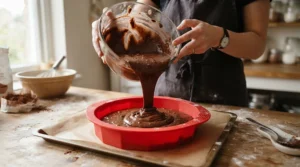
Platinum silicone is silicone cured with a platinum catalyst. In general terms, that gives a clean, stable, odour-free material. The cheaper alternative, peroxide curing, can leave small by-products behind, which is one reason lower-grade moulds sometimes smell. Brands like Lékué and Silikomart lead with platinum silicone in their marketing for that reason.
Here is the nuance most listings skip. Terms like “food grade” aren’t a guarantee on their own, and both curing methods can comply if they meet food-contact limits. So platinum silicone is a strong quality signal, but not the only legitimate one.
There’s also a folk test worth knowing. Pinch and twist a corner of the mould. Pure silicone shouldn’t change colour, whereas filler-heavy silicone can turn white at the stress point. It isn’t laboratory proof, but it costs nothing and takes five seconds.
For release specifically, platinum silicone matters because it keeps its flexibility and glossy surface over many bakes. A tired, tacky mould sticks. A fresh, supple one lets go. If you bake weekly, paying a little extra for platinum silicone is a sensible bet.
Oven Safe to 230°C: What a Heat Resistant Silicone Cake Mould Really Offers
Seeing oven safe to 230°C on a listing is reassuring, but it is a ceiling, not a recipe temperature. Sponges bake at roughly 160-180°C, so a heat resistant silicone cake mould rated to 230°C gives you a wide safety margin, even in a hot fan oven.
That’s why Lékué quoting 220°C and Silikomart quoting 230°C aren’t contradictory. They are different makers declaring their own tested limits. The Judge Silicone Round Cake Tin 23cm also stops at 220°C, and for cakes that rarely matters.
Three practical rules follow:
- Never put silicone under a grill or against a heating element.
- Trust a separate oven thermometer, because fan ovens often run hotter than the dial suggests.
- Never use silicone on a hob or for frying, however high the quoted rating.
If you want to push heat, such as roasting or very hot bakes, pick moulds with a published range, like the Silikomart Round Silicone Mould 20cm with Ring. Check the label on the product you actually receive, because specifications can differ between batches and listings.
Flexible Base Support: Do You Need a Frame?
Flexible base support is the difference between a mould you carry confidently and one you carry like a full pint on a train. Silicone alone is soft, so a full tin can bow in the middle and slop batter over the edge.
There are four ways to fix it:
- A hidden metal frame. The Lakeland Reinforced 12-Cup Mini Loaf Pan and Judge Silicone Round Cake Tin 23cm both use one to hold the rim rigid.
- A support ring. The Silikomart Round Silicone Mould 20cm with Ring uses a rigid ring, which also suits entremets.
- Handles. Those on the Lékué Round Cake Mould 20cm improve grip, but they don’t stop flex.
- A baking sheet. It’s an old trick that works with any silicone mould.
One golden rule: place the mould on the sheet before you fill it. Moving a full frameless mould is how most spills happen. If you bake weekly, a frame is a small premium for a lot of peace of mind. If you bake rarely, a sheet and a steady hand cost nothing.
Flexible Silicone Mould for Sponge Cake: Getting a Better Crumb
A flexible silicone mould for sponge cake behaves differently from metal because silicone insulates. It heats gently, which helps delicate batters rise evenly. The flip side is paler, softer sides, so don’t judge doneness by colour alone.
Fill to about two-thirds. Tap the filled mould once to burst large bubbles. Bake on a sheet in the centre of the oven, then test with a skewer rather than the clock, since silicone can shift timings by a few minutes either way.
Cooling is the secret to clean release. Leave the cake in the mould for about ten minutes so the structure sets, then ease the sides away and press the base. Cut too early and you tear a warm sponge. Wait until stone cold and some cakes cling.
For a smooth top, level the batter with a spatula. For a golden finish, remove the cake from the mould for the last few minutes on a rack, if your recipe allows. A flexible silicone mould for sponge cake rewards patience more than force.
Silicone vs Metal Cake Tins: An Honest Comparison
| Factor | Silicone | Metal | Best For |
|---|---|---|---|
| Release | Peel and push, often little greasing | Needs greasing and lining | Silicone for delicate sponges |
| Browning | Paler sides and base | Deeper, crisper colour | Metal for crusty bakes |
| Stability | Flexes unless reinforced | Rigid | Metal for heavy batters |
| Storage | Folds and stacks flat | Bulky | Silicone for small kitchens |
| Lifespan | Long if cared for | Long, but coatings wear | Either, with care |
The table shows that neither material wins outright; they solve different problems. Silicone owns release and storage. Metal owns browning and rigidity. For soft sponges where a pale edge doesn’t matter, silicone is the easier life.
Consumer group Choice reports from past tests that there’s little or no difference in cooking performance between silicone and metal. It also recommends a metal baking sheet underneath silicone for stability. So the decision comes down to convenience rather than chemistry.

Practical Guide: From First Wash to First Release
New moulds repay a little care in the first 30 days.
- Wash before first use. Hot soapy water or the dishwasher removes manufacturing residue and any faint smell.
- Grease once. Lightly butter the first bake, even if the maker says it’s unnecessary. It conditions the surface.
- Set up the tray. Place the mould on a baking sheet before filling.
- Mind the temperature. Stay comfortably below the rated ceiling, and use an oven thermometer.
- Cool in the mould. Wait about ten minutes, then peel the sides back and push the base.
- Clean promptly. Wash soon after use so oils can’t build into a tacky film.
Common first-month mistakes include cutting inside the mould, which scores the surface, and levering with sharp knives. Stacking moulds while they’re still warm is another. Silikomart also advises against strong detergents to extend lifespan. Store flat or loosely rolled, never sharply folded, and your mould should stay supple for years.
Real-World Scenarios: Matching the Mould to the Baker
The weekend sponge baker. Someone making a Victoria sponge every Sunday wants reliability, not novelty. The Lékué Round Cake Mould 20cm or the Judge Silicone Round Cake Tin 23cm fits, with the Judge giving extra rigidity for bigger bakes. Budget about £10-£22 for either.
The birthday-party host. Baking for a dozen children means identical portions and no tears. The Lakeland Reinforced 12-Cup Mini Loaf Pan delivers twelve little cakes per tray. Because the frame keeps it steady, it’s easy to carry with one hand, which suits a kitchen full of excitable guests.
The tiered-cake enthusiast. Rainbow or layered cakes need several sizes at once. The SILIVO 4-Piece Cake Mould Set covers four diameters in one purchase. Use a tray underneath, and check the listing for your preferred size variant.
The celebration-cake maker. For weddings, showers or milestone birthdays, the Silikomart Cloud gives you a showpiece. The cost per use only makes sense if you bake occasion cakes regularly.
The Bundt devotee. If your favourite cakes have ridges, the Lékué Deep Silicone Gugelhupf Mould 22cm suits you. Detailed shapes are where silicone’s flexibility pays back most.
Problem and Solution: Fixing Common Silicone Mould Headaches
Problem: the cake is pale and soft on the sides. Silicone insulates, so this is normal. Bake slightly longer, or remove the cake from the mould for the last few minutes on a rack.
Problem: the mould spills when I carry it. Fill it on a baking sheet. If it keeps happening, move up to a framed option such as the Judge Silicone Round Cake Tin 23cm.
Problem: the surface feels greasy or tacky. Oils build up over time. Soak in hot soapy water, or wash in the dishwasher where the maker allows it. One retailer suggests boiling water if white marks appear after repeated dishwasher cycles.
Problem: the cake stuck. Cooling too long or cutting too early is the usual culprit. Aim for the ten-minute rest, and try a light butter coating for delicate recipes.
Problem: there’s a lingering smell. Wash thoroughly. Persistent odour can hint at lower-grade silicone, which is another argument for platinum silicone.
Safety and Regulations: What UK Bakers Should Know
In Britain, bakeware that touches food falls under food-contact-materials law. The government’s overview of food contact materials regulations applies across England, Northern Ireland and Wales. The Food Standards Agency also publishes guidance on food contact materials for businesses.
In England, the Materials and Articles in Contact with Food (England) Regulations 2012 sit at the heart of the rules. They provide for enforcement of the underlying framework, and in plain terms, materials must not transfer substances to food in harmful amounts.
For you as a buyer, that translates into simple habits. Buy from named brands with clear specifications. Prefer platinum silicone or a recognised food-safety test. Avoid moulds with a strong chemical smell or oily film, and never exceed the stated temperature. Regulation sets a floor, not a quality guarantee, so product details and reviews still matter.
If a listing gives no material details at all, treat that as a warning sign. Names like the Judge Silicone Round Cake Tin 23cm and Lékué Round Cake Mould 20cm at least state their material and limits up front.
Long-Term Cost and Maintenance
A mould costing £12-£22 that lasts years beats a cheap tin you replace when the coating wears. The Lékué Round Cake Mould 20cm and Silikomart Round Silicone Mould 20cm with Ring cost little per bake if they stay supple for hundreds of uses. The Silikomart Cloud only justifies its premium if you bake occasion cakes often.
Maintenance is straightforward. Wash promptly, avoid sharp tools, store flat and keep moulds away from direct heat. Silicone can pick up pigments and odours from strongly spiced foods, so a soak in hot water with a little bicarbonate of soda can help.
Guarantees are an underrated value signal. Lakeland Reinforced 12-Cup Mini Loaf Pan comes with a three-year guarantee, and the Judge Silicone Round Cake Tin 23cm with two. That tells you the makers expect them to last.
For budget buyers, the SILIVO 4-Piece Cake Mould Set lowers the cost of entry. It carries more uncertainty about longevity, so test one size before you commit your whole baking routine to it.

Frequently Asked Questions
❓ Can a silicone cake mould go straight from freezer to oven?
❓ Is a silicone cake mould safe for food?
❓ How long does a silicone cake mould last?
❓ Do you need to change baking time in silicone?
❓ What size silicone mould replaces an 8-inch tin?
Conclusion
The best silicone cake mould for easy release depends on how you bake. For a dependable everyday sponge, the Lékué Round Cake Mould 20cm and the Silikomart Round Silicone Mould 20cm with Ring offer platinum silicone quality and clear heat ratings. For wobble-free handling, the Lakeland Reinforced 12-Cup Mini Loaf Pan and the Judge Silicone Round Cake Tin 23cm stand out thanks to their hidden metal frames. For showpiece cakes, the Silikomart Cloud delivers, and for budget layers, the SILIVO 4-Piece Cake Mould Set is a low-risk way to try silicone. If Bundt shapes are your thing, the Lékué Deep Silicone Gugelhupf Mould 22cm is the specialist.
Remember what matters most. Check the material, check the temperature rating, support the mould with a baking sheet or frame, and respect the cooling time. A heat resistant silicone cake mould that is oven safe to 230°C gives you headroom, but your recipe will rarely need it.
Where reviews were thin, I’ve said so, so check current ratings and availability before you buy. Pick the mould that fits your oven, your recipes and your patience, and enjoy a cake that simply slides out.
✨ Ready to retire the knife-and-prayer routine?
🍰 Click any highlighted product above to check current price and availability, then bake your next sponge with confidence!
Recommended for You
- Non Stick Tin For Gluten Free Sponge: 7 Best Foolproof Picks (2026)
- Omelette Pans Under £20: 7 Best Budget Picks For UK Hobs (2026)
- Best Omelette Pan: 7 Proven Picks For UK Kitchens (2026)
Disclaimer: This article contains affiliate links. As an Amazon Associate, I earn from qualifying purchases. If you purchase products through these links, we may earn a small commission at no additional cost to you.
✨ Found this helpful? Share it with your friends! 💬🤗
