In This Article
What is the best omelette pan? The best omelette pan is a 20-24 cm non-stick or well-seasoned pan with gently flared sides, a flat base and an evenly heating body. Eggs release cleanly, fold without tearing and cook gently. For most UK kitchens, that also means induction-ready, lightweight enough to tilt one-handed, and easy to clean.
Eggs are the least forgiving ingredient in the kitchen. Ten seconds too long and you’ve got rubber. One sticky patch and your elegant fold becomes scrambled eggs with ambitions. The omelette has been testing cooks since the French word came into use in the mid-16th century, and the pan has always been half the battle.
So this guide does the groundwork. It compares seven real, UK-available pans, from budget stone-effect coatings to a lifetime carbon steel classic. For each I’ve looked at the specifications, what they mean at the hob, and where marketing outruns the metal. You’ll also find a plain-English look at omelette pan vs frying pan, honest non-stick coating comparisons, and advice on choosing an omelette pan for fluffy eggs. There are no exact prices, because they change daily. You get price bands and context instead.
One honest note before we start. I haven’t cooked on these pans, so none of what follows is a hands-on test. It’s analysis built on real specifications, published UK roundups and the sort of problems reviewers tend to raise. Where I couldn’t verify something, I say so.
Best Omelette Pan Quick Comparison Table
| Pan | Size | Build and coating | Induction | Best for |
|---|---|---|---|---|
| Blackmoor Classic 24 cm | 24 cm | Forged aluminium, hybrid stone coating | Yes | All-round budget value |
| ZUOFENG 24 cm | 24 cm (20 and 28 cm also sold) | Aluminium, granite-effect coating | Yes | Stylish everyday cooking |
| MasterClass Eco 20 cm | 20 cm | Aluminium with iron base, ceramic coating | Yes | Solo breakfasts |
| ilimiti 22 cm | 22 cm | Die-cast aluminium, stone-derived coating | Yes | Easy slide-out omelettes |
| TECHEF Frittata and Omelette Pan | Roughly 24 cm | Aluminium, Teflon Select | No | Folded omelettes to share |
| De Buyer Mineral B 24 cm | 24 cm rim | Carbon steel, beeswax finish | Yes | Lifetime use, no coating |
| Le Creuset 3-Ply 20 cm | 20 cm | 18/10 stainless steel, three-ply, non-stick | Yes | Premium daily driver |
Looking at the table, the Blackmoor Classic 24 cm and ZUOFENG 24 cm give budget buyers the most pan for the least outlay, and both work on induction. The TECHEF Frittata and Omelette Pan is the only one that won’t, so check your hob first. The De Buyer Mineral B 24 cm is the odd one out, since it has no synthetic coating and rewards a little effort.
💬 Just one click — help others make better buying decisions too!😊
Top 7 Best Omelette Pan Picks: Expert Analysis
1. Blackmoor Classic 24 cm — best all-round value for most UK homes
The standout is how sensible the package is: a forged aluminium body, a hybrid stone coating and a cool-touch handle, all at a budget-tier price. Forged aluminium gives the pan some heft and spreads heat evenly. That matters because hot spots scorch the edge of an omelette before the centre has set. It’s rated for induction, electric and gas, so it survives a future hob upgrade. At 24 cm, it handles roughly a three-egg omelette.
On paper, this suits anyone who wants one pan for omelettes, fried eggs and general frying. It’s sold as a general frying pan rather than a dedicated omelette shape, so the slide-and-fold takes a touch more wrist. I couldn’t verify a large enough pool of recent reviews to summarise honestly. What is on record is that a UK cookware roundup (Chef’s Pick) ranked it a top pick for induction hobs, citing its coating and heat holding. When you check reviews, scan for comments on coating wear after six months.
Pros:
- ✅ Forged aluminium spreads heat evenly
- ✅ Works on induction, gas and electric hobs
- ✅ Cool-touch handle keeps control comfortable
Cons:
- ❌ General frying pan shape, not a true omelette profile
- ❌ Non-stick coatings wear eventually at any price
Budget tier, typically under £25 (check current price). Value verdict: hard to beat as a first purchase.
2. ZUOFENG 24 cm — best-looking pan with a cool wooden handle
The wooden handle is the hook. It stays comfortable while the pan works, and it gives the pan a more considered look than most budget cookware. The body is aluminium with a ferrous base, which is how it earns induction compatibility, and the granite-effect coating is described as PFOA-free. You can buy it in 20, 24 and 28 cm, which is handy if you want to match size to appetite.
Here’s what to weigh. A wooden handle is lovely to hold but limits oven use, so it’s a hob-first pan. The 24 cm size suits a two-to-three egg omelette. One caution on marketing: “granite” and “stone” aren’t regulated terms, so read the listing to see what the coating actually is. Reviews for lesser-known brands can swing, so check the latest feedback on handle fixing and coating durability rather than trusting the headline score.
Pros:
- ✅ Cool wooden handle feels comfortable and looks good
- ✅ Induction-ready with a ferrous base
- ✅ Three sizes available to suit different appetites
Cons:
- ❌ Wooden handle restricts oven use
- ❌ Lesser-known brand, so check recent reviews
Budget tier, typically under £25 (check current price). Value verdict: a strong choice if looks and comfort matter to you.
3. MasterClass Eco 20 cm — best chemical-free ceramic pick for solo breakfasts
MasterClass is a well-known UK cookware range, and this 20 cm pan uses a ceramic coating that the maker markets as chemical-free. A flat iron base makes the aluminium body induction compatible. At 20 cm, it’s sized for a one-to-two egg omelette, which is exactly what most people cook on a Tuesday morning.
Ceramic suits cooks who want to avoid PTFE-type coatings. The trade-off is that ceramic can lose its slickness sooner than traditional PTFE, according to expert commentary on non-stick durability. So treat it kindly: medium heat, no metal tools, no dishwasher. UK roundups single this pan out for its low price and clean design. I couldn’t verify a broad review sample, so check recent buyer comments on how the coating holds up after a few months of daily egg cooking.
Pros:
- ✅ Ceramic coating suits PTFE-avoiding cooks
- ✅ Compact 20 cm size is ideal for one or two eggs
- ✅ Induction-ready with a flat iron base
Cons:
- ❌ Ceramic may lose slickness faster than PTFE
- ❌ Too small for family-sized omelettes
Budget tier, typically under £25 (check current price). Value verdict: a smart low-cost choice if you’re careful with heat.
4. ilimiti 22 cm — best curved-side shape for effortless slides
The curved sides are the clever bit. They let a spatula glide under the omelette and let the whole thing slide onto a plate. The 22 cm pan has a scratch-resistant, stone-derived coating that the seller describes as mineral-based and a heavy die-cast body. The heft helps the pan hold its temperature when cold eggs hit it. The Bakelite handle and induction suitability round out a practical spec.
I’d flag two points. A heavy die-cast pan is steadier on the hob but a little more tiring to tilt and flip than the lightest options. And “mineral-based” is a manufacturer claim, so take it as marketing rather than gospel. For a fluffy, evenly set result, the thick base is the real asset. A UK roundup praised its coating and shape. As with the others, check the most recent reviews for coating longevity, because that’s where budget pans usually separate themselves.
Pros:
- ✅ Curved sides make slides and folds easier
- ✅ Heavy die-cast body holds steady heat
- ✅ Induction-suitable with scratch-resistant coating
Cons:
- ❌ Heavier to tilt than lighter pans
- ❌ Coating claims come from the manufacturer
Budget to lower mid-range, roughly £15-£30 (check current price). Value verdict: good shape and substance for the money.
5. TECHEF Frittata and Omelette Pan — best folding pan for symmetrical omelettes
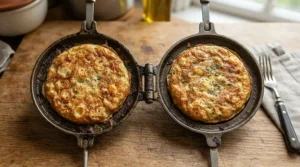
This is the showpiece of folding pan designs. The pan splits into two hinged halves, so you cook the omelette flat, add fillings, then fold one half over the other. The cooking area measures about 9.5 by 10.5 inches (roughly 24 by 25 cm), big enough for four eggs. The Teflon Select coating is PFOA-free, and the pan is aluminium, so it’s light.
Who is it for? Sharers and filling-lovers. It makes a neat, restaurant-style half-moon with far less drama than a traditional flip. Practice matters, though, because UK reviewers note that bits of omelette can escape over the side if you fold carelessly. It is not induction-compatible, which rules it out for many modern kitchens. Check recent reviews for comments on hinge durability, since moving parts are where folding pans fail.
Pros:
- ✅ Hinged design folds omelettes without flipping
- ✅ Generous cooking area fits four eggs
- ✅ Light aluminium body is easy to handle
Cons:
- ❌ Not compatible with induction hobs
- ❌ Folding takes practice to avoid spillage
Mid-range, roughly £25-£45 (check current price). Value verdict: excellent for brunch hosts with gas or ceramic hobs.
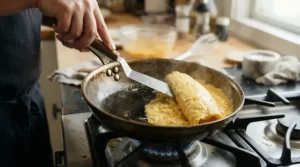
6. De Buyer Mineral B 24 cm — best long-life carbon steel pan
The standout is longevity. This is carbon steel (about 99% iron, 1% carbon) with a beeswax finish, and it carries no synthetic non-stick layer. Once you’ve seasoned it, it develops a natural non-stick patina that improves with use. The 24 cm label refers to the rim, and the actual cooking surface is closer to 16 cm across. That makes it a precise tool for two or three eggs rather than a family-sized skillet. The riveted French-style handle gives leverage, and the pan works on all hobs including induction.
Here’s what the spec sheet won’t tell you: the coating that wears out is the one thing this pan doesn’t have. The price you pay is routine. You’ll need to season it, dry it promptly and avoid soaking. The coated handle also means only brief oven use. Chef’s Pick named it its overall recommendation. I couldn’t verify review volume, but the common theme with carbon steel is a learning curve followed by loyalty.
Pros:
- ✅ No coating to wear out or flake
- ✅ Suitable for all hobs including induction
- ✅ Can last for decades with good care
Cons:
- ❌ Needs seasoning and careful drying
- ❌ Coated handle limits oven time
Mid-range, roughly £25-£45 (check current price). Value verdict: arguably the best long-term value on this list.
7. Le Creuset 3-Ply 20 cm — best premium build for daily use
The standout is the construction. Three bonded layers of stainless steel and aluminium combine fast, even heating with an 18/10 stainless exterior that doesn’t absorb flavours. It’s compatible with induction, and the 20 x 4 cm shape suits a two-egg omelette. Of the pans here, it’s the one that feels built for a decade of breakfasts.
The non-stick layer still wears over time, as every coating does, so “premium” doesn’t mean “immortal”. What you’re paying for is the body: it resists warping, heats evenly and looks the part. It’s sensible for cooks who make omelettes often, dislike replacing pans, and have a budget to match. UK roundups call it the most expensive pan in their list and praise its build quality. Check recent reviews for coating longevity comments before you commit.
Pros:
- ✅ Three-ply body heats quickly and evenly
- ✅ Induction-ready stainless steel construction
- ✅ Premium build resists warping
Cons:
- ❌ Highest price on this list
- ❌ Only a compact 20 cm size
Premium tier, roughly £60-£90 (check current price). Value verdict: worth it only if you’ll use it near daily.
| Pan | Key spec | Price band | Best for |
|---|---|---|---|
| Blackmoor Classic 24 cm | Forged aluminium, cool-touch handle | Under £25 | One pan for everything |
| ZUOFENG 24 cm | Wooden handle, ferrous base | Under £25 | Comfort and looks |
| MasterClass Eco 20 cm | Ceramic coating, iron base | Under £25 | Solo breakfasts |
| ilimiti 22 cm | Die-cast body, curved sides | £15-£30 | Easy slides |
| TECHEF Frittata and Omelette Pan | Hinged, about 24 x 25 cm cooking area | £25-£45 | Sharing, folded omelettes |
| De Buyer Mineral B 24 cm | Carbon steel, about 16 cm cooking surface | £25-£45 | Decades of use |
| Le Creuset 3-Ply 20 cm | Three-ply stainless, non-stick | £60-£90 | Premium daily cooking |
Star ratings are left out of the table because they shift daily, and these price bands are indicative only, so check current prices. Reading across, the Blackmoor Classic 24 cm and MasterClass Eco 20 cm undercut the field, while the Le Creuset 3-Ply 20 cm costs several times more. That premium only pays off if you cook eggs most mornings. If you want longevity without paying Le Creuset money, the De Buyer Mineral B 24 cm is the quiet winner.
✨ Ready to Find Your Pan?
🍳 Compare the options above, click any highlighted pan name to check current pricing and availability, and pick the size and material that match your hob and your breakfast habits.
Breakfast Cooking Techniques: Setup, Heat Control and Your First 30 Days
A good pan rewards good habits, and these breakfast cooking techniques apply to almost any pan above. Start by washing a new pan, drying it fully, and, if it’s carbon steel, seasoning it per the maker’s instructions. For non-stick, a light wipe of butter or oil on first use is plenty.
Then follow the standard method. Delicious magazine’s walkthrough recommends a medium heat, a knob of butter and waiting until it foams. Pour in the beaten eggs and swirl to cover the base. Gently draw the set edges inward with a spatula, tilt the pan so the liquid runs into the gaps, then fold.
The mistakes that shorten a pan’s life tend to arrive in the first 30 days:
- Week one: learn your hob’s medium. Induction heats faster than gas, so you’ll need less power than you expect.
- Week two: switch to silicone or wooden utensils for good.
- Week three: hand wash after each use, because dishwashers are hard on coatings and carbon steel.
- Week four: keep the pan for eggs and delicate foods, and use a different pan for searing meat.
Heat control also matters more than technique. A pan that’s too hot browns the omelette before it sets and speeds up coating wear. The pan can only do half the job, so your hand on the dial does the rest.
Real-World Scenarios: Matching the Best Omelette Pan to Your Kitchen
Specifications only matter in context, so here are three realistic profiles.
The student with an induction hob and a tight budget. You cook eggs most days and have limited cupboard space. A MasterClass Eco 20 cm or Blackmoor Classic 24 cm fits: both are induction-ready, cheap and easy to wash. If you share a kitchen and only need a pan for one, the 20 cm size is the more practical choice.
The family brunch host. Sunday brings four hungry people and fillings galore. The TECHEF Frittata and Omelette Pan gives you four-egg capacity and a neat fold, but only if you have a gas or ceramic hob. On induction, the ZUOFENG 24 cm or Blackmoor Classic 24 cm does the same job with a traditional fold.
The keen cook who hates replacing things. You make omelettes several times a week and want a pan that gets better with age. The De Buyer Mineral B 24 cm suits you, provided you don’t mind the seasoning routine. If you’d rather avoid maintenance and have a premium budget, the Le Creuset 3-Ply 20 cm is the lower-effort alternative.
Think about frequency too. Cooking omelettes two or three times a week can justify a mid-range pan, while once a month rarely justifies more than a budget option.
Problem and Solution: Why Your Omelettes Stick, Brown or Break
Most omelette disasters come down to four fixable problems.
Problem 1: it sticks. The pan was probably too cold when the eggs went in, or the coating is worn. Heat the pan first, add butter, and wait for the foam to settle. On a carbon steel pan like the De Buyer Mineral B 24 cm, sticking usually means it needs re-seasoning.
Problem 2: it browns too fast. The heat is too high. Drop it to medium. Heavier bases such as the ilimiti 22 cm are more forgiving because they smooth out temperature swings.
Problem 3: it tears when folding. The omelette is overset or the pan is too big for the eggs. Use the size guidance later in this guide: roughly 20 cm for two eggs, 25 cm for three. A hinged pan like the TECHEF Frittata and Omelette Pan removes the flipping step entirely.
Problem 4: it comes out rubbery. You’ve overcooked it. Take it off the heat while the top is still slightly glossy, because residual heat finishes the job. Eggs go from silky to tough quickly, so patience here matters more than any pan upgrade.
How to Choose the Best Omelette Pan
Choosing the best omelette pan comes down to six decisions, in this order:
- Check your hob. Induction needs a magnetic base. Hold a fridge magnet to the pan’s underside, and if it sticks firmly you’re set. Gas and electric are more forgiving.
- Pick the size by egg count. Roughly 20 cm suits two eggs, 25 cm suits three, and 30 cm suits four. Remember that rim diameter isn’t cooking surface, as the De Buyer Mineral B 24 cm shows.
- Choose your surface. PTFE-type non-stick offers the easiest release, ceramic suits those avoiding PTFE, and carbon steel trades convenience for longevity.
- Look at the sides. Gently flared sides help you slide and fold. Straight sides suit rolled Japanese-style omelettes.
- Test the handle mentally. It should feel balanced, stay cool and fit your grip. Wooden handles limit oven use.
- Decide how long you want it to last. Budget pans are cheap to replace, while carbon steel or premium multi-ply pans cost more upfront and less over time.
Omelette Pan vs Frying Pan: What Actually Differs?
The omelette pan vs frying pan question has a simple answer: they’re close cousins, and the differences are small but useful. An omelette pan typically has more flared sides, a flatter base and a longer handle for control. A standard frying pan has straighter sides and is designed for searing and shallow frying.
| Factor | Omelette pan | Frying pan | Electric omelette maker |
|---|---|---|---|
| Sides | Flared, easy slide | Straighter, more depth | Enclosed moulds |
| Versatility | Eggs, pancakes, delicate foods | Everything | Omelettes only |
| Learning curve | Moderate | Moderate | Very low |
| Storage | Compact | Varies | Bulky |
| Best for | Regular omelette cooks | General cooking | Hands-off cooks |
Honestly, a decent non-stick frying pan will cook a perfectly good omelette. Chef’s Pick makes the same point: if you only cook omelettes occasionally, a specialist pan isn’t essential. The advantage of a dedicated pan is control. The sloped sides help the omelette glide out and the smaller footprint keeps eggs thick enough to fold. For example, the Blackmoor Classic 24 cm is a frying pan that doubles as an omelette pan, while the ilimiti 22 cm leans closer to a true omelette shape. If you want one pan for everything, buy the former. If you want better omelettes, choose the latter.
Non-Stick Coating Comparisons: PTFE, Ceramic, Stone-Effect and Bare Steel
These non-stick coating comparisons cut through the jargon. PTFE-based coatings (like the Teflon Select on the TECHEF Frittata and Omelette Pan) give the slickest release and tend to last longer than ceramic. Overheating is their main weakness, because PTFE coatings can begin breaking down at around 260°C (500°F), which is well within reach of an empty pan on high heat.
Ceramic coatings, such as the MasterClass Eco 20 cm, avoid PTFE and feel cleaner to some buyers, but they can lose slickness faster. Stone-effect or granite coatings, such as those on the ZUOFENG 24 cm and Blackmoor Classic 24 cm, are mostly a marketing category. Read the listing carefully, because the terms aren’t regulated and it isn’t always obvious what’s underneath. Carbon steel, as on the De Buyer Mineral B 24 cm, uses seasoning instead of a coating, so there’s nothing to chip.
The phrase “PFOA-free” also deserves a pause. It tells you one specific chemical is absent, not that the coating is PTFE-free. If avoiding PTFE matters to you, look for that exact wording on the listing. And whatever you pick, medium heat is the single best way to protect any surface.
Choosing an Omelette Pan for Fluffy Eggs
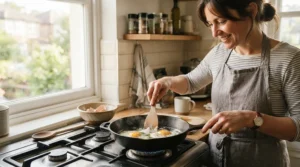
An omelette pan for fluffy eggs does three things: it heats evenly, holds temperature when cold eggs go in, and lets you control the set. Thick, heavy bases like the ilimiti 22 cm and Blackmoor Classic 24 cm are more forgiving than thin, light pans, which swing from cold to scorching quickly.
Size matters just as much. Fluffiness comes from depth, and a pan that’s too big spreads the eggs thin. For two eggs, a 20 cm pan like the MasterClass Eco 20 cm or Le Creuset 3-Ply 20 cm keeps the layer deep enough to puff. Technique does the rest: whisk the eggs thoroughly, optionally add a splash of water for extra lift (a tip from UK cooking guides), and cook gently rather than fast.
The pan can’t create fluffiness from nothing. What it does is stop the things that kill it: scorching, sticking and uneven setting. Even heat plus a sensible size gives you the best chance, and the rest is your wrist.
Folding Pan Designs: Hinged, Rolled and Classic Flip
Folding pan designs fall into three families. Hinged pans like the TECHEF Frittata and Omelette Pan split into two halves, so you fold the pan, not the egg. Rolled-omelette pans (such as Japanese tamagoyaki pans) have straight sides and a rectangular shape for layered rolls. Classic flared-side pans, including the ilimiti 22 cm and De Buyer Mineral B 24 cm, rely on your technique.
Which should you choose? Wikipedia’s list of French omelettes notes that there are two basic types, folded and flat. That’s a useful reminder that a “right” omelette depends on style. Hinged pans make folded omelettes foolproof but suit fewer hobs and add a moving part that can wear. Classic pans take more skill but are versatile, durable and compatible with induction.
If you’re a beginner who loves fillings, a hinged pan is a confidence booster. If you want a pan that doubles as a daily frying pan, stick with a classic shape.
Long-Term Cost and Maintenance: What Each Pan Really Costs You
The cheapest pan isn’t always the cheapest over time. Non-stick coatings wear, so a budget pan may need replacing every few years with careful use, while carbon steel can last for decades.
| Tier | Typical band | Example | Likely lifespan | Verdict |
|---|---|---|---|---|
| Budget | Under £25 | Blackmoor Classic 24 cm | A few years with care | Best for low outlay |
| Mid-range | £25-£45 | De Buyer Mineral B 24 cm | Potentially decades | Best long-term value |
| Premium | £60-£90 | Le Creuset 3-Ply 20 cm | Long-lived body, coating still wears | Best for heavy use |
Lifespans are broad estimates based on typical care, not guarantees. Spread over years, a mid-range carbon steel pan often costs less per breakfast than a budget pan replaced twice. The Blackmoor Classic 24 cm still wins for anyone who wants a low-risk entry point. Maintenance is the hidden cost: carbon steel asks for a little routine, while coated pans ask for gentle heat and soft utensils. Choose the maintenance style you’ll genuinely keep up.
Safety, Regulations and Egg Handling
Pan safety is mostly about heat. Overheating a non-stick pan, especially an empty one, is the common way to damage the coating and, with PTFE, to release fumes. Keep the heat medium, never leave an empty pan on the hob, and ventilate the kitchen.
In Great Britain, cookware that touches food must meet food-contact materials rules, so buy from reputable sellers and avoid unbranded pans with no information. PFOA is also restricted under UK rules, which is why most listings now advertise “PFOA-free”.
Egg safety matters too. The Food Standards Agency changed its advice in 2017 so that eggs produced under the British Lion Code can be eaten lightly cooked or raw, even by vulnerable groups, as Food Standards Scotland’s review of the advice explains. The advice doesn’t extend to severely immunocompromised people, and eggs without the Lion mark should still be thoroughly cooked. That’s useful if you like a soft, creamy French-style omelette.
FAQ
❓ What is the best omelette pan for an induction hob?
❓ How much should I spend on the best omelette pan?
❓ How often should I replace a non-stick omelette pan?
❓ Can an omelette pan go in the dishwasher?
❓ Do I need butter or oil in a non-stick omelette pan?
Conclusion
The best omelette pan is the one that matches your hob, your appetite and your patience for upkeep. For most UK households, the Blackmoor Classic 24 cm is the safest, cheapest way to get reliable results, and the ZUOFENG 24 cm and MasterClass Eco 20 cm offer budget alternatives with different handles and coatings. If you cook for others and have a gas or ceramic hob, the TECHEF Frittata and Omelette Pan makes folding almost foolproof. For a pan that rewards you for decades, the De Buyer Mineral B 24 cm is hard to argue with, and the Le Creuset 3-Ply 20 cm suits those who want a premium, low-fuss build. The ilimiti 22 cm sits neatly between, with a shape built for sliding.
Whichever you choose, remember the pan is only half the job. Medium heat, soft utensils and a little patience will do more for your breakfasts than any upgrade.
✨ Time to Upgrade Your Mornings!
🍳 Click on any highlighted pan above to check current pricing and availability, then treat yourself to a better omelette this weekend. 🥚
Recommended for You
- Crepe Pans Under £25: 7 Best Budget Picks For UK Cooks (2026)
- Best Crepe Pan: 7 Brilliant Picks For UK Kitchens (2026)
- Fondue Sets Under £45: 7 Brilliant Picks For UK Homes (2026)
Disclaimer: This article contains affiliate links. As an Amazon Associate, I earn from qualifying purchases. If you purchase products through these links, we may earn a small commission at no additional cost to you.
✨ Found this helpful? Share it with your friends! 💬🤗
