In This Article
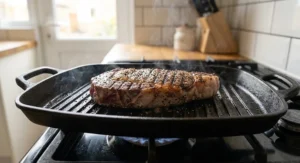
There’s a particular sound a kitchen makes right before something good happens: the hiss of a cast iron griddle pan meeting a room-temperature steak. Not a polite sizzle — a proper, aggressive crackle that tells you the pan is hotter than your instincts probably want it to be. That sound is doing more work than you’d think. It’s the sound of the Maillard reaction kicking in, the same browning chemistry that turns bread crust golden and coffee beans fragrant, and it’s the entire reason a good cast iron griddle pan earns a permanent spot on the hob rather than getting shuffled to the back cupboard.
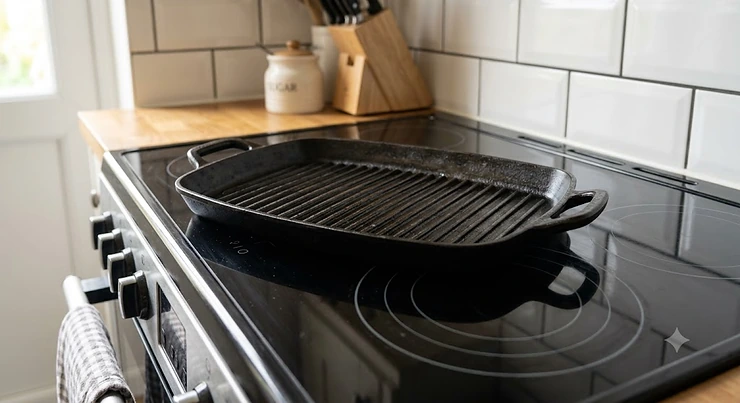
A cast iron griddle pan is essentially a flat or ridged iron cooking surface designed to sear food at high, sustained heat, mimicking the charred, smoky results of outdoor grilling from an indoor hob. Unlike a standard frying pan, its raised ribs lift food away from pooling fat, drain grease into the channels, and stamp those coveted char grill marks onto steak, halloumi, and vegetables alike.
Whether you’re chasing a steakhouse-style sear on a Tuesday night, weighing up a ridged cast iron pan against a smooth one, or hunting for a cast iron griddle pan with press to flatten bacon and smash burgers properly, this guide walks through seven genuinely available options, how they stack up, and how to actually use one without cracking it, rusting it, or setting off the smoke alarm. According to cookery experts interviewed by Kutir’s griddle pan guide, the ridges on a griddle pan aren’t just cosmetic — they let fat drain away from food while concentrating flavour, which is a large part of why chefs reach for cast iron over a flat frying pan when steak is on the menu.
Quick Comparison Table
| Product | Type | Weight | Best For |
|---|---|---|---|
| Lodge Pre-Seasoned Square Grill Pan | Ridged, single-sided | ~2.3kg | Budget steak searing |
| NutriChef Reversible Griddle Pan | Flat + ridged, reversible | ~3.4kg | Two-in-one versatility |
| Lodge Reversible Grill/Griddle | Flat + ridged, large format | ~4.5kg | Cooking for a crowd |
| VonShef Reversible Griddle Pan | Flat + ridged, reversible | ~2.9kg | Griddle-and-press steak nights |
| Netherton Foundry Spun Iron Baking Griddle | Flat, lightweight spun iron | ~1.8kg | Lightest handling, British-made |
| Skeppshult Traditional Grill Pan 25cm | Ridged, deep-cast | ~3.1kg | Heirloom-quality Swedish cast iron |
| Le Creuset Signature Square Skillet Grill | Ridged, enamelled | ~3.2kg | Low-maintenance premium searing |
A quick glance tells its own story: this is a spectrum from entry-level workhorse to lifetime investment, and weight is doing a lot of the talking. Heavier pans like the Lodge Reversible Grill/Griddle and Skeppshult Traditional Grill Pan 25cm hold heat more stubbornly once it’s built up, which matters enormously for searing, while lighter options like the Netherton Foundry Spun Iron Baking Griddle trade a touch of thermal mass for something your wrist will thank you for on a Tuesday. None of these are exact substitutes for each other, and that’s rather the point of the round-up below.
💬 Already got a favourite in mind? Scroll down to the full breakdown and check today’s availability before it sells out.
Top 7 Cast Iron Griddle Pans: Expert Analysis
1. Lodge Pre-Seasoned Square Grill Pan — best budget pan for steak
The Lodge Pre-Seasoned Square Grill Pan is the pan most people picture when they hear “cast iron griddle pan,” and there’s a reason it’s stayed a bestseller for decades. It ships pre-seasoned with Lodge’s proprietary vegetable oil coating, meaning you can get a steak into it within minutes of unboxing rather than spending an evening building up seasoning from scratch.
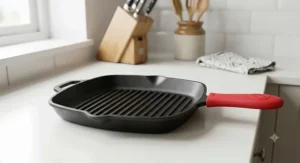
At roughly 26cm square with deep, closely spaced ridges, this pan is built specifically for high-heat searing rather than delicate work. The thick cast iron base takes a good five to seven minutes to properly preheat, but once it’s there, it holds that heat with real stubbornness — exactly what you want when a cold steak hits the surface and you don’t want the temperature to crash. Based on the spec comparison with thinner aluminium griddles, that mass is the single biggest reason cast iron sears better than lighter alternatives; a thin pan loses heat the instant food touches it, while this one barely flinches.
Reviewers consistently report that the assist handle (a small loop opposite the main handle) makes a real difference when the pan is full and needs shifting into the oven, and that the pre-seasoning holds up well provided it’s dried thoroughly and never left to soak in the sink. A recurring theme in aggregated feedback is that first-time cast iron owners are pleasantly surprised by how little food actually sticks once the pan has a few cooks behind it, though a small number of reviewers note visible pinholes or minor casting imperfections — a normal characteristic of sand-cast cookware rather than a defect.
Pros:
- ✅ Arrives pre-seasoned and ready to cook on day one
- ✅ Exceptional heat retention for restaurant-style searing
- ✅ Affordably priced entry point into proper cast iron
Cons:
- ❌ Single-sided design limits it to ridged cooking only
- ❌ Deep ridges are fiddly to scrub clean by hand
Expect this pan to sit in the lower price bracket, generally under £40, which makes it one of the most accessible ways to try proper cast iron searing. Given the durability cast iron is famous for, the value case here is straightforward: this is a pan you’ll likely still own in a decade.
2. NutriChef Reversible Griddle Pan — best flat-and-ridged two-in-one
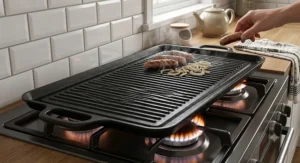
Where the Lodge square pan commits fully to ridges, the NutriChef Reversible Griddle Pan hedges its bets by giving you both surfaces on one slab of iron. Flip it one way for a smooth flat griddle perfect for pancakes, fried eggs, and flatbreads; flip it the other for the familiar ridged sear pattern.
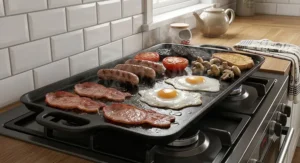
At around 51 x 26cm, this is a genuinely large cooking surface — big enough to griddle four rashers of bacon and a couple of eggs simultaneously, which matters more than spec sheets usually let on when you’re cooking breakfast for more than one person. The pan is compatible with induction, gas, electric, and oven use, and Nutrichef includes a metal scraper, a small but genuinely useful inclusion for maintaining the ridged side without resorting to steel wool that would strip the seasoning.
Who is this actually for? Based on the dual-surface design, it suits households that cook a genuine mix of griddled and flat-pan food rather than committing to steak nights exclusively. Aggregated review sentiment points to praise for the size and versatility, alongside a recurring caution that reversible pans of this weight need two hands and a clear worktop to flip safely — not a pan to manoeuvre one-handed straight from the hob.
Pros:
- ✅ Two cooking surfaces in a single pan
- ✅ Large enough for family-sized breakfasts
- ✅ Includes a metal scraper for maintenance
Cons:
- ❌ Heavy and awkward to flip when hot
- ❌ Handles run warmer than single-purpose grill pans
Priced in a similar bracket to premium non-stick griddles — typically the £35-£50 range — the value proposition rests on that dual surface effectively replacing two separate pans, which for smaller kitchens is a real space-saver.
3. Lodge Reversible Grill/Griddle — best large-format pan for cooking a crowd
Step up in scale and you land on the Lodge Reversible Grill/Griddle, a genuinely enormous rectangular slab measuring roughly 51 x 27cm that straddles two hob rings at once. This is the pan you reach for when you’re cooking a full fry-up for six or searing burgers for a garden party moved indoors by British weather.
The sheer thermal mass here is the standout feature: because it spans two burners, the surface temperature stays remarkably even edge to edge, avoiding the classic griddle problem where the centre scorches while the corners stay lukewarm. Lodge’s pre-seasoning process means, as with their square pan, this arrives ready to use, and the reversible design again offers flat and ridged options from the same casting.
What most buyers overlook about a pan this size is storage — it doesn’t fit in a standard drawer and needs a dedicated spot, either hung on a rail or stored flat in a lower cupboard. Reviewers consistently mention this as the one genuine drawback, alongside its considerable weight (expect to lift close to 4.5kg with food on it). For anyone regularly cooking for a household of four or more, though, aggregated feedback is overwhelmingly positive on the practical benefit of not needing a second batch to feed everyone at once.
Pros:
- ✅ Spans two hob rings for genuinely even heat
- ✅ Reversible flat and ridged surfaces
- ✅ Ideal for feeding larger households in one pass
Cons:
- ❌ Requires dedicated storage space
- ❌ Too heavy and large for one- or two-person kitchens
Sitting in the mid-price range, typically £45-£65, this pan earns its keep through batch-cooking efficiency rather than everyday convenience — it’s a specialist tool for a specific kind of household.
4. VonShef Reversible Griddle Pan — best griddle-and-press combo for steak nights
For anyone specifically hunting a cast iron griddle pan with press for genuinely restaurant-style results, the smartest real-world combination is the VonShef Reversible Griddle Pan paired with a dedicated cast iron accessory like the Lodge Cast Iron Grill Press. The VonShef pan itself is a solid, pre-seasoned reversible griddle with sturdy side handles, while the Lodge press — a flat, heavy disc of cast iron with a cool-grip spiral handle — sits on top of food to apply consistent, even downward pressure.
Here’s what the spec sheet won’t tell you: a press isn’t just about aesthetics. Pressing a smash burger flat the instant it hits the griddle maximises surface contact with the hot iron, which dramatically speeds up and deepens the Maillard browning across the whole patty rather than just the parts touching the pan unevenly. The same logic applies to bacon, which curls as fat renders unevenly; a press keeps it dead flat, cooking it more consistently and, per aggregated reviewer feedback on similar press products, noticeably crisper.
This combination is squarely aimed at the steak-and-burger crowd rather than the breakfast-and-pancakes crowd. Reviewers of the Lodge press specifically highlight its usefulness beyond burgers — for crisping bacon, flattening paninis, and searing pork chops evenly — while VonShef griddle owners report solid heat retention for the price point, with a handful of reviews noting the seasoning needs a couple of extra coats before it performs at its best.
Pros:
- ✅ Press dramatically improves surface contact and browning
- ✅ Versatile beyond burgers — bacon, paninis, pork chops
- ✅ Reversible griddle base adds flat-cooking flexibility
Cons:
- ❌ Two separate purchases rather than one bundled set
- ❌ Initial seasoning on the griddle may need topping up
Budget around £30-£45 for the griddle and a further £15-£20 for a quality press, putting the total combo in a similar bracket to a single premium griddle pan — a reasonable trade-off for the technique upgrade it delivers.
5. Netherton Foundry Spun Iron Baking Griddle — best lightweight British-made griddle
The Netherton Foundry Spun Iron Baking Griddle takes a genuinely different manufacturing approach from every other pan on this list. Rather than being sand-cast, it’s spun from a flat disc of 99.1% pure iron on a lathe by craftsmen at the company’s Shropshire works — the same traditional metal-spinning technique used for centuries, now largely rare in British manufacturing.
The practical upshot of spinning versus casting is weight: this griddle weighs roughly half what an equivalent cast iron pan does, while retaining similar heat-holding properties. For anyone who’s ever struggled to lift a full cast iron griddle one-handed to check on a pizza base or flip a stack of crumpets, that difference is immediately noticeable. The pan comes pre-seasoned with Sussex-sourced flax oil and, based on the spec comparison with mineral-oil seasoned pans, tends to build a smoother, more resilient patina over repeated use.
Who should care about this one specifically? Based on its design, it particularly suits bakers using it for pizza bases and flatbreads (Netherton markets it explicitly as a baking griddle) as well as anyone with wrist or grip concerns who finds standard cast iron genuinely difficult to manage. It’s a niche pick compared with the mass-market names on this list, but for buyers who value provenance and craftsmanship, this is one of the few British-manufactured options in the category. Netherton Foundry’s own product guidance recommends heating the pan gradually rather than blasting it with high heat immediately, since spun iron can warp if shocked with sudden temperature changes — a maintenance quirk cast-iron owners don’t typically need to worry about.
Pros:
- ✅ Roughly half the weight of equivalent cast iron
- ✅ Handmade in Britain using traditional metal-spinning
- ✅ Pre-seasoned with natural, food-safe flax oil
Cons:
- ❌ Must be heated gradually to avoid warping
- ❌ Premium price relative to mass-produced alternatives
Expect to pay a premium for this one, generally in the £60-£90 range depending on size, reflecting the hand-craftsmanship and smaller-batch production — genuinely a different value proposition to the mass-manufactured pans above it on this list.
6. Skeppshult Traditional Cast Iron Grill Pan 25cm — best Swedish heirloom grill pan
Sweden’s Skeppshult foundry has been casting iron cookware since 1906, and its Traditional Cast Iron Grill Pan 25cm is the kind of pan built with multi-generational use explicitly in mind — the company backs its cast iron with a 25-year warranty, a rarity in this category.
What sets this pan apart on paper is its use of virgin iron ore rather than recycled scrap, which Skeppshult states produces a denser, more consistent casting with fewer of the surface irregularities you sometimes find on budget sand-cast pans. The deep ridges and generous 25cm cooking diameter give plenty of room for a large steak or a couple of chicken breasts, and the pre-seasoning uses organic canola oil rather than synthetic coatings.
Here’s the honest trade-off: this pan is heavy, even by cast iron standards, and it demands the same manual seasoning maintenance as any raw cast iron pan — no enamel shortcut here. Reviewers and independent cookware retailers consistently describe the handle as notably more comfortable than typical cast iron handles, a detail that matters more than it sounds once you’re lifting a hot, food-laden pan repeatedly. Based on the spec comparison with pans half its price, the case for Skeppshult really comes down to longevity: buyers investing here are typically doing so expecting to own — and eventually hand down — one pan rather than replace several cheaper ones over the decades.
Pros:
- ✅ 25-year manufacturer warranty on cast iron
- ✅ Made from virgin iron ore for denser, more even casting
- ✅ Notably comfortable handle design
Cons:
- ❌ Among the heaviest pans in this comparison
- ❌ Requires ongoing manual seasoning like any raw cast iron
Positioned firmly at the premium end, typically in the £120-£150 range, this pan is best understood as a heritage purchase rather than a casual upgrade — but the warranty genuinely reflects confidence in the casting quality.
7. Le Creuset Signature Square Skillet Grill — best premium enamelled griddle pan
The Le Creuset Signature Square Skillet Grill takes the opposite maintenance philosophy to every raw cast iron pan on this list: rather than building and protecting a seasoning layer, its interior is finished in a durable black satin enamel that needs no seasoning at all, straight out of the box.
The high, closely spaced ridges are specifically engineered to create pronounced sear marks while channelling excess fat and grease away from food, and the two integrated pouring spouts allow drip-free draining — a small design touch that larger, cheaper griddles rarely bother with. Because the interior is enamelled rather than raw iron, this pan is dishwasher-safe, though hand-washing is recommended to preserve the exterior’s colour finish over time.
Aggregated reviews and cookware retailer comparisons consistently rank Le Creuset’s griddle among the most reliable performers for a clean, low-maintenance sear, with the trade-off being a price point considerably above the raw cast iron competition. What most buyers overlook about enamelled cast iron is that while it sidesteps rust and seasoning entirely, the enamel itself can chip if the pan is dropped or subjected to sudden extreme temperature shocks, so it rewards gentler handling than a raw iron equivalent. For anyone put off by the maintenance ritual of traditional cast iron but still wanting the heat retention and sear quality, this is the pan built specifically to solve that dilemma.
Pros:
- ✅ No seasoning required, ever
- ✅ Dual pouring spouts for drip-free fat drainage
- ✅ Available in Le Creuset’s full colour range
Cons:
- ❌ Enamel can chip if dropped or shocked with extreme heat
- ❌ Significantly pricier than raw cast iron alternatives
Positioned at the top of this comparison, generally in the £130-£160 range, the value case rests entirely on convenience: buyers are explicitly paying to skip the seasoning maintenance that every other pan on this list requires.
Benefits vs Traditional Alternatives
| Cooking Method | Sear Quality | Fat Drainage | Maintenance |
|---|---|---|---|
| Cast iron griddle pan | Excellent, deep char marks | High (ridged channels) | Seasoning required (unless enamelled) |
| Standard non-stick frying pan | Poor to moderate | None | Low |
| Outdoor charcoal BBQ | Excellent, smoky flavour | High | Weather-dependent, seasonal |
| Stainless steel griddle | Good, less pronounced marks | Moderate | Low, but no seasoning benefit |
Looking at the comparison above, the standout advantage of a cast iron griddle pan is that it delivers roughly 80% of an outdoor barbecue’s char and flavour without depending on the British weather cooperating. A standard non-stick frying pan simply can’t replicate the same depth of Maillard browning because it lacks both the thermal mass and the ridged fat-drainage design; food effectively steams in its own rendered fat rather than searing. Stainless steel griddles split the difference reasonably well but never quite match cast iron’s heat retention once a cold ingredient hits the surface.
✨ Don’t Miss These Exclusive Deals!
🔍 Take your indoor grilling to the next level with these carefully selected griddle pans. Click on any highlighted product above to check current pricing and availability. These pans will help you create authentic, chargrilled results your whole family will love!
Practical Usage Guide: Your First 30 Days with a Cast Iron Griddle Pan
Getting a new cast iron griddle pan right in the first month sets the tone for years of use, and most of the common mistakes happen early. Start by giving a pre-seasoned pan one light coat of a high smoke-point oil (vegetable, rapeseed, or grapeseed) before its very first use, even though it arrives “ready” — this tops up the factory coating and helps it survive that crucial first high-heat cook.
For the first few weeks, cook fattier foods deliberately: bacon, sausages, or oiled steak rather than delicate fish or eggs. Fat rendered during cooking bonds with the existing seasoning layer and thickens it, building genuine non-stick performance rather than relying on the thin factory coat alone. Avoid acidic ingredients like tomato-based sauces or a squeeze of lemon juice during this period, since acid actively strips fresh seasoning before it’s had a chance to bond properly.
The single most common early mistake is washing with soap and a scourer straight after cooking. Instead, while the pan is still warm, scrape off food debris with a spatula or the metal scraper many pans include, rinse with hot water only, and dry it immediately and thoroughly — ideally back on a low hob flame for sixty seconds to drive off every trace of moisture, since that’s the single biggest cause of rust in a new pan’s life. Finish with a very thin wipe of oil using kitchen roll before storing.
A quick maintenance rhythm worth adopting: re-oil lightly after every wash for the first month, then move to re-oiling roughly once a week with regular use once the seasoning is well established. If rust spots do appear despite your best efforts, don’t panic — a light scrub with fine steel wool, a re-oil, and one bake in a hot oven for an hour will usually restore the surface completely.
Real-World Scenario: Who Should Buy Which Pan
The Tuesday-night steak enthusiast, budget-conscious, cooking for two: This profile fits the Lodge Pre-Seasoned Square Grill Pan almost perfectly. It’s affordable, arrives ready to use, and its compact size heats up quickly on a single hob ring — ideal for someone who wants great sear results without a large kitchen footprint or a big financial commitment.
The family of five running a hectic weekend breakfast rota: Here, the Lodge Reversible Grill/Griddle or the NutriChef Reversible Griddle Pan make far more sense. Both offer enough surface area to cook multiple portions simultaneously, and the reversible flat side handles pancakes and eggs just as capably as the ridged side handles bacon and sausages.
The smash-burger obsessive who’s watched one too many diner videos: The VonShef Reversible Griddle Pan paired with a Lodge Cast Iron Grill Press is the clear match. The combination directly targets that specific technique — flattening patties hard against a screaming-hot surface for maximum caramelisation — in a way a standalone griddle alone can’t replicate.
The design-conscious cook who hates seasoning maintenance: The Le Creuset Signature Square Skillet Grill solves this precisely, trading a higher upfront cost for essentially zero ongoing seasoning ritual, while still delivering genuine sear performance thanks to its cast iron core beneath the enamel.
How to Choose a Cast Iron Griddle Pan
- Decide between raw cast iron and enamelled cast iron first. Raw iron sears slightly more aggressively and is cheaper, but demands seasoning upkeep; enamel needs zero maintenance but costs more and can chip.
- Match the size to your hob and household. A single-ring pan around 25-26cm suits one or two people; a double-ring pan over 45cm suits batch cooking for four-plus.
- Consider weight realistically. If you have wrist, shoulder, or grip concerns, spun iron options like Netherton Foundry are genuinely worth the premium over standard cast iron.
- Check oven-safe ratings if you plan to finish dishes under the grill. Most cast iron handles this fine; enamelled handles sometimes have lower maximum temperatures.
- Decide if you need reversible flat-and-ridged functionality, which effectively replaces two pans but adds weight and flipping awkwardness.
- Factor in a press if steak or smash burgers are the priority. A griddle pan and a separate cast iron press together often outperform a single all-in-one pan for that specific technique.
- Read the maintenance instructions before buying, not after — some spun and cast pans have specific heating-rate requirements that matter more than most buyers expect.
What is the Maillard Reaction? (And Why It’s the Whole Point)
The Maillard reaction is a chemical reaction between amino acids and reducing sugars that occurs when food is heated above roughly 140-165°C, producing the complex brown crust and savoury flavour compounds associated with searing, roasting, and toasting. It’s named after French chemist Louis-Camille Maillard, who first described the reaction in 1912, and it’s distinct from simple caramelisation because it involves proteins rather than sugar alone, as explained in detail on Wikipedia’s overview of the Maillard reaction.
For anyone using a cast iron griddle pan, this is the entire technical reason the pan needs to be properly hot before food goes anywhere near it. A lukewarm pan simply can’t reach Maillard temperatures fast enough, so instead of searing, the food steams in its own moisture and juices, producing grey, flavourless meat rather than a deep brown crust. This is precisely why cast iron’s thermal mass matters so much practically — it holds the surface temperature above that Maillard threshold even after a cold piece of meat is placed on it, where a thin, lightweight pan’s temperature would crash below the threshold and stall the browning process entirely.
Char Grill Marks Technique: Getting Restaurant-Quality Results
Achieving genuine, evenly spaced char grill marks — rather than one scorched patch and a pale pan otherwise — comes down to three factors most home cooks underestimate: preheat time, food surface moisture, and pan contact pressure.
First, preheat properly. Cast iron needs a genuine five to eight minutes on a medium-high flame before it’s ready; rushing this step is the single biggest reason home griddle marks look patchy rather than crisp. Second, pat food completely dry before it touches the pan — surface moisture creates steam, and steam actively prevents the direct iron-to-protein contact that produces clean sear lines. Third, resist the urge to move food around. Place it down at a slight diagonal to the ridges, press down gently (or use a proper griddle press for maximum contact), and leave it undisturbed for the full recommended time per side; constantly checking and shifting food breaks the developing crust and blurs the marks.
For genuine crosshatch marks, rotate the food 90 degrees roughly two-thirds of the way through cooking on the first side, rather than flipping early — this is the technique restaurant kitchens use, and it works identically on a home hob given a properly heated pan.
Griddle Press for Steak: Does It Actually Make a Difference?
Yes, and the mechanism is straightforward physics rather than marketing. A griddle press applies constant, even downward force across the entire surface of a steak or patty, eliminating the natural curl and doming that thinner cuts develop as muscle fibres contract unevenly under heat. That doming means only the highest points of the meat make full contact with the pan, while lower areas cook through convection and residual heat rather than direct conductive contact — which is far less effective at driving the Maillard reaction.
Reviewers of dedicated cast iron presses like the Lodge Cast Iron Grill Press consistently report the most noticeable improvement on thinner cuts — minute steaks, flattened chicken breasts, and particularly smash-style burger patties — rather than thick steaks, which are heavy enough to self-flatten reasonably well without assistance. For bacon specifically, a press is close to essential if you want uniformly flat, evenly crisped rashers rather than the classic curled, unevenly cooked result of unpressed bacon shrinking as its fat renders.
One practical tip: preheat the press alongside the pan itself. A cold press dropped onto hot food briefly cools the contact surface, undermining exactly the browning effect you’re trying to achieve.
Ridged vs Flat: Which Cast Iron Pan Surface Wins?
This is less a “better or worse” question than a “different job” one. Ridged cast iron pans excel specifically at draining fat away from food and imprinting visual char marks, which matters enormously for steak, halloumi, and vegetables where both flavour concentration and presentation count. The trade-off is reduced direct contact area — only the ridge tops actually touch the food, meaning slightly less overall browning coverage than a fully flat surface achieves.
Flat cast iron griddles, by contrast, maximise total surface contact, making them the better choice for pancakes, fried eggs, flatbreads, and anything where an even, unbroken golden colour matters more than dramatic char lines. They’re also considerably easier to clean, since there are no deep channels for stuck-on debris to hide in.
For anyone genuinely torn, a reversible pan like the NutriChef or Lodge options above sidesteps the decision entirely, offering both surfaces on one casting — the sensible middle ground for households whose cooking needs vary week to week.
Common Mistakes When Buying a Cast Iron Griddle Pan
The most frequent mistake is buying based on diameter alone without checking actual cooking surface area, since a round pan’s corners are unused space compared with a rectangular one of similar size. A close second is underestimating weight: a 4-5kg pan filled with food can be genuinely difficult for some users to lift and flip safely, something spec sheets rarely emphasise enough.
Buyers also frequently overlook induction compatibility, assuming all cast iron works automatically — most does, but very thin or heavily domed bases can sit unevenly on some induction hob designs. Finally, a significant number of first-time buyers skip reading maintenance requirements entirely, then feel disappointed when a raw cast iron pan needs active seasoning care that an enamelled equivalent simply doesn’t.
Long-Term Cost & Maintenance: What You’re Really Paying For
A quality cast iron griddle pan, properly maintained, genuinely can outlast the person who bought it — Skeppshult’s 25-year warranty reflects real confidence, not marketing fluff. Calculated per year of use over a couple of decades, even a premium £140 pan works out to roughly £7 annually, considerably cheaper over time than replacing a £20 non-stick pan every eighteen months to two years as its coating degrades.
The ongoing cost of raw cast iron ownership is genuinely minimal: a bottle of cooking oil used sparingly for periodic re-seasoning, and perhaps an occasional evening re-seasoning a pan that’s developed rust after storage in a damp environment. Enamelled options like Le Creuset eliminate that maintenance cost entirely but carry a higher purchase price upfront, so the total cost of ownership evens out more than the sticker price alone suggests — it’s genuinely a question of paying upfront versus paying in small increments of time and oil.
Features That Actually Matter (And Those That Don’t)
Thermal mass and base thickness matter enormously — thicker cast iron genuinely holds heat better through the shock of cold food hitting the surface, which directly affects sear quality. A comfortable, well-balanced handle matters more than most buyers initially credit, since cast iron’s weight makes poor ergonomics genuinely fatiguing over repeated use.
What matters considerably less: colour and cosmetic finish, beyond personal preference, since it has zero bearing on cooking performance. Marketing claims around “enhanced non-stick technology” on raw cast iron pans are also largely irrelevant — genuine non-stick performance in cast iron comes almost entirely from proper seasoning built through use, not from a proprietary factory process, regardless of how it’s branded.
Safety and Regulatory Considerations
Cast iron cookware sold in the UK must comply with general product safety regulations enforced through the UK’s trading standards framework, and reputable manufacturers publish clear care instructions precisely because improperly maintained cast iron (rust, flaking seasoning) can pose genuine food safety concerns if ignored for long periods. For guidance on safe food preparation temperatures and general kitchen hygiene when handling raw meat on any grill or griddle surface, the NHS food safety advice pages offer clear, practical guidance worth reviewing regardless of which pan you’re cooking on.
Unlike many modern non-stick coatings, properly seasoned raw cast iron contains no PTFE or PFAS “forever chemicals,” which is a genuine point in its favour for anyone specifically avoiding synthetic non-stick coatings — several manufacturers, including Lodge, now explicitly market this as a selling point rather than an incidental feature.
Frequently Asked Questions
❓ Can you put a cast iron griddle pan in the dishwasher?
❓ Do cast iron griddle pans work on induction hobs?
❓ How do you get rid of the smoke smell when using a griddle pan indoors?
❓ Is a ridged cast iron pan better than a flat one for steak?
❓ How often should you re-season a cast iron griddle pan?
Conclusion
A cast iron griddle pan isn’t really a single product — it’s a small category of tools that all lean on the same underlying physics: enormous thermal mass, ridged or flat contact surfaces, and heat retention that simply outperforms lighter cookware the moment cold food touches it. Whether that means the accessible Lodge Pre-Seasoned Square Grill Pan for a first purchase, the family-sized practicality of the Lodge Reversible Grill/Griddle, the lightweight craftsmanship of the Netherton Foundry Spun Iron Baking Griddle, or the maintenance-free convenience of the Le Creuset Signature Square Skillet Grill, the right pick genuinely depends on how you cook, how many people you’re feeding, and how much seasoning ritual you’re willing to take on. Pair any of the ridged options with a proper press, as covered above with the VonShef Reversible Griddle Pan, and you’ve got a setup capable of steakhouse results on an ordinary weeknight — no back garden or charcoal required.
Recommended for You
- Cast Iron Wok: 7 Best Picks Tested & Compared (2026 UK Guide)
- Wok for Induction Hob: 7 Best Picks Tested for UK Kitchens (2026)
- 7 Best Non Stick Wok Picks for Effortless Stir-Fries (2026)
Disclaimer: This article contains affiliate links. As an Amazon Associate, I earn from qualifying purchases. If you purchase products through these links, we may earn a small commission at no additional cost to you.
✨ Found this helpful? Share it with your friends! 💬🤗
