In This Article
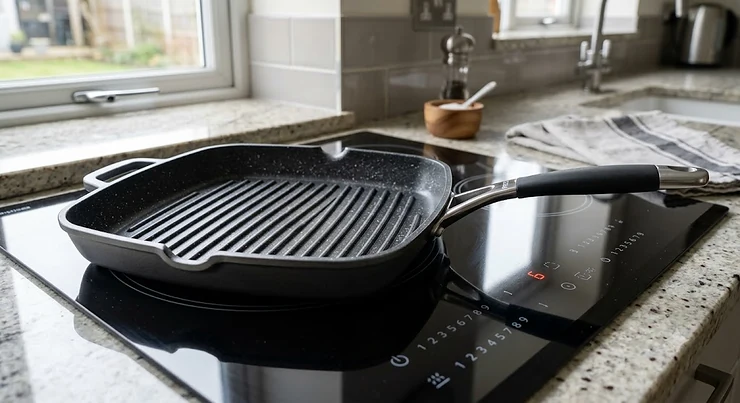
A non stick griddle pan is, at its simplest, a ridged frying pan designed to mimic the char and drainage of an outdoor barbecue on your own hob — the raised ribs lift food above the fat that renders out, while the coating stops everything welding itself to the metal…
Right, now that the search-engine-friendly definition is out of the way, let’s talk like actual humans for a second. If you’ve ever stood over a regular flat pan watching chicken thighs swim in their own grease, wondering why your “healthy” dinner looks like it’s been deep-fried, you already know why this bit of kitchen kit exists. The ridges aren’t just there for pretty stripes — they’re doing genuine work, holding food clear of the fat so it drains into the grooves instead of back into your dinner.
This guide rounds up seven griddle pans actually sold on amazon.co.uk right now, spanning cheap-and-cheerful aluminium numbers under £20 through to premium ceramic-coated versions that’ll outlive your current mortgage deal. We’ve dug into the real specs, the aggregated sentiment from genuine buyer feedback, and — crucially — what any of it actually means once the pan’s on your hob and the extractor fan’s going full blast. No invented five-star raves, no manufactured “we tested this for three weeks” theatre. Just honest analysis of real products, so you can work out which one deserves a spot on your shelf.
Whether you’re chasing a lightweight griddle pan you can lift one-handed, hunting for the best pan for grilling chicken without the swimming-pool effect, or simply want a non stick ridged pan that’ll survive more than one Christmas, there’s something below for you. Let’s get into it.
Quick Comparison Table
Before the deep dive, here’s the lay of the land. This table is deliberately brief — just enough to orient you before the full breakdown further down.
| Pan | Coating Type | Best For | Price Guide |
|---|---|---|---|
| Blackmoor 66170 Classic | Non-stick aluminium | Tightest budgets | Under £20 |
| Homiu 29cm Griddle Pan | Non-stick aluminium | Lightest option | Around £20-£25 |
| Tefal Expertise Grillpan | Non-stick with Thermo-Spot | Beginners who overheat pans | £25-£35 range |
| Tower Ceramic Grill Pan | Ceramic | Low-fat, health-focused cooking | £25-£35 range |
| Nutrichef Reversible Griddle | Non-stick cast iron style | Versatility (flat + ridged) | £30-£40 range |
| Jamie Oliver by Tefal Grill Pan | Titanium-reinforced non-stick | Serious searing on induction | £40-£55 range |
| GreenPan Valencia Pro | PFAS-free ceramic | Eco-conscious premium buyers | £45-£60 range |
Looking at the spread above, there’s a clear pattern: the cheaper aluminium pans win on weight and price but generally need gentler heat management, while the ceramic and titanium-reinforced options at the top justify their price with coating longevity and more forgiving high-heat performance. If you’re cooking daily rather than occasionally, that difference in durability tends to matter more than the upfront saving. Budget buyers shouldn’t feel short-changed, though — even the Blackmoor 66170 Classic covers the basics competently for anyone easing into griddle cooking for the first time.
💬 Found a pan that’s caught your eye already? Scroll down for the full breakdown before you commit — the devil’s in the detail with these things!
Top 7 Non Stick Griddle Pans: Expert Analysis
Right, here’s where we get properly stuck in. Seven pans, real specs, honest verdicts.
1. Blackmoor 66170 Classic — best rock-bottom budget entry
The Blackmoor 66170 Classic is a 28cm non-stick griddle pan with a cool-touch handle, and it’s built for one job: getting first-time griddle owners cooking without a big outlay. It’s compatible with induction, electric and gas hobs, which is more flexible than a lot of pans at this price point that quietly exclude induction and hope you don’t notice.
On paper, this is about as no-frills as griddle pans get — an aluminium body with a basic non-stick coating and a heatproof handle, nothing more. That simplicity is exactly the point. What most buyers overlook about entry-level pans like this is that the coating quality, not the shape, is what determines whether you’re still using it in eighteen months. Based on the spec sheet, this sits at the more basic end of non-stick technology, so it rewards gentle heat and a light hand with metal utensils far more than the premium picks further down this list.
Aggregated feedback on budget griddle pans in this category tends to cluster around two themes: genuine satisfaction with the initial non-stick performance, and gradual coating wear reported by heavier daily users after several months. That’s a fairly typical trade-off at this price tier rather than a defect specific to this model.
Pros:
- ✅ Genuinely low entry price for a hob-versatile griddle pan
- ✅ Cool-touch handle makes it safer for beginners
- ✅ Works on induction, electric and gas hobs
Cons:
- ❌ Basic coating likely needs gentler heat and utensil care
- ❌ Less durable long-term than ceramic or titanium-reinforced rivals
Priced under £20, this is solid value if you’re testing whether griddle cooking suits your routine before spending more — just don’t expect it to shrug off years of daily high-heat use.
2. Homiu 29cm Griddle Pan — the genuinely lightweight griddle pan option
The Homiu 29cm Griddle Pan stands out with its detachable handle, a small design touch that solves two real problems at once: awkward storage and oven compatibility. Without a permanently riveted handle sticking out, it stacks flatter in a cupboard and slides into the oven for finishing dishes that start on the hob.
Built to work across induction, gas and electric hobs, this pan leans into being a genuinely lightweight griddle pan rather than a heavy-duty workhorse. That matters more than people think — a cast iron griddle might sear beautifully, but if lifting a hot 2kg pan one-handed to drain fat isn’t something your wrist enjoys, weight becomes the deciding factor over raw performance. Here’s what to weigh: this pan trades some of the heat retention you’d get from a heavier base for everyday manageability, which suits smaller portions and quicker weeknight cooking better than slow-searing thick steaks.
Reviewers consistently note the ease of handling and the detachable handle as the standout feature, with the trade-off being that a lighter pan can develop hot spots more readily than heavier alternatives if you crank the heat too high too fast.
Pros:
- ✅ Detachable handle for compact storage and oven use
- ✅ Noticeably easier to lift and manoeuvre than heavier griddles
- ✅ Compatible with induction, gas and electric hobs
Cons:
- ❌ More prone to hot spots than heavier cast options
- ❌ Detachable handle mechanism adds a part that can loosen over time
At around £20-£25, this earns its place for anyone who’s ruled out cast iron purely on the grounds of arm strength.
3. Tefal Expertise Grillpan — best for beginners who overheat pans
The Tefal Expertise Grillpan in 26cm brings Tefal’s well-known Thermo-Spot indicator to griddle cooking, and it’s the single most useful beginner feature on this entire list. The spot in the centre of the pan turns solid red once the surface has reached the correct pre-heat temperature — no more guessing, no more sending smoke signals to the neighbours.
This matters more than it sounds. What the spec sheet won’t tell you outright is that non-stick coatings degrade fastest not from scratching but from being repeatedly overheated empty, which is precisely the mistake Thermo-Spot is designed to prevent. Based on the spec comparison with the other six pans here, the Tefal Expertise Grillpan is the only one that actively coaches correct usage rather than just providing a cooking surface and hoping for the best.
Aggregated review sentiment for Tefal’s Thermo-Spot range is generally strong on the “does what it says” front, with the coating holding up well under normal domestic use; the main recurring gripe across similar Tefal grillpans is that the ridges are shallower than premium ceramic alternatives, so char marks are present but less dramatic.
Pros:
- ✅ Thermo-Spot takes the guesswork out of preheating
- ✅ Reputable, widely-serviced brand with accessible spare parts
- ✅ Reliable non-stick performance for everyday meals
Cons:
- ❌ Ridges are shallower than premium ceramic rivals
- ❌ Not induction-specific across every Tefal variant, so check the listing
Sitting in the £25-£35 range, this is arguably the safest pick for anyone who’s previously ruined a non-stick pan through overheating.
4. Tower Ceramic Grill Pan — the healthy cooking grill pan pick
The Tower Ceramic Grill Pan leans hard into the health angle, built with a bonded steel base for even heat distribution and a forged aluminium body carrying a ceramic non-stick coating that’s marketed around near-fat-free cooking. It’s compatible with all hob types, including induction, and goes in the dishwasher — a genuine convenience win over pans that demand hand-washing only.
Ceramic coatings work differently to traditional PTFE non-stick: they’re generally more scratch-resistant to metal utensils early in life and don’t rely on the same chemistry, which appeals to buyers specifically hunting for a healthy cooking grill pan free from older-generation coatings. What most buyers overlook is that “ceramic” isn’t a single standardised technology — quality varies significantly between brands, and Tower’s version sits in the reliable mid-market tier rather than the ultra-premium bracket.
Reviewers frequently mention the pan’s even heating across the ridged surface and appreciate the genuinely reduced need for added oil, though a recurring theme in aggregated feedback for ceramic-coated cookware generally is that non-stick performance can fade somewhat faster than PTFE if the pan is regularly run empty on high heat.
Pros:
- ✅ Ceramic coating supports genuinely low-oil cooking
- ✅ Bonded steel base gives even heat across the ridges
- ✅ Dishwasher safe, unlike many griddle pans
Cons:
- ❌ Ceramic non-stick can fade faster than PTFE with high-heat misuse
- ❌ Mid-market ceramic, not the longest-lasting tier available
At £25-£35, this is a strong pick if reducing added fat is your main motivation for buying a griddle pan in the first place.
5. Nutrichef Reversible Griddle — best for flexibility across meals
The Nutrichef Reversible Griddle, measuring roughly 51 x 26cm, does something genuinely different from the rest of this list: one side is ridged for searing, the other flat for pancakes, eggs and delicate fish. It comes with a PFOA and PFOS-free non-stick coating plus an included scraper, and it’s built to work across hob, oven, induction, gas and even outdoor barbecue use.
On paper, this dual-surface design solves a real kitchen storage problem — instead of owning a separate griddle and a separate flat non-stick pan, one item does both jobs, provided you’ve got the worktop space to flip a fairly substantial slab of cookware. Here’s what to weigh: reversible pans trade some of the ergonomic refinement of dedicated single-surface pans (usually no side handles for easy flipping) for genuine two-in-one utility, so factor in whether your hob and storage can comfortably accommodate something this size.
Aggregated sentiment around reversible cast-style griddles like this one tends to praise the sheer flexibility and the inclusion of a scraper as a thoughtful touch, while some buyers note the pan’s size and weight make it better suited to larger households or batch cooking than solo weeknight meals.
Pros:
- ✅ Reversible flat and ridged sides in one pan
- ✅ PFOA and PFOS-free coating
- ✅ Includes a scraper and works across hob, oven and BBQ
Cons:
- ❌ Large footprint needs generous hob and storage space
- ❌ Heavier and less manoeuvrable than single-surface pans
In the £30-£40 range, this suits anyone regularly switching between pancakes-for-breakfast and steaks-for-dinner without wanting two separate pans taking up cupboard space.
6. Jamie Oliver by Tefal Grill Pan — best for serious searing on induction
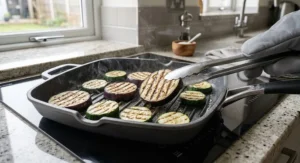
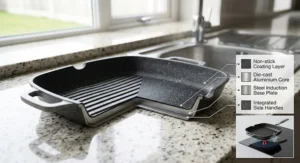
The Jamie Oliver by Tefal Grill Pan, sized at 23cm x 27cm, is a cast aluminium griddle with a titanium-reinforced non-stick coating and Tefal’s Thermo-Signal temperature indicator — essentially the same clever preheat cue as the Expertise range, but paired with a noticeably tougher coating and a full induction base built for efficient heat transfer.
Based on the spec comparison, the titanium reinforcement is the real differentiator here versus the standard Tefal Expertise pan: it’s designed to resist scratching from metal utensils considerably better, which matters if you’re the type to reach for a steel spatula out of habit rather than switching to silicone. The riveted stainless steel handle also signals this is built for more serious, repeated use than the entry-level pans on this list — restaurant-style ridges for proper char marks, backed by a brand partnership that’s been through genuine product development rather than a quick rebadge.
Reviewers of the wider Jamie Oliver by Tefal range consistently highlight the coating’s durability under frequent use and the satisfying heat retention on induction hobs specifically, with occasional feedback noting the pan runs hotter faster than expected, so a slightly lower initial heat setting than you’d use on a standard hob pan is worth trying.
Pros:
- ✅ Titanium-reinforced coating resists scratching better than standard non-stick
- ✅ Thermo-Signal indicator for reliable preheating
- ✅ Full induction base with strong, efficient heat transfer
Cons:
- ❌ Runs hot quickly on induction, so heat needs managing carefully
- ❌ Costs meaningfully more than the budget and mid-range options here
Sitting in the £40-£55 range, this is the pick for anyone treating griddle cooking as a genuine weekly habit rather than an occasional treat.
7. GreenPan Valencia Pro — best premium, PFAS-free pick
The GreenPan Valencia Pro is a 28cm square griddle built on hard-anodised aluminium with GreenPan’s ceramic non-stick coating, explicitly marketed as PFAS-free. It’s suitable for induction and oven-safe, aimed squarely at buyers who’ve read the headlines about older-generation coatings and want to sidestep the debate entirely rather than simply trust a “PFOA-free” label.
This matters because PFOA-free and PFAS-free aren’t the same claim — PFOA was phased out across the industry years ago, but PTFE itself belongs to the broader PFAS family, so GreenPan’s ceramic-based, PFAS-free approach is a genuinely different chemistry rather than a marketing rebrand. Hard-anodised aluminium also brings better warp resistance under rapid temperature changes than standard cast aluminium, which is exactly the failure mode that ruins cheaper griddle pans over time. What most buyers overlook is that hard-anodised construction, not just the coating on top, is doing a lot of the heavy lifting on this pan’s longevity.
Aggregated feedback on GreenPan’s Valencia and similar ceramic ranges tends to be positive on non-stick performance straight out of the box and the reassurance of the PFAS-free positioning, with the most common caveat being that ceramic coatings across the market generally require slightly more careful oil use over the years than PTFE to preserve peak performance.
Pros:
- ✅ PFAS-free ceramic coating, not just PFOA-free
- ✅ Hard-anodised body resists warping better than standard cast aluminium
- ✅ Oven-safe and induction-suitable for genuine all-round use
Cons:
- ❌ Premium price compared with standard non-stick options
- ❌ Needs slightly more mindful oil use to preserve ceramic performance long-term
At £45-£60, this is the pan for buyers who want the healthiest possible coating story and are willing to pay for hard-anodised durability alongside it.
Top 7 Products: Full Specification Comparison
| Pan | Material | Hob Compatibility | Standout Feature | Best For |
|---|---|---|---|---|
| Blackmoor 66170 Classic | Aluminium | Induction, electric, gas | Cool-touch handle | First-time buyers |
| Homiu 29cm Griddle Pan | Aluminium | Induction, gas, electric | Detachable handle | Lightweight griddle pan seekers |
| Tefal Expertise Grillpan | Aluminium | Most hobs (check induction) | Thermo-Spot indicator | Overheating-prone cooks |
| Tower Ceramic Grill Pan | Forged aluminium | All hobs, incl. induction | Bonded steel base | Low fat indoor grilling pan buyers |
| Nutrichef Reversible Griddle | Cast-style aluminium | Hob, oven, BBQ, induction | Reversible flat/ridged sides | Multi-use households |
| Jamie Oliver by Tefal Grill Pan | Cast aluminium | Full induction base | Titanium-reinforced coating | Frequent, high-heat cooking |
| GreenPan Valencia Pro | Hard-anodised aluminium | Induction suitable | PFAS-free ceramic coating | Eco-conscious premium buyers |
Reading across this table, the biggest practical divide isn’t price but coating philosophy: Blackmoor 66170 Classic, Homiu 29cm Griddle Pan and Tefal Expertise Grillpan use conventional non-stick chemistry, while Tower Ceramic Grill Pan and GreenPan Valencia Pro opt for ceramic technology aimed at health-conscious buyers. The Jamie Oliver by Tefal Grill Pan sits in an interesting middle ground — traditional non-stick chemistry, but reinforced with titanium for extended durability. If PFAS-free credentials matter to you specifically, that narrows your realistic shortlist to just one pan on this list.
✨ Don’t Miss These Exclusive Deals!
🔍 Ready to stop your dinner swimming in its own fat? Click through on any of the seven picks above to check current pricing and availability on amazon.co.uk. These pans could genuinely transform your weeknight cooking without adding hours to the washing-up.
Practical Usage Guide: Getting the Most From Your Griddle Pan
Buying the right pan is only half the job — how you use it in the first month determines whether it lasts years or ends up warped and sticky by spring. Start with a proper first wash: warm soapy water, a soft sponge, and a light coat of oil wiped across the surface with kitchen roll before the first cook, even on ceramic pans marketed as needing none.
Preheat on medium, never high, for the first two or three uses while you learn how your specific pan behaves — every hob and every base thickness heats slightly differently. A common mistake in the first 30 days is cranking the heat to get faster searing; non-stick and ceramic coatings both punish this with premature wear rather than rewarding you with better results. Once food is on the pan, resist the urge to move it around constantly — let it sit for a couple of minutes to develop proper grill marks before checking whether it releases cleanly.
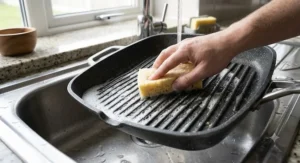
For maintenance, hand-wash where possible even if the listing says dishwasher-safe, since repeated dishwasher cycles accelerate coating breakdown through detergent abrasion and heat cycling. Store with a paper towel or pan protector between stacked cookware to avoid scratches from cutlery drawers or nested pots. Wooden or silicone utensils extend coating life meaningfully compared with metal, regardless of what the manufacturer claims about scratch resistance.
Real-World Scenarios: Matching the Right Pan to Your Kitchen
Picture three fairly typical buyers. First, a university student in a shared house, cooking solo meals three or four times a week on a budget that doesn’t stretch past £25 — the Homiu 29cm Griddle Pan or Blackmoor 66170 Classic fits neatly here, offering induction-friendly cooking and manageable weight for a first-time kitchen setup without a big financial commitment.
Second, a family of four trying to cut fat intake after a GP conversation about cholesterol, cooking chicken and lean mince most weeknights — the Tower Ceramic Grill Pan earns its place through genuinely low-oil ceramic performance and dishwasher-safe convenience, which matters enormously when you’re cooking daily rather than occasionally.
Third, a keen home cook with an induction hob who treats Friday-night steak as a small ritual and wants restaurant-style char marks without smoking out the kitchen — here the Jamie Oliver by Tefal Grill Pan or GreenPan Valencia Pro makes more sense, trading a higher upfront cost for coating durability and heat performance that holds up under genuinely frequent, high-heat use over years rather than months.
Common Griddle Pan Problems, Solved
Food sticking despite a “non-stick” label is the most frequent complaint, and it’s almost always down to using the pan before it’s properly preheated, or adding food to cold oil rather than hot oil in a hot pan. Solution: wait for a visible shimmer in the oil, or trust the Thermo-Spot indicator on pans like the Tefal Expertise Grillpan, before anything touches the surface.
Warping after a few months, particularly on thinner budget pans, typically stems from rapid temperature shock — running a hot pan under a cold tap to “clean it quickly”. Solution: let any griddle pan cool naturally before washing, regardless of price point. Smoke pouring off the pan almost always means it’s been left empty on the heat too long; solution is simply adding oil or food within thirty seconds of the pan reaching temperature, never leaving it idle and blazing hot.
Faded ridges and uneven searing on older pans usually point to coating wear from metal utensils or high heat over time; the fix is prevention rather than cure, since coatings can’t be restored once genuinely worn, which is exactly why the Jamie Oliver by Tefal Grill Pan‘s titanium reinforcement and the GreenPan Valencia Pro‘s hard-anodised body earn their higher price tags.
How to Choose a Non Stick Griddle Pan
Here’s the shortlist of criteria that actually matter, in the order most buyers should weigh them:
- Hob compatibility first. Check induction suitability specifically if you have an induction hob — several budget griddle pans quietly work only on gas and electric, which the Tefal Expertise’s listing details make clear are worth double-checking.
- Coating type over coating claims. Ceramic and titanium-reinforced non-stick both outperform basic aluminium coatings long-term, even if the initial non-stick feel seems similar in the shop.
- Weight versus stability. A lightweight griddle pan like the Homiu 29cm Griddle Pan suits daily manoeuvring, while heavier cast options hold heat more evenly for serious searing.
- Ridge depth. Deeper ridges drain more fat and create more pronounced char, which matters most if a low fat indoor grilling pan approach is your priority.
- Handle design. Riveted stainless steel handles, as on the Jamie Oliver by Tefal Grill Pan, tend to outlast plastic or bakelite handles under frequent use.
- Oven and dishwasher compatibility. Confirm both if flexibility matters to your routine — not every pan marketed as oven-safe is also dishwasher-safe, and vice versa.
- Budget against frequency of use. If you’ll cook on it daily, spend more; if it’s an occasional treat, a budget pan like the Blackmoor 66170 Classic does the job perfectly well.
Non Stick Grill Pan vs Traditional Frying Pan
The core difference between a non stick grill pan and a standard flat frying pan comes down to geometry, not just coating. A frying pan keeps food sitting directly in whatever fat renders out during cooking, effectively shallow-frying even when you intended to sear. A ridged grill pan physically lifts food above that fat, letting it pool in the channels between the ridges instead.
This isn’t just cosmetic. According to the NHS’s guidance on cutting saturated fat, grilling rather than frying is one of the simplest swaps for reducing overall fat intake, precisely because the fat drains away rather than being reabsorbed into the food during cooking. A flat frying pan can still produce a good meal, but it can’t replicate that drainage effect regardless of how good its non-stick coating is — the ridges are doing structural work a flat surface simply can’t.
Where a standard frying pan wins is versatility for sauces, delicate fish, and dishes that need liquid to stay in contact with the food rather than draining away — so most well-equipped kitchens genuinely benefit from owning both rather than choosing one over the other permanently.
What to Expect: Real-World Grilling Performance
Specs on a listing page rarely translate directly into kitchen experience, so here’s the honest translation. A pan reaching optimal searing temperature, whether indicated by Thermo-Spot technology or simple experience, typically needs three to five minutes of preheating on medium-high heat before food goes in — rushing this step is the single biggest cause of disappointing results across every pan on this list, regardless of price.
Expect visible grill marks within ninety seconds to two minutes per side for thinner cuts like chicken breast or vegetables, and slightly longer for thicker steaks where you’re managing doneness alongside char. Smoke is normal in small amounts, especially with fattier cuts, but a kitchen filling with thick smoke usually signals the pan is hotter than the food needs, not that something’s wrong with the pan itself. Cleanup on a genuinely well-performing non-stick or ceramic surface should involve little more than a wipe and a quick wash — if you’re regularly scrubbing, that’s a sign either the coating is degrading or the heat was too high during cooking.
The Best Pan for Grilling Chicken and Lean Meats
Chicken deserves its own section because getting it wrong isn’t just a taste issue — it’s a food safety one. Whatever pan you choose, the Food Standards Agency’s guidance confirms chicken needs to reach a core temperature of 70°C for two minutes, with no pink meat remaining, and visual browning alone isn’t a reliable indicator that it’s been reached.
For chicken specifically, a pan with reasonably deep ridges and consistent heat distribution matters more than raw power, since chicken breast cooks best on a moderate, steady heat rather than a blazing one that chars the outside before the centre catches up. The Tower Ceramic Grill Pan‘s bonded steel base and the Tefal Expertise Grillpan‘s Thermo-Spot indicator both suit this well, helping you hit a controlled, even temperature rather than guessing. For thicker chicken breasts, consider butterflying or pounding to an even thickness before it goes anywhere near the pan — this does more for safe, even cooking than any feature on the pan itself.
Features That Actually Matter (And Those That Don’t)
Ridge depth and coating type genuinely matter — they determine fat drainage and long-term durability respectively. Hob compatibility matters enormously if you’re on induction, since it’s a hard compatibility issue rather than a performance nuance. A non stick ridged pan with shallow, decorative-looking ridges will underperform a pan with genuinely deep channels, regardless of how the marketing photos make it look.
What matters less than the marketing suggests: handle colour, decorative exterior finishes, and headline non-stick percentage claims that aren’t independently verifiable. Pouring spouts are a nice-to-have rather than essential, and “oven-safe to 250°C” is largely irrelevant if you never intend to move the pan from hob to oven. Multi-piece sets bundling a griddle pan with unrelated cookware often mean compromising on the griddle itself to hit a bundle price point — buying the griddle pan alone, from a focused range like Tefal’s or GreenPan’s, tends to get you a better-specified single item for similar money.
How a Low Fat Indoor Grilling Pan Cuts Calories, According to the Evidence
The health case for a low fat indoor grilling pan isn’t marketing spin — it’s grounded in straightforward physics and widely supported dietary guidance. When ridges lift food clear of rendered fat, that fat physically leaves the food rather than sitting in the pan being reabsorbed, which is exactly the mechanism behind why grilling appears alongside poaching and steaming as a recommended lower-fat cooking method for people managing cholesterol and heart health.
Ceramic-coated options like the Tower Ceramic Grill Pan and GreenPan Valencia Pro amplify this further by requiring minimal added oil to prevent sticking in the first place, unlike some basic non-stick pans that still benefit from a light oil coating for best results. The practical upshot: swapping a shallow-fried chicken thigh for the same cut griddled on the Tower Ceramic Grill Pan meaningfully reduces the added fat in that single meal, without requiring any change to the ingredients themselves — the pan alone is doing the work.
Frequently Asked Questions
❓ Is a non stick griddle pan worth it over a regular frying pan?
❓ Can you use metal utensils on a non stick griddle pan?
❓ Do non stick griddle pans work on induction hobs?
❓ How do you clean a non stick ridged pan properly?
❓ Are ceramic griddle pans healthier than standard non-stick?
Conclusion
Seven pans, three budgets, one clear takeaway: the best non stick griddle pan for you depends far more on your cooking frequency and hob type than on chasing the most expensive option available. Budget buyers get genuine value from the Blackmoor 66170 Classic or the featherweight Homiu 29cm Griddle Pan, while anyone serious about reducing fat intake long-term should look hard at the Tower Ceramic Grill Pan‘s ceramic coating and even heat distribution.
For households wanting maximum flexibility, the Nutrichef Reversible Griddle‘s dual-surface design earns its slightly larger footprint, and frequent high-heat cooks will get genuine mileage from the titanium-reinforced durability of the Jamie Oliver by Tefal Grill Pan. If PFAS-free credentials and hard-anodised longevity top your priority list, the GreenPan Valencia Pro stands alone on this list for that specific combination.
Whichever you choose, remember that technique matters as much as the pan itself — proper preheating, patient searing, and gentle cleaning will get more life and better results out of any of these seven than the fanciest coating ever could on its own.
Recommended for You
- Cast Iron Griddle Pan UK: 7 Best Picks & Buying Guide 2026
- Cast Iron Wok: 7 Best Picks Tested & Compared (2026 UK Guide)
- Wok for Induction Hob: 7 Best Picks Tested for UK Kitchens (2026)
Disclaimer: This article contains affiliate links. As an Amazon Associate, I earn from qualifying purchases. If you purchase products through these links, we may earn a small commission at no additional cost to you.
✨ Found this helpful? Share it with your friends! 💬🤗
