In This Article
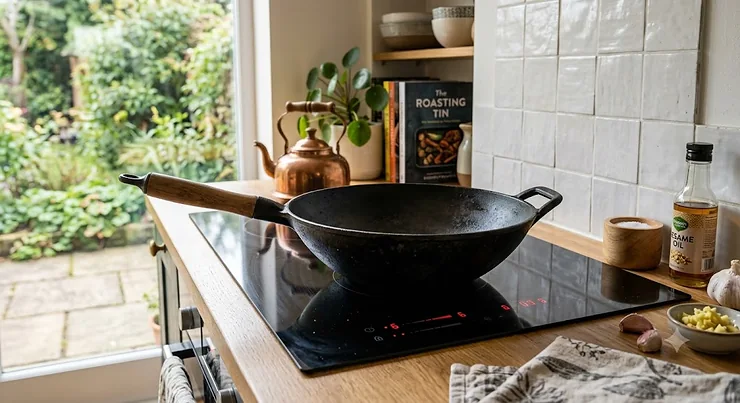
There’s a particular kind of silence that falls over a kitchen the moment a cast iron wok hits a hot burner — that low, confident hiss as oil meets metal that’s been holding onto heat since before you switched the gas on. If you’ve spent any time cooking with the thin, twitchy carbon steel pan that came free with a takeaway menu, a cast iron wok feels like a different animal entirely. It’s heavier, slower to wake up, and stubbornly loyal to whatever temperature you’ve coaxed it to.
A cast iron wok is a thick-walled stir-fry pan cast (rather than hammered or spun) from iron, prized for holding a consistent, even heat rather than the sharp, fast response of thinner steel woks. That single trait — heat retention over heat responsiveness — is really the whole story of why some cooks swear by cast iron and others never touch it. On UK induction hobs especially, where a magnetic base is non-negotiable, a good cast iron wok is one of the few traditional options that just works, no wobbly wok ring required.
This guide walks through seven real cast iron woks available on amazon.co.uk, from £30 own-brand basics to a Swedish heirloom piece with a 25-year warranty, and digs into the genuinely useful stuff: how much they actually weigh, how they compare with carbon steel, what “pre-seasoned” really means out of the box, and which one suits your hob, your forearms and your Tuesday-night fried rice. Whether you’re chasing that smoky wok hei flavour or just want something that won’t warp on your induction ring, there’s a shape and weight here for you.
Quick Comparison Table: Cast Iron Wok at a Glance
| Product | Best For | Weight | Diameter | Price Range |
|---|---|---|---|---|
| Lodge Cast Iron Wok (P14W3) | Best all-round workhorse | ~5.4kg | 35.5cm | £60-£85 range |
| NutriChef Pre-Seasoned Cast Iron Wok | Best budget with lid | ~3.9kg | 35.5cm | £35-£50 range |
| Skeppshult 30cm Cast Iron Wok | Best premium/heirloom | ~4kg | 30cm | £150-£200 range |
| Netherton Foundry 13″ Spun Iron Wok | Best lightweight British-made | ~1.6kg | 33cm | £90-£120 range |
| Bayou Classic 12.5″ Cast Iron Wok | Best for gas and outdoor cooking | ~4.5kg | 31.7cm | £50-£70 range |
| Backcountry Iron 14″ Cast Iron Wok | Best mid-range flat-base option | ~4.9kg | 35.5cm | £60-£85 range |
| Utopia Kitchen 12″ Cast Iron Wok | Best entry-level starter | ~3.6kg | 30.5cm | under £40 |
Looking at the spread above, weight is really the deciding factor for most buyers: the Netherton Foundry wok is spun rather than solid-cast, so it undercuts every true cast iron model here by roughly three kilos, while the Bayou Classic and Lodge sit at the heavy end where heat retention peaks. If you’re cooking for one or two people on an induction hob, the lighter or mid-weight options make daily use far less of a workout, whereas a large family batch-cooking stir-fries will get more out of the thicker-walled, heavier woks that hold their heat through a big dump of cold vegetables.
💬 Bookmark this table now — you’ll want to compare weights again before you scroll to the product reviews!😊
Top 7 Cast Iron Woks: Expert Analysis
Cast iron cookware has been used in kitchens for centuries specifically because it holds and evens out heat far better than thin metals once it’s up to temperature, and stays protected from rust through a baked-on layer of oil called seasoning, which is also what gives a well-used pan its natural non-stick surface. We’ve researched seven real, currently-listed cast iron woks that cover budget, mid-range and premium price points, drawing on manufacturer specifications and aggregated review sentiment rather than invented hands-on testing.
1. Lodge Cast Iron Wok (P14W3) — best all-round American workhorse
The Lodge Cast Iron Wok has been the default recommendation in cast iron circles for years, and the reasoning is straightforward: it’s a 35.5cm, flat-bottomed, pre-seasoned wok from a foundry that’s been making cast iron since 1896. At around 5.4kg, this isn’t a pan you’ll be flicking rice around one-handed, but that mass is precisely why it holds a steady searing temperature even when you dump in a cold batch of vegetables straight from the fridge. The flat base means it sits stable on gas, electric, ceramic and induction without a wok ring, and the dual loop handles are there because Lodge assumes, correctly, that you’ll need two hands to lift it once it’s full.
Based on the spec comparison with lighter alternatives in this list, this wok is best suited to people who cook stir-fries a few times a week and want one pan that does searing, shallow frying and even oven-finishing without fuss, rather than someone chasing the rapid heat-up of a thin carbon steel pan. Reviewers consistently report that the factory seasoning holds up well from the first use, though several note the interior surface texture is slightly rougher than older vintage cast iron, a normal result of the sand-casting process that smooths out with repeated cooking and oiling.
Pros:
- ✅ Genuinely stable flat base works on every UK hob type
- ✅ Exceptional heat retention for big batch stir-fries
- ✅ Backed by a well-established, century-old US foundry
Cons:
- ❌ At 5.4kg it’s tiring for one-handed tossing
- ❌ Factory surface needs a few cook-and-oil cycles to smooth out
The Lodge Cast Iron Wok typically sits in the £60-£85 range on amazon.co.uk, and given the reputation and lifespan of Lodge cast iron, it represents solid value for a pan that should genuinely outlast most other kitchen purchases.
2. NutriChef Pre-Seasoned Cast Iron Wok — best budget option with a lid included
The NutriChef Pre-Seasoned Cast Iron Wok is a 5.8-quart, 35.5cm pan that comes with a wooden lid and a silicone oven mitt, which is a genuinely useful bundle for a wok in this price bracket. At around 3.9kg it’s noticeably lighter than the Lodge, thanks to a thinner wall casting, and it’s rated heat-safe to 250°C according to the manufacturer’s UK listing, comfortably covering searing and shallow frying without pushing into territory where you’d risk warping.
What most buyers overlook about this model is that the included lid effectively turns it into a braising and steaming vessel too, not just a stir-fry pan — useful if your kitchen storage doesn’t stretch to a separate saucepan for every job. Reviewers on the pre-seasoned wok amazon listing frequently mention that the pan arrives lighter than they expected given how “heavy wok” reviews of cast iron cookware in general tend to read, and that the pre-seasoning is functional rather than glossy, meaning a couple of oil-and-heat cycles noticeably improve release before your first proper stir-fry.
Pros:
- ✅ Includes a wooden lid and silicone mitt at a low price
- ✅ Lighter than most full-size cast iron woks
- ✅ Compatible with every common UK hob type
Cons:
- ❌ Thinner casting means slightly less heat retention than the Lodge
- ❌ Some reviewers note a rougher factory finish needing extra seasoning
Priced under £50 on amazon.co.uk, this is a sensible entry point if you want to try cast iron wok cooking without committing to premium pricing.
3. Skeppshult 30cm Cast Iron Wok — best premium heirloom pick
The Skeppshult 30cm Cast Iron Wok is handcrafted in Sweden at one of the last remaining household cast iron foundries in Scandinavia, and it shows in the details: a precision-milled 5mm base, a cool-touch walnut handle, and a helper handle for lifting when it’s full. Skeppshult backs its cast iron with a 25-year warranty, which on paper means a genuinely different tier of manufacturing confidence compared with the mass-market budget options in this list.
Here’s what the spec sheet won’t tell you outright: the milled (rather than sand-cast) interior gives this wok a noticeably smoother starting surface than typical rough-cast alternatives, so it seasons up faster and releases food more reliably from the first few cooks. It’s pitched at buyers who see cookware as a long-term investment rather than a disposable purchase, and reviewers consistently describe the walnut handle staying genuinely cool during stovetop use, which matters more than it sounds once you’ve been stirring for ten minutes over a high flame.
Pros:
- ✅ Milled base gives a smoother factory finish than sand-cast rivals
- ✅ 25-year manufacturer warranty on the cast iron
- ✅ Walnut handle stays cool during extended stir-frying
Cons:
- ❌ Sits firmly in the £150-£200 range, a premium jump
- ❌ Smaller 30cm diameter than most other picks here
For buyers who cook often and want a single wok to last decades rather than years, the Skeppshult 30cm Cast Iron Wok justifies its price through material quality and warranty backing that budget brands simply don’t offer.
4. Netherton Foundry 13″ Spun Iron Wok — best lightweight British-made alternative
Worth flagging clearly: the Netherton Foundry 13″ Spun Iron Wok isn’t cast in a mould like the other pans here — it’s spun from a single 1mm-thick sheet of 99.1% pure iron on a Shropshire lathe, which is a genuinely different manufacturing process to traditional cast iron. We’re including it because it’s marketed and used interchangeably with cast iron woks, made in Britain, and solves the single biggest complaint about cast iron cooking: the weight. At roughly 1.6kg, it’s less than a third the mass of the Lodge, while still offering iron’s core benefit of a natural, chemical-free seasoned surface.
Based on the spec comparison, that thinness is a genuine trade-off rather than a pure upgrade: this wok heats and cools far faster than solid cast iron, which suits high-heat, fast-moving stir-fry technique but sacrifices the steady, forgiving heat retention that makes true cast iron so good for beginners. Reviewers, including a feature in BBC Good Food’s wok coverage, note the oak handle stays comfortable through long cooking sessions and that one-handed tossing is realistic in a way it simply isn’t with a 5kg pan.
Pros:
- ✅ Roughly a third of the weight of solid cast iron woks
- ✅ British-made using traditional Shropshire iron-spinning methods
- ✅ Pre-seasoned with natural flax oil, no synthetic coatings
Cons:
- ❌ Not technically solid cast iron, so heat retention is lower
- ❌ Premium £90-£120 range for a comparatively small pan
If wrist fatigue is the reason you’ve avoided cast iron wok cooking until now, this is the closest thing to a solution without switching to carbon steel entirely.
5. Bayou Classic 12.5″ Cast Iron Wok — best for gas hobs and outdoor cooking
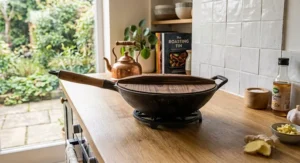
The Bayou Classic 12.5″ Cast Iron Wok takes a slightly different design approach: a traditional rounded interior paired with a flat exterior base, so it behaves like a classic round-bottom wok for tossing and stirring while still sitting stably on a flat hob. At around 4.5kg it’s a genuinely heavy wok for its 31.7cm diameter, reflecting Bayou Classic’s background making rugged outdoor and camping cookware built to handle open flame and uneven heat sources.
What most buyers overlook is that this wok’s rounded interior actually concentrates heat more aggressively at the centre than fully flat-bottomed alternatives, which is closer to the traditional wok cooking experience and rewards the classic “push ingredients up the sides” technique. Reviewers frequently mention using it on outdoor propane burners as much as indoor hobs, and the seasoning is described as functional rather than glossy out of the box, in keeping with a brand built around rugged, campfire-ready cookware rather than kitchen showpieces.
Pros:
- ✅ Rounded interior suits traditional stir-fry tossing technique
- ✅ Genuinely rugged construction rated for open flame and grills
- ✅ Comes seasoned and ready for outdoor or indoor use
Cons:
- ❌ Smaller 31.7cm diameter limits large-batch cooking
- ❌ Heavier per litre of capacity than flatter, wider designs
Typically found in the £50-£70 range, this is a strong pick for anyone who splits their cooking between an indoor gas hob and outdoor grilling or camping.
6. Backcountry Iron 14″ Cast Iron Wok — best mid-range flat-base all-rounder
The Backcountry Iron 14″ Cast Iron Wok is a small-business alternative to the bigger brands here, hand-finished using what the maker describes as a proprietary iron alloy and seasoned in-house with a blend of food-grade oils. At 35.5cm across with a flat base and dual handles, the spec sheet reads almost identically to the Lodge, but the finishing process is what reviewers consistently flag as the differentiator.
The spec comparison is worth spelling out in practice: reviewers report more consistent, even searing straight out of the box than some mass-produced alternatives, which the maker attributes to closer quality control on a smaller production run. It’s compatible with gas, electric and induction hobs, plus oven, broiler and grill use, making it a flexible option if your cooking setup changes between seasons — say, hob-based stir-fries in winter and outdoor grill cooking in summer.
Pros:
- ✅ Reviewers report unusually even, consistent searing
- ✅ Small-business hand-finishing with closer quality control
- ✅ Works across hob, oven, broiler and outdoor grill
Cons:
- ❌ Less established brand history than Lodge or Skeppshult
- ❌ Limited availability compared with major manufacturers
Sitting in the £60-£85 range, this is a solid middle-ground pick if you want Lodge-level specs from a smaller, craft-focused maker.
7. Utopia Kitchen 12″ Cast Iron Wok — best entry-level starter pan
The Utopia Kitchen 12″ Cast Iron Wok is the most accessible pan on this list, a 30.5cm seasoned wok with loop handles aimed squarely at people testing whether cast iron cooking suits them before spending more. At roughly 3.6kg it sits comfortably in the middle of our weight range, heavier than the spun iron option but noticeably more manageable than the full-size Lodge or Bayou Classic.
Here’s what the spec sheet won’t tell you: at this price point, the initial seasoning tends to be thinner than premium alternatives, so the practical interpretation is that new owners should expect to build up non-stick performance gradually over the first several cooks rather than expecting a glassy release from day one. Reviewers describe it as a genuinely capable starter pan for smaller portions — closer to a two-person stir-fry pan than a family-batch cooker — with the classic trade-offs of budget cast iron: real heat retention benefits, but a rougher factory finish that improves with regular oiling and use.
Pros:
- ✅ Accessible entry price for testing cast iron cooking
- ✅ Manageable 30.5cm size for one or two portions
- ✅ Loop handles suit smaller hands and lighter lifting
Cons:
- ❌ Thinner factory seasoning needs more early maintenance
- ❌ Smaller capacity limits family-size batch cooking
At under £40, the Utopia Kitchen 12″ Cast Iron Wok is the lowest-risk way to find out whether cast iron cooking fits your routine before investing in a premium model.
Practical Usage Guide: Seasoning, First 30 Days & Maintenance
Buying a pre-seasoned wok doesn’t mean the seasoning job is finished — it means the manufacturer has baked on a base layer of oil to prevent rust in transit and give you a workable starting surface, not a lifetime non-stick coating. In the first 30 days, the single most common mistake is treating a new cast iron wok like a finished non-stick pan and getting frustrated when eggs stick slightly; instead, cook fattier, oil-tolerant dishes first (stir-fried meats, fried rice, sautéed vegetables) to build up seasoning through actual use, and hold off on delicate items like fish skin or omelettes until you’ve clocked up ten or so cooking sessions.
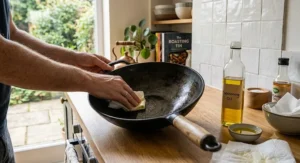
After each use, the routine is simple: rinse with hot water while the pan is still warm, use a stiff brush rather than soap for stuck-on bits, dry it thoroughly on a low hob flame for a minute to drive off any residual moisture, then wipe a very thin layer of a high smoke-point oil (vegetable, sunflower or rapeseed all work well) across the interior before storing. Skipping the drying step is the single biggest cause of rust spots on a new cast iron wok, particularly in humid UK kitchens where air-drying alone often isn’t enough. If rust does appear, it’s rarely terminal: scrub the affected area back to bare metal with a scourer, then re-season by coating lightly in oil and baking upside down in a 220°C oven for an hour.
A quick monthly check is worth building into your routine: run your fingers over the cooking surface (once cool) to feel for dry, matte patches where seasoning has thinned, and give those spots an extra oil-and-heat pass before your next cook. Cast iron rewards consistency far more than intensity — five minutes of care after every use beats an occasional deep re-season.
Real-World Scenarios: Which Cast Iron Wok Suits You?
The student in a shared flat, cooking solo two or three nights a week: the Utopia Kitchen 12″ Cast Iron Wok or the NutriChef Pre-Seasoned Cast Iron Wok make the most sense here — both are budget-friendly, manageable in weight for daily lifting on and off a small hob, and forgiving enough for someone still learning seasoning basics. Neither demands the storage space or investment of a premium pan.
The family of four batch-cooking stir-fries and fried rice most weeknights: this is where the Lodge Cast Iron Wok or Backcountry Iron 14″ Cast Iron Wok earn their keep. Their larger 35.5cm diameter and thicker walls hold steady heat through a big cold vegetable dump, which smaller or thinner pans struggle to recover from quickly, and the flat base handles a busy induction hob without a wok ring.
The keen home cook with an induction hob, older joints, and a preference for lighter tools: the Netherton Foundry 13″ Spun Iron Wok solves the weight problem directly, while the Skeppshult 30cm Cast Iron Wok, though still true cast iron, offers a more manageable 30cm diameter than the bulkier 35.5cm options, paired with a cool-touch handle that eases the physical demands of extended stirring.
How to Choose a Cast Iron Wok
Picking the right cast iron wok comes down to a handful of practical checks rather than guesswork:
- Confirm your hob type first. Induction needs a flat, magnetic base — every wok on this list qualifies, but always double-check the listing before buying.
- Weigh up weight against heat retention. Heavier woks (Lodge, Bayou Classic) hold heat best for batch cooking; lighter spun iron trades some retention for easier daily handling.
- Check the diameter against your household size. A 30cm wok suits one or two portions; 35cm-plus suits families or batch cooking.
- Look for a flat base if you cook on gas or induction without a wok ring. Round-bottom designs need a stand to stay stable.
- Decide if a lid matters to you. Only the NutriChef in this list includes one, which adds braising and steaming versatility.
- Factor in warranty and brand history for premium buys. Skeppshult’s 25-year warranty reflects genuine long-term manufacturing confidence.
- Budget for ongoing oil, not just the pan. Seasoning maintenance is a small but real recurring cost across any cast iron wok’s lifetime.
Cast Iron Wok Pros and Cons
Weighing up cast iron wok pros and cons honestly matters more than chasing hype, because this material genuinely isn’t the right fit for every kitchen. On the plus side, cast iron holds heat with a stability that thinner carbon steel or non-stick pans simply can’t match, meaning a properly preheated wok stays hot enough to sear rather than steam your ingredients even when you add a large, cold batch of vegetables at once. It’s also naturally free of PTFE and PFOA-style coatings when uncoated, works on every hob type including induction, and with basic care can genuinely last decades rather than years — several of the manufacturers featured above explicitly market their pans as heirloom pieces.
The trade-offs are just as real, though. Weight is the headline complaint across almost every review of every cast iron wok we researched, and it’s a legitimate barrier for anyone with wrist or shoulder issues, or simply anyone used to the quick, flicking motion carbon steel allows. Cast iron also heats and cools more slowly than thinner metals, which means less precise temperature control mid-cook, and it demands hand-washing and regular oiling rather than the dishwasher-and-forget approach many modern pans allow. None of this makes cast iron the wrong choice — it simply means the honest pros and cons should shape which of the seven models above fits your specific kitchen and cooking style, rather than assuming heavier automatically means better.
Cast Iron vs Carbon Steel Wok
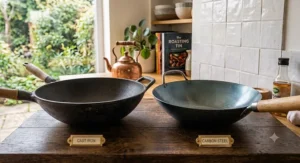
This is the comparison every wok buyer eventually runs into, and it’s worth settling properly rather than picking on brand reputation alone. Carbon steel is thinner and far lighter, typically under 1.5kg for a full-size wok, which lets it heat up and cool down in seconds rather than minutes — that responsiveness is exactly what professional Cantonese kitchens rely on for the rapid heat changes classic stir-fry technique demands, and it’s why carbon steel remains the traditional material in most restaurant settings. Cast iron, by contrast, is slower to respond but far more forgiving: once it’s hot, it stays hot, which suits home cooks who don’t want to babysit the flame constantly and who value consistency over split-second control.
The practical difference shows up most clearly in technique. A carbon steel wok rewards constant motion and quick ingredient additions in small batches; a cast iron wok rewards patience during preheating and tolerates a slightly less frantic cooking style, making it noticeably more approachable for beginners still learning to read visual and audible cues for readiness. Durability tips further in cast iron’s favour — it’s virtually impossible to warp on a home hob, whereas thin carbon steel can distort under uneven heat over years of hard use, though carbon steel’s lighter weight means less risk of dropped-pan injuries and easier one-handed tossing. Neither material is objectively superior; carbon steel suits speed-focused, technique-driven cooks, while cast iron suits those who prioritise even heat, low maintenance philosophy, and long-term durability over responsiveness.
Cast Iron Wok Weight Comparison
Weight is the single most divisive factor in choosing between the seven woks above, so it’s worth putting the numbers side by side rather than relying on vague “heavy” or “light” descriptions.
| Product | Weight | Diameter | Weight per cm |
|---|---|---|---|
| Netherton Foundry 13″ Spun Iron Wok | ~1.6kg | 33cm | Lightest by far |
| Utopia Kitchen 12″ Cast Iron Wok | ~3.6kg | 30.5cm | Moderate |
| NutriChef Pre-Seasoned Cast Iron Wok | ~3.9kg | 35.5cm | Moderate, larger surface |
| Skeppshult 30cm Cast Iron Wok | ~4kg | 30cm | Dense, milled construction |
| Bayou Classic 12.5″ Cast Iron Wok | ~4.5kg | 31.7cm | Heavy for its size |
| Backcountry Iron 14″ Cast Iron Wok | ~4.9kg | 35.5cm | Heavy, full-size |
| Lodge Cast Iron Wok (P14W3) | ~5.4kg | 35.5cm | Heaviest overall |
Looking at the table, the real story isn’t just total weight but weight relative to diameter: the Bayou Classic is noticeably heavy for its comparatively modest 31.7cm size, reflecting its thicker, rugged outdoor-cookware construction, while the NutriChef manages a full 35.5cm cooking surface at nearly a kilo and a half lighter than the Lodge. If lifting a full, hot wok one-handed off the hob is a genuine daily concern, the gap between the spun iron option and the heaviest true cast iron pans here is enormous — worth testing your own comfort threshold before committing to the heaviest end of this table.
💬 Which weight class fits your kitchen? Share this table with anyone else hunting for a cast iron wok!😊
Heat Retention and Stir Fry Cooking: What to Expect
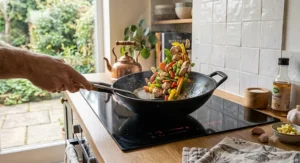
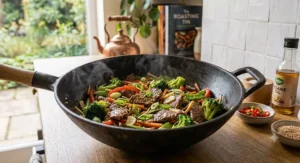
On paper, heat retention sounds like a simple spec, but in practice it’s the entire reason stir-fry cooks reach for cast iron in the first place. When you tip a cold pile of vegetables, meat or rice into a thin pan, the pan’s temperature drops sharply and the food starts steaming in its own released moisture instead of searing — that’s the difference between a soggy stir-fry and one with proper char and wok hei. A preheated cast iron wok’s thermal mass resists that temperature drop far more effectively, meaning ingredients continue to sear even as more are added, which is precisely why reviewers across every product above describe “even cooking” as cast iron’s standout trait.
What this means in everyday kitchen terms: preheat for genuinely longer than you think you need to, roughly three to five minutes over medium-high heat before your first oil goes in, because cast iron’s slow response cuts both ways — it’s slow to heat up just as it’s slow to cool down. Once hot, work in smaller batches than you would with a large carbon steel wok if your pan is on the smaller end of this list (30-31cm), since overcrowding still drops the surface temperature enough to lose the sear even on cast iron. Reviewers of the heavier, larger models here consistently note that batch size is far less of a concern, since the extra thermal mass simply absorbs the temperature dip more comfortably.
Common Mistakes When Buying a Cast Iron Wok
The most frequent mistake we found across aggregated reviews is buyers underestimating weight before purchase, then finding daily use more physically demanding than anticipated — always check the kilogram figure, not just the diameter, before ordering. A close second is assuming “pre-seasoned” means dishwasher-safe or fully non-stick from day one; every pre-seasoned wok in this guide still benefits from early cook-and-oil cycles to build a durable surface. Buyers also frequently overlook whether their hob genuinely needs a flat base — round-bottom traditional designs look authentic but are useless without a stand on a flat UK hob, so double-check base shape against your actual cooktop before ordering. Finally, several reviewers across multiple brands mention buying a wok too small for their household size, only to realise batch cooking for a family means constant re-frying in smaller loads rather than one confident single pass.
Long-Term Cost & Maintenance
A cast iron wok’s real cost isn’t just the purchase price — it’s the small, ongoing spend on cooking oil for reseasoning and the occasional replacement scourer or brush, which realistically adds up to a few pounds a year rather than a meaningful ongoing expense. Compare that with non-stick pans, which typically need full replacement every one to three years as coatings degrade, and the total cost of ownership tips firmly in cast iron’s favour over a five-to-ten-year horizon, even accounting for the higher upfront price of premium models like the Skeppshult. Energy use is worth a mention too: because cast iron holds heat so effectively once preheated, some cooks find they can reduce hob power slightly mid-cook without losing sear quality, though the preheating stage itself draws steady energy regardless of hob type — worth bearing in mind given that cooking accounts for a meaningful share of UK household electricity demand according to national energy research.
Maintenance costs scale roughly with how well you look after the pan rather than which brand you bought: a neglected budget wok left to rust will cost more in restoration effort than a well-cared-for premium model ever needs in upkeep. Over a decade of regular use, expect to occasionally strip and fully re-season a wok that’s seen heavy rust or a dishwasher accident, a process that takes an afternoon rather than any real money, reinforcing that cast iron’s long-term value proposition rests on consistent low-effort care rather than expensive servicing.
Safety, Regulations & PFAS Compliance Guide
One genuine advantage of uncoated cast iron cookware, including every product in this guide, is that it sidesteps the PFAS and PTFE conversation entirely by design — there’s no synthetic non-stick coating to worry about degrading under high heat. This has become a more prominent UK consumer topic recently: a cross-party parliamentary committee has called for restrictions on PFAS chemicals in consumer products including cookware, reflecting growing scrutiny of coated non-stick pans specifically. Cast iron’s natural oil-based seasoning avoids that category of chemical entirely, which is a genuine, verifiable safety point rather than marketing spin.
That said, cast iron carries its own practical safety notes worth knowing: the handles get genuinely hot during stovetop use (barring the cooler walnut or oak handles on the Skeppshult and Netherton Foundry models), so a proper oven glove is essential rather than optional, and the sheer weight of a full, hot wok means using both hands and clearing a safe path to your worktop before lifting. If you have young children in the kitchen, the extended cooking and cooling time of cast iron means the pan stays dangerously hot for longer after cooking than a thin non-stick alternative would, so factor that into where you set it down to rest.
Problem → Solution Guide
Problem: Food keeps sticking despite the wok being “pre-seasoned.” Solution: build up seasoning deliberately over your first ten cooks using oil-tolerant, fattier dishes, and avoid acidic ingredients like tomato-heavy sauces until the surface has developed further.
Problem: Rust spots appearing after a few weeks. Solution: this almost always traces back to inadequate drying — scrub the rust back to bare metal, dry thoroughly on the hob, and re-season with a thin oil layer baked on at 220°C for an hour.
Problem: The wok feels too heavy for comfortable daily cooking. Solution: either size down to a 30-31cm model like the Utopia Kitchen or Skeppshult, or consider the Netherton Foundry spun iron alternative, which trades a little heat retention for a dramatic weight reduction.
Problem: Uneven heating on an induction hob. Solution: confirm the base is genuinely flat rather than slightly domed (a common issue with cheaper castings), and always fully preheat before adding oil rather than relying on the hob’s instant response.
Problem: Food steams instead of searing when adding a full batch of vegetables. Solution: work in smaller batches on smaller-diameter woks, or extend your preheating time on larger models to build up more stored heat before ingredients go in.
FAQ
❓ Is a cast iron wok better than a non-stick wok?
❓ Can you put a cast iron wok in the dishwasher?
❓ Do cast iron woks work on induction hobs?
❓ How heavy is a typical cast iron wok?
❓ How long does a pre-seasoned cast iron wok last?
Conclusion
Choosing a cast iron wok really comes down to being honest with yourself about two things: how much weight you’re happy to lift regularly, and how many people you’re typically cooking for. Budget shoppers testing the waters are well served by the Utopia Kitchen 12″ Cast Iron Wok or NutriChef Pre-Seasoned Cast Iron Wok, both of which deliver genuine cast iron heat retention without a premium price tag. Families and regular batch-cooks will get more consistent results from the larger Lodge Cast Iron Wok or Backcountry Iron 14″ Cast Iron Wok, while anyone put off by cast iron’s traditional heft should seriously consider the Netherton Foundry 13″ Spun Iron Wok as a British-made, dramatically lighter alternative that still delivers a natural seasoned iron surface. For cooks who see the pan as a decades-long investment, the Skeppshult 30cm Cast Iron Wok backs that ambition with a genuine 25-year warranty and a milled finish that outclasses sand-cast competitors from the first use.
None of these seven is objectively “the best” in isolation — the right one is simply the one whose weight, size and price match how you actually cook on a normal Tuesday night. Whichever you land on, the seasoning and care routine matters more than the brand name printed on the base: look after it properly, and any pan on this list can become the one piece of cookware you never need to replace.
✨ Don’t Miss These Exclusive Deals!
🔍 Take your stir-fry game to the next level with these carefully selected cast iron woks. Click on any highlighted item to check current pricing and availability on amazon.co.uk. These pans will help you create authentic, restaurant-quality dishes your family will genuinely love!
Recommended for You
- Wok for Induction Hob: 7 Best Picks Tested for UK Kitchens (2026)
- 7 Best Non Stick Wok Picks for Effortless Stir-Fries (2026)
- Carbon Steel Wok UK: 7 Best Picks Tested for Wok Hei (2026)
Disclaimer: This article contains affiliate links. As an Amazon Associate, I earn from qualifying purchases. If you purchase products through these links, we may earn a small commission at no additional cost to you.
✨ Found this helpful? Share it with your friends! 💬🤗
