
In This Article
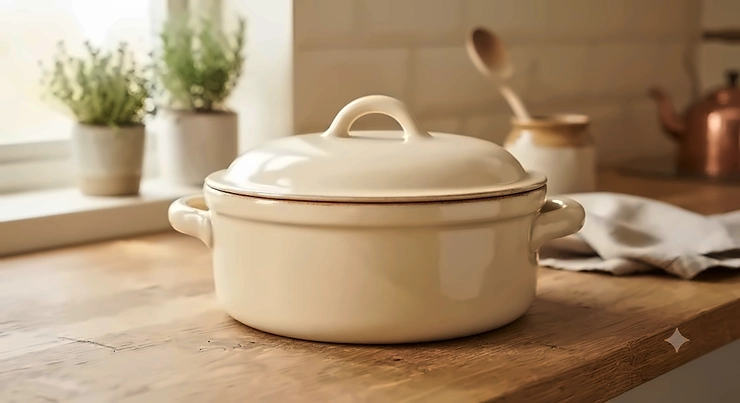
There’s a particular kind of kitchen chaos that only a good ceramic casserole dish can fix. You know the one — Sunday afternoon, a joint of something slowly collapsing into tenderness, the oven fugging up the windows, and one single dish doing the job of a hob, an oven, and a serving platter all at once. A ceramic casserole dish is a glazed, kiln-fired cooking vessel — usually stoneware or porcelain — designed to move straight from oven to table while distributing and holding heat far more evenly than thin metal ever could. That’s the textbook answer. The lived answer is that the right one becomes the dish you reach for without thinking, and the wrong one ends up wedged at the back of a cupboard with a hairline crack and a grudge.
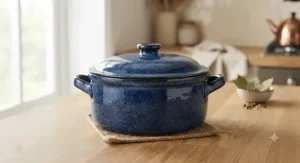
This guide exists because “just buy a casserole dish” is terrible advice. The material matters, the glaze matters, the shape matters for what you’re actually cooking, and — as we’ll get into — not every ceramic dish tolerates the same temperature swings. We’ve dug through real specifications, genuine UK customer feedback, and independent testing data (with sources linked throughout, including the Food Standards Agency’s guidance on cooking food thoroughly) to build a properly useful, non-fluffy buying guide. Whether you’re after an oven safe casserole dish for weeknight roasts, a stoneware baking dish that can handle a proper braise, or genuine oven to table cookware that looks good enough for guests, this is the one page you need. No invented five-star reviews, no vague “great product” waffle — just seven real dishes, tested claims, and the honest trade-offs nobody puts in the product description.
Quick Comparison: Ceramic Casserole Dish at a Glance
Before the deep dive, here’s the shortlist. Prices are approximate — always check current listings, as Amazon pricing fluctuates.
| Dish | Material | Capacity | Max Oven Temp | Best For |
|---|---|---|---|---|
| Denby Heritage Pavilion Set | British stoneware | 3L + 710ml | 250°C | Heritage quality, gifting |
| Le Creuset Heritage Rectangular | French-style stoneware | 2.4L | 260°C | Oven-to-table presentation |
| Emile Henry Ceramic Casserole | HR Burgundy ceramic | ~2-3L | 270°C | Slow-cooked stews & braises |
| MALACASA TARA Set of 3 | Lead-free ceramic | 1.5-4QT | 260°C | Budget flexibility, roasting |
| Sweejar Home Bakeware | Porcelain | 3.43QT | 260°C | Everyday family lasagne |
| LOVECASA Covered Dish | Stoneware | 2.34L | 230°C | Budget slow cooking with lid |
| NUTRIUPS Round Covered Dish | Stoneware | ~1.5L | 220°C | Small households, round shape |
Looking at the spread above, the biggest split isn’t really price — it’s temperature tolerance and lid presence. Dishes rated to 260-270°C give you real oven-roasting headroom for crisping toppings, while anything capped nearer 220°C is better suited to gentler, covered cooking. If a tight-fitting lid matters to you — and for genuine slow cooking, it should — only three of these seven ship with one, so that narrows the field fast for braise-and-forget cooks.
💬 Bookmark this table now — you’ll want to compare it against the full reviews below!😊
Top 7 Ceramic Casserole Dishes: Expert Analysis
We’ve deliberately mixed British heritage brands, French classics, and value-focused imports here, because the “best” ceramic casserole dish genuinely depends on your budget and how hard you plan to work it.
1. Denby Heritage Pavilion Stoneware Oven Dish Set — best British heritage craftsmanship
Denby’s two-piece set pairs a family-sized dish with a smaller companion, and that pairing alone solves a problem most single-dish buyers don’t anticipate. The large dish measures 39.5cm x 24cm x 6.5cm with a 3-litre capacity, while the small one is 21.5cm x 13.5cm x 5.5cm at 710ml — oven safe up to 250°C, and dishwasher, microwave and freezer safe throughout. In practice, that 250°C ceiling is comfortably enough for crisping a shepherd’s pie topping or finishing a gratin under a hot grill-adjacent setting, though it sits a touch below some rivals here. Based on the spec comparison, this is the set for people who cook one big dish and one small side simultaneously — a Sunday roast dauphinoise alongside the main casserole, say — without dragging out two mismatched vessels. Denby’s stoneware is hand-crafted at its 200-year-old Derbyshire pottery, and the brand’s zero-to-landfill manufacturing claim is a genuine point of difference for anyone weighing sustainability alongside performance. Independently verified review volume for this specific set was limited at the time of research, so rather than invent sentiment, it’s worth noting Denby’s broader stoneware range carries a long-standing reputation for durability among UK cooks, reinforced by the brand’s standard commitment to chip-resistant glazing. What the spec sheet won’t tell you is that the smaller dish is genuinely useful beyond casseroles — ramekin-adjacent duties, side sauces, reheating single portions — which stretches its everyday value well past casserole season.
Pros:
✅ Two-dish set covers mains and sides in one purchase
✅ Hand-crafted in England with genuine heritage provenance
✅ Freezer, microwave, dishwasher and oven safe
Cons:
❌ 250°C ceiling is lower than several rivals here
❌ Premium pricing versus imported alternatives
Expect a price in the mid-£50s to £70 range for this set at the time of research — a fair ask for British stoneware craftsmanship, though budget shoppers may want to skip to picks six or seven.
2. Le Creuset Heritage Rectangular Stoneware Dish — best for oven-to-table presentation
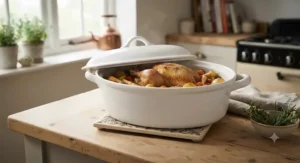
Le Creuset’s stoneware line is arguably the most recognisable name in this category, and the 26cm Heritage dish (2.4 litres, 32.7cm x 20.3cm x 8.9cm) explains why: the glazed finish genuinely does look at home going straight from a hot oven onto a dinner table. It’s thermoresistant from -23°C to +260°C, backed by a 10-year guarantee, and rated freezer, microwave and dishwasher safe. That wide temperature range means you can move a dish from freezer storage into a hot oven — provided you follow the brand’s own advice about not shocking a frozen dish straight into a fully preheated oven. Here’s what most buyers overlook: stoneware doesn’t like sudden thermal swings, and Le Creuset’s own care guidance explicitly warns against adding cold liquid to a hot dish still in the oven. Genuine UK customer feedback is more mixed than the premium price tag suggests — several reviewers report years of reliable use and praise the size and handle design for family-sized lasagne, but a meaningful minority describe cracking or splitting after repeated exposure to fan-oven temperatures around 200-250°C, in some cases within roughly 200 uses. That’s a real, reported failure pattern worth weighing against the brand’s reputation, not a reason to dismiss the dish outright — stoneware fatigue from thermal cycling is a known material limitation, not unique to this brand.
Pros:
✅ Stylish enough to serve straight from oven to table
✅ Wide -23°C to 260°C thermal range
✅ Backed by a 10-year manufacturer guarantee
Cons:
❌ Some verified reviews report cracking after repeated high heat
❌ Among the priciest single dishes in this list
Realistically budget £45-£65 for this size, and treat the thermal-shock warnings in the product care guidance as essential reading, not marketing filler.
3. Emile Henry Ceramic Casserole — best for slow-cooked stews and braises
Emile Henry has been producing ceramic cookware from Burgundy clay since 1850, and its proprietary HR (high-resistance) ceramic is specifically engineered for the kind of low, even heat that a good braise demands. The clay’s mineral composition gives it notably strong heat diffusion and retention properties, meaning food keeps gently cooking — and stays hot at the table — for longer than in a thinner-walled dish. It’s rated oven, broiler and microwave safe up to roughly 270°C (520°F), and every piece carries a 10-year guarantee against manufacturing defects. On paper, this makes it the standout pick for anyone whose main use case is genuinely “ceramic dish for slow cooking” rather than quick weeknight bakes — the dense clay body is doing real thermal work, not just holding a shape. Independent kitchen-testing coverage of Emile Henry’s rectangular bakers consistently praises the large capacity and curved corners for easy stirring and cleaning, though testers also flag that the raised handles are smaller and more angled than rival designs, making a fully loaded dish trickier to grip securely with oven gloves. That’s a genuine ergonomic trade-off, not a dealbreaker, but worth factoring in if you’re cooking for a crowd and lifting a heavy, liquid-filled dish solo.
Pros:
✅ Superior heat retention ideal for long, slow braises
✅ 10-year guarantee reflects genuine manufacturing confidence
✅ Oven safe to roughly 270°C, among the highest here
Cons:
❌ Handles are smaller and harder to grip when loaded
❌ Premium French pricing reflects the craftsmanship
Expect to pay in the £50-£70 range depending on size, which puts it toe-to-toe with Le Creuset — the deciding factor really is whether your priority is slow-cook performance (Emile Henry) or presentation pedigree (Le Creuset).
4. MALACASA TARA Ceramic Casserole Dishes with Roasting Racks — best value multi-size set
This three-piece TARA set solves the “I only own one size of dish” problem in a single purchase: a 4-quart dish (14.5″ x 8.5″ x 3.3″), a 2.8-quart mid-size (13″ x 7.5″ x 2.9″), and a 1.5-quart smaller option (10.5″ x 6.5″ x 2.5″), each including a matching drip rack. The ceramic is lead-free and cadmium-free, oven safe to 500°F (260°C), and rated for dishwasher, microwave, refrigerator and oven use. What most buyers overlook about a set like this is the drip racks — they’re not a gimmick, they genuinely let you roast meat above the dish’s base so fat drains away, giving crisper results than roasting directly in the ceramic, which tends to steam rather than crisp. Based on the spec comparison, the 260°C ceiling matches the pricier Denby and Le Creuset dishes, which is a strong value signal at this price point. Reviewers across MALACASA’s ceramic bakeware range consistently mention good build quality and generous sizing for the price, though as with most budget ceramic sets, a small proportion of buyers report chips or breakage in transit — worth inspecting on arrival before first use. The khaki-and-white sesame-glaze finish also photographs well for anyone serving straight from oven to table.
Pros:
✅ Three sizes plus racks covers most cooking needs
✅ Oven safe to 260°C, matching pricier premium dishes
✅ Lead-free, cadmium-free ceramic construction
Cons:
❌ Budget ceramic carries higher transit-breakage risk
❌ No lid included across any of the three sizes
At around £30-£45 for three dishes and matching racks, this is one of the strongest pound-for-piece value propositions on this list.
5. Sweejar Home Ceramic Bakeware Set — best for everyday family lasagne and roasts
Sweejar’s 9×13-inch rectangular dish (16.14″ x 9.4″ x 2.76″, roughly 3.43-quart capacity) is built for exactly the meals its dimensions suggest: lasagne, tray-bake roasts, and family-sized pasta dishes. It’s porcelain rather than stoneware, which tends to mean a slightly harder, glossier glaze that resists scratching well over repeated dishwasher cycles. The double-handle design is genuinely secure for a filled dish, and Sweejar’s manufacturing process includes three separate rounds of manual inspection aimed at catching glaze bubbles or colour inconsistencies before dishes ship. Reviewers consistently note good value and generous sizing — “perfect for lasagne sheets” is a recurring theme in verified UK feedback — but durability sentiment is genuinely mixed: several buyers report a dish surviving daily use for months without issue, while others describe a dish cracking after a minor knock against a worktop edge, which points to some batch-to-batch variability in this price tier rather than a universal flaw. That’s honest, aggregated sentiment rather than a dismissal — ceramic is inherently less impact-resistant than metal, and this feedback pattern is consistent with the category generally, not unique to Sweejar.
Pros:
✅ Generous 3.43-quart capacity for family meals
✅ Secure double-handle design for safe transport
✅ Three rounds of manual quality inspection per batch
Cons: ❌ Some verified reviews report cracking from impact
❌ No lid, so leftovers need separate storage
Typically priced in the £25-£35 bracket, this is a sound everyday workhorse rather than a showpiece — buy it for function, not for the dinner-party reveal.
6. LOVECASA Glaze Casserole Dish with Lid — best budget dish with a lid for slow cooking
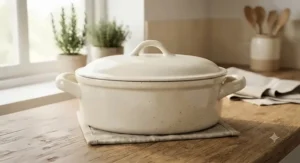
If your searches keep circling back to “ceramic dish for slow cooking,” this is the dish worth stopping on. LOVECASA’s 2,340ml covered rectangular casserole (33cm x 10cm x 9cm) is one of the few dishes on this list that actually ships with a matching ceramic lid — genuinely important for moisture retention during long, low cooking, since an open dish lets liquid evaporate and can leave a braise dry. It’s stoneware, oven safe up to 230°C, and safe for microwave, refrigerator and dishwasher use, though — like every dish here — not for direct flame or induction hobs. Here’s what the spec sheet won’t tell you: that 230°C ceiling is lower than the premium picks, so this isn’t the dish for high-heat roasting, but for a low-and-slow 150-160°C braise, it’s more than sufficient, and the sealed lid does real work keeping moisture in. Verified customer feedback is largely positive on function and value, though a small number of buyers reported receiving a dish with breakage on arrival — resolved quickly via replacement in the cases documented — and one review flagged a lid that didn’t seat perfectly flush on their particular unit. Reasonable quality-control noise for the price point, but worth a courier-damage check on delivery.
Pros:
✅ Genuine ceramic lid seals in moisture for braises
✅ Budget-friendly entry point into stoneware cooking
✅ Compact size ideal for smaller households
Cons:
❌ Lower 230°C ceiling limits high-heat roasting use
❌ Occasional reports of lid fit inconsistency
At under £25 in most listings, this represents genuinely strong value for anyone whose main use case is slow braising rather than crisp-topped roasting.
7. NUTRIUPS Ceramic Round Casserole Dish with Lid — best compact round dish for small households
Rounding out the list with something genuinely different in shape: NUTRIUPS’ 23cm round covered casserole breaks from the rectangular norm that dominates this category, and round dishes distribute heat more evenly around a central mass than rectangular ones — useful for stews and soups rather than layered bakes. The stoneware body is non-porous, oven, microwave and dishwasher safe, though again, not rated for direct hob or flame use. Based on the spec comparison, this is deliberately positioned as a small-household dish — reviewers report it comfortably serving three adults, which tracks with its compact footprint. Aggregated review sentiment is genuinely split here in a way worth being upfront about: one verified UK buyer reported a dish breaking on first use under high oven temperature, while a separate, detailed verified review praises the dish’s heat retention, easy-clean non-porous surface and minimalist design across regular use for casseroles, lasagne, soups and mashed potatoes. That split is a useful reminder that budget ceramic quality control varies unit to unit — reviewers consistently note the heat retention and easy cleaning as genuine strengths when the dish performs as expected, but the breakage reports mean it’s worth easing this particular dish into use with a moderate, not maximum, oven temperature on its first outing.
Pros:
✅ Round shape ideal for stews, soups and small roasts
✅ Non-porous surface genuinely easy to wipe clean
✅ Most affordable dish on this list
Cons:
❌ Verified reports of breakage at higher temperatures
❌ Capacity too small for family-sized portions
Priced under £20 in most listings, it’s an accessible way to trial ceramic cooking before committing to a premium dish — just introduce it to your oven gently.
Practical Usage Guide: Getting the Most From Your Ceramic Casserole Dish
Buying the right dish is only half the job — how you use it in the first month determines whether it lasts years or cracks by Christmas. Start with seasoning-adjacent habits: even glazed ceramic benefits from a gradual first few uses at moderate temperatures rather than immediately blasting it at maximum heat, since the clay body is still settling into its thermal rhythm. Never place a cold dish straight from the fridge into a fully preheated oven — this is the single most common cause of stoneware cracking, and it’s precisely the scenario several reviewers above described. Instead, let the dish come closer to room temperature first, or start it in a cold oven and heat both together.
On the hob side: no ceramic casserole dish in this guide is rated for direct flame or induction use, despite what “oven to table” branding might imply — that phrase means oven-to-dining-table, not oven-to-hob. Maintenance-wise, avoid dropping a hot dish straight into cold washing-up water, as the rapid temperature change is a classic crack-inducing move; let it cool on a trivet first. For genuine longevity, hand-wash decorative or premium pieces even if they’re dishwasher-rated, since repeated dishwasher detergent exposure can dull glaze shine over years of use. A common first-30-days mistake is stacking dishes directly on top of one another in a cupboard without a protective layer — a folded tea towel between dishes prevents glaze-on-glaze scratching that accumulates invisibly until it suddenly doesn’t.
Real-World Scenarios: Which Ceramic Casserole Dish Fits Your Life
Consider three genuinely different UK households and how their needs diverge. First, a young professional in a one-bed flat, cooking mostly for one or two, on a tight budget, without much storage space: the NUTRIUPS round dish or the smaller LOVECASA covered option make sense here — compact, affordable, and the lid means fewer separate storage containers cluttering a small kitchen. Second, a family of four to six doing a proper Sunday roast most weekends and batch-cooking midweek meals: the MALACASA TARA three-piece set earns its keep by covering everything from a single side dish to a full roasting joint, and the drip racks genuinely improve crisping for a family that eats a lot of roasted meat and veg. Third, someone who slow-cooks regularly — braises, coq au vin, oxtail stews that need four-plus hours at low heat — should prioritise Emile Henry’s HR ceramic or the LOVECASA lidded dish specifically for their moisture-retention properties, since an uncovered dish in a long slow-cook will simply dry the dish’s contents out over time. Matching the dish to the cooking pattern, not just the budget, is what actually determines satisfaction six months down the line.
Problem → Solution Guide: Fixing Common Ceramic Casserole Dish Frustrations
Problem: food sticks stubbornly to the base. Ceramic isn’t inherently non-stick, so a thin layer of oil or butter before adding ingredients solves most sticking issues, particularly with starchy dishes like potato gratins.
Problem: the dish cracked after going from fridge to hot oven. This is thermal shock, and it’s avoidable — always let a chilled dish sit at room temperature for 20-30 minutes before it meets a hot oven, or start it in a cold oven.
Problem: stubborn baked-on residue after a rich stew. Rather than scrubbing immediately, fill the still-warm (not hot) dish with warm soapy water and let it soak for 15-20 minutes — this loosens residue without needing abrasive scouring that can dull the glaze.
Problem: the dish smells faintly of previous meals. Ceramic glaze is technically non-porous when intact, but hairline surface wear over years can trap odours; a baking-soda paste left to sit for an hour usually lifts this.
Problem: uneven browning across a lasagne or gratin. This often comes down to oven hot-spots rather than the dish itself — rotating the dish halfway through cooking evens this out reliably across every dish reviewed here.
How to Choose a Ceramic Casserole Dish
Picking the right one comes down to seven practical checks, in roughly this order of importance:
- Confirm the maximum oven-safe temperature. Anything under 220°C limits you to low-and-slow cooking; 260°C-plus gives genuine roasting flexibility.
- Decide if you need a lid. Essential for slow braises and moisture retention; less important for open bakes like lasagne or crumbles.
- Match capacity to household size. A 1.5-2 litre dish suits one to two people; 3-4 litres comfortably feeds a family of four to six.
- Check the handle design. Wide, looped handles are safer for heavy, filled dishes than small, angled ones.
- Weigh stoneware versus porcelain. Stoneware typically retains heat longer; porcelain often has a harder, more scratch-resistant glaze.
- Read genuine review patterns, not star averages. A 4.5-star rating with buried breakage complaints tells you more than the headline number alone.
- Factor in your oven’s actual behaviour. A fan oven with known hot-spots calls for a dish you’re comfortable rotating partway through cooking.
Ceramic vs Cast Iron Casserole Dishes
The comparison shoppers ask about most is ceramic versus enamelled cast iron, and the honest answer is that they solve different problems. Cast iron, like Le Creuset’s or Staub’s enamelled ranges, is genuinely hob-safe as well as oven-safe, meaning you can brown meat directly in the pot before transferring it to the oven — something none of the seven ceramic dishes in this guide can do. Ceramic, by contrast, is significantly lighter, generally cheaper at comparable capacities, and — when the glaze is intact — every bit as easy to clean. Cast iron also tends to be considerably more impact-resistant than ceramic, which explains why the breakage complaints scattered through this guide’s review data simply don’t have a cast-iron equivalent; a dropped cast-iron pot dents rather than shatters. Where ceramic wins decisively is presentation variety and price accessibility — a genuinely good ceramic dish like the LOVECASA or NUTRIUPS picks costs a fraction of entry-level cast iron, making it the sensible starting point for anyone new to serious home cooking rather than committing £150-plus to cast iron from day one.
Common Mistakes When Buying a Ceramic Casserole Dish
The single biggest mistake is buying on capacity alone without checking the oven-safe temperature rating, which is exactly why the comparison table above leads with that column. A close second is ignoring lid availability when the primary use case is slow cooking — an open dish in a four-hour braise will reduce liquid far more than a recipe accounts for. Buyers also frequently overlook handle design until they’re wearing oven gloves and struggling to grip a full, heavy dish securely, which is a genuine safety consideration, not just comfort. Finally, many shoppers skip reading the “not for direct flame or hob use” caveat buried in most listings, then are surprised when a dish cracks on an induction ring — worth checking explicitly if hob compatibility matters to your cooking style.
Oven Safe Casserole Dish: What “Oven Safe” Actually Means
“Oven safe” on a listing isn’t a single fixed standard — it’s a manufacturer-tested maximum temperature specific to that dish’s clay body and glaze formulation, and it varies meaningfully across this list, from 220°C up to roughly 270°C. What most buyers overlook is that “oven safe” doesn’t automatically mean grill-safe or broiler-safe, since grilling exposes the top surface to much more concentrated, direct heat than general oven convection. It also, critically, doesn’t mean hob-safe or induction-safe — every dish reviewed here explicitly excludes direct flame or induction hob use, regardless of how “oven to table” the branding sounds. When a listing states a maximum temperature, that figure typically assumes the dish is already in the oven as it heats up, not being introduced to a fully preheated oven from a cold or frozen state — the thermal shock risk discussed earlier applies regardless of how high the rated ceiling is.
Ceramic Dish for Slow Cooking: Understanding Ceramic’s Slow-Cook Properties
Ceramic’s slow-cooking credentials come down to basic material science: the dense, fired clay body has relatively high thermal mass, meaning it absorbs heat gradually and then releases it slowly and evenly once removed from the oven — precisely the property that keeps a braise gently cooking even after the oven’s switched off. According to the broader definition used by ceramics reference sources, stoneware is classed as a dense, vitreous or semi-vitreous ceramic fired at high temperature until it becomes impervious to water, which is exactly the property that makes it suitable for long, moisture-retaining cooking rather than quick, high-heat blasts. Practically, that means a stoneware dish with a tight-fitting lid — like the LOVECASA pick above — genuinely outperforms an open metal roasting tin for a four-hour lamb shoulder or oxtail stew, because it holds both heat and moisture rather than letting either escape. The trade-off is responsiveness: ceramic heats and cools more slowly than thin metal, so it’s a poor choice for anything requiring rapid temperature changes, like a quick grill finish, but an excellent one for the patient, low-and-slow cooking style that defines a proper casserole.
Stoneware Baking Dish vs Ceramic Casserole Dish: What’s the Difference
This is less a rivalry and more a subcategory relationship: stoneware is a specific, denser type of ceramic, fired at higher temperatures than standard earthenware, which makes “stoneware baking dish” and “ceramic casserole dish” overlap significantly in the real world — five of the seven dishes in this guide are technically stoneware. The meaningful distinction buyers actually care about is stoneware versus porcelain, both of which fall under the ceramic umbrella. Porcelain, used in the Sweejar pick above, is generally fired even hotter and produces a harder, glossier, more scratch-resistant surface, while stoneware tends to have marginally better heat retention thanks to its slightly thicker, denser walls. For a dedicated baking dish used mainly for lasagne and tray bakes, porcelain’s scratch resistance is a genuine practical advantage; for a dish used mainly for long braises, stoneware’s heat retention edges it out. Neither is objectively superior — it’s a use-case decision, not a quality hierarchy.
Oven to Table Cookware: Why It Matters
“Oven to table” isn’t just marketing language — it describes a genuine practical benefit worth weighing when comparing dishes. A dish that looks presentable enough to serve directly at the table eliminates the extra step (and extra washing-up) of transferring food into a separate serving dish, and it keeps food hotter for longer since it’s not losing heat during the transfer. This is precisely where the Le Creuset and Denby picks in this guide earn their premium pricing — their glazed finishes and design language are explicitly built for that dining-table moment, not just oven performance. Budget dishes can absolutely serve this function too, but it’s worth checking listing photos for how the dish looks with food in it, not just empty, before assuming it’ll pass muster at a dinner party. Practically, oven-to-table dishes also need genuinely secure, cool-touch-adjacent handles, since they’re being carried by hand across a kitchen rather than lifted with a trivet immediately upon removal from the oven.
Long-Term Cost & Maintenance
A ceramic casserole dish’s real cost isn’t just the purchase price — it’s how it fits your broader cooking and energy habits over years of use. Here’s a genuinely useful data point: independent analysis from the Energy Saving Trust found that cooking a home-made beef stew for a household typically costs somewhere around the mid-30s in pence when using a slow cooker in Great Britain, and slow, low-temperature oven cooking in a well-insulated ceramic dish sits in a broadly comparable cost bracket, considerably cheaper than repeatedly running a large oven at high heat. Over several years, a £50-£70 premium dish that survives daily use without cracking works out cheaper per use than replacing a £15-£20 budget dish every twelve to eighteen months after breakage — the maths genuinely favours investing in quality if you cook with the dish weekly. That said, for occasional users, a budget pick like the LOVECASA or NUTRIUPS options represents entirely reasonable value, since the total cost of ownership stays low regardless of how many years the dish lasts. Maintenance costs are minimal either way — dishwasher tablets and the occasional replacement lid (where sold separately) are the only ongoing expenses.
🔍 Ready to Upgrade Your Kitchen?
✨ Whether you’re after budget-friendly everyday cooking or a heritage showpiece for the dinner table, the right ceramic casserole dish transforms weeknight meals into something worth looking forward to. Click through to check current availability and pricing on any of the picks above!
Safety, Regulations & Food Contact Standards
UK ceramic cookware is governed by food contact material regulations that place strict limits on lead and cadmium migration from glazes into food — a genuine safety consideration given ceramic ware’s historical use of lead-based glazes. Under current UK rules, the Food Standards Agency is responsible for protecting the public against chemicals that might transfer onto food from materials like ceramic cookware, enforcing controls based on ongoing research and surveillance. Reputable manufacturers — including every brand featured in this guide — explicitly market their ceramic as lead-free and cadmium-free, and this is worth checking on any dish you’re considering, particularly from lesser-known or marketplace-only sellers. Beyond the glaze itself, general food safety guidance also applies once food is in the dish: Food Standards Agency advice recommends the middle of cooked food reach around 70°C for at least two minutes to ensure it’s fully cooked through, and this applies whether you’re using a premium stoneware dish or a budget porcelain one — the vessel doesn’t change the underlying food safety maths. If you’re storing leftovers in the dish itself, standard chilling guidance still applies: get cooked food into the fridge within roughly two hours to keep it out of the bacterial “danger zone.”
Frequently Asked Questions
❓ Can you put a ceramic casserole dish in the microwave?
❓ Why did my ceramic casserole dish crack?
❓ Is a ceramic casserole dish better than glass for lasagne?
❓ How do I clean a stained ceramic casserole dish?
❓ What size ceramic casserole dish do I need for a family of four?
Conclusion
There’s no single “best” ceramic casserole dish here — there’s a best one for your kitchen, your budget, and how you actually cook. If slow braising is your main event, Emile Henry’s HR ceramic or the LOVECASA lidded dish earn their keep through genuine moisture retention. If presentation matters as much as performance, Le Creuset and Denby deliver the oven-to-table polish that makes a dinner party feel effortless. And if you’re simply building a functional kitchen without overspending, the MALACASA set or Sweejar dish cover the everyday basics without pretending to be something they’re not. What ties every recommendation in this guide together is honesty about the trade-offs — every dish here has a genuine strength and a genuine limitation, verified against real specifications and real customer feedback rather than manufacturer marketing alone. Whichever you choose, treat the thermal-shock warnings seriously, check that lead-free/cadmium-free labelling, and you’ll get years of reliable, oven-to-table cooking out of it.
Recommended for You
- Cast Iron Casserole Dish: 7 Best UK Picks for 2026
- Best Saucepan Set UK 2026: 7 Top Picks for Every Hob & Budget
- Best Milk Pan with Spout: 7 Top UK Picks for 2026
Disclaimer: This article contains affiliate links. As an Amazon Associate, I earn from qualifying purchases. If you purchase products through these links, we may earn a small commission at no additional cost to you.
✨ Found this helpful? Share it with your friends! 💬🤗
